How Long Does It Take to Build Topical Authority? A Practical SEO Timeline
How long does it take to build topical authority? Explore the factors that affect the timeline, a practical month-by-month SEO plan, and ways to measure your progress.

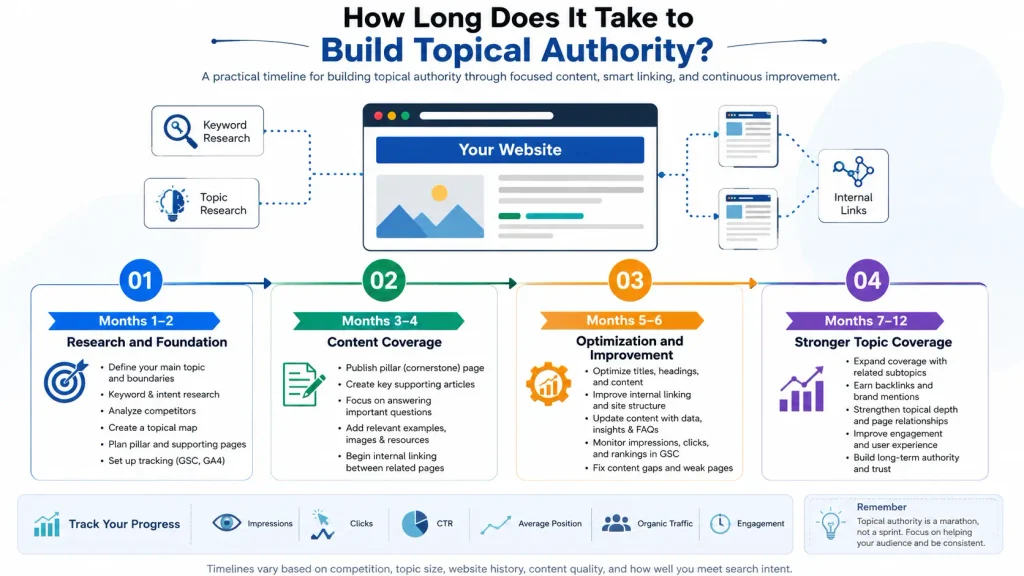
How long does it take to build topical authority? For many websites, meaningful progress can take several months, while stronger and more consistent visibility may take six to twelve months or longer. There is no guaranteed schedule. Your starting point, competition, content quality, topic size, website structure, and ability to meet search intent all affect the process.
How Long Does It Take to Build Topical Authority?
Building topical authority is usually a months-long process, not a quick SEO task. The first signs of progress are not always top rankings. A more developed position takes sustained work.
What Is a Realistic Topical Authority Timeline?
A useful timeline separates early visibility from broader performance. Ahrefs also describes six to twelve months as a common expectation in its topical authority guide, but this remains an industry estimate, not a Google rule.
Ahrefs
These stages are planning checkpoints, not promises.
It is also possible to see uneven results.
Early Visibility Versus Established Authority
Early visibility means search engines have found and shown some of your pages. Explore our topical authority resources for related guidance.
Do not treat a third-party metric as proof that Google considers your site an authority.
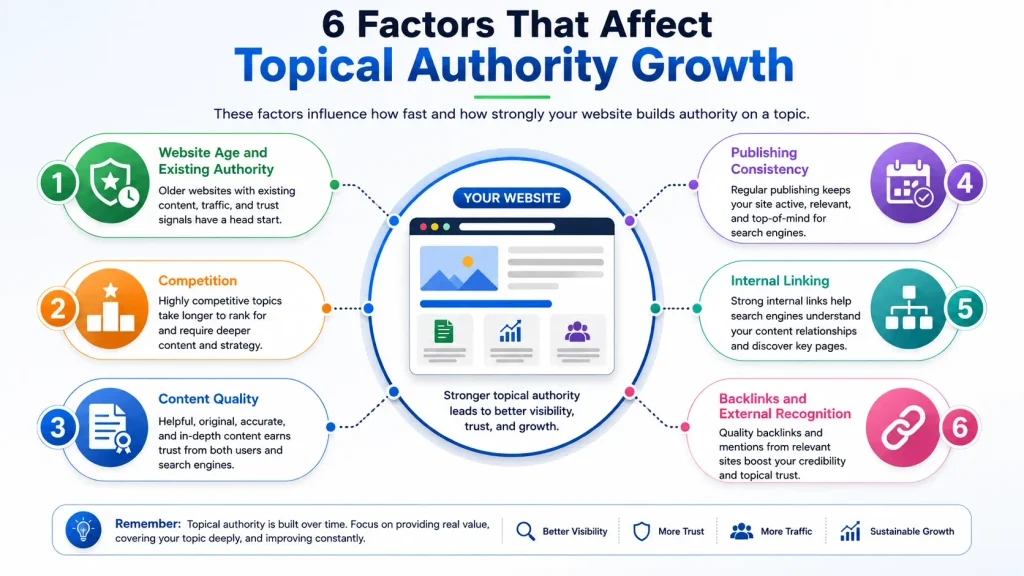
What Factors Affect How Long It Takes to Build Topical Authority?
The time required depends on the gap between your current website and the level of coverage your audience needs.
Website Age and Existing Authority
A newer website often starts with fewer indexed pages, fewer external references, and little search performance history.
An established website may already have relevant pages, links, brand recognition, and organic traffic.
Start with an audit.
Competition and Topic Difficulty
A narrow subject with few strong resources may require less content than a broad subject dominated by established publishers.
Do not copy a competitor’s article count or outline.
Content Quality and Topical Coverage
Quality matters more than publishing volume alone. A clear editorial process can support your SEO content writing.
Google’s guidance on helpful, reliable, people-first content encourages original, useful information created for people.
Coverage also needs balance.
Publishing Consistency and Frequency
A consistent publishing schedule helps a team plan research, writing, review, and updates efficiently.
Choose a pace based on available expertise and resources.
Internal Linking and Website Structure
Internal links help readers discover related information and help search engines find pages. A sound website SEO strategy supports this structure.
Google’s SEO Starter Guide recommends useful site organization and descriptive links. Learn more about semantic SEO when planning relationships between related concepts.
Backlinks and External Recognition
Relevant backlinks can help search engines discover pages and understand how other websites reference your content.
Focus on earning links through original research, helpful templates, expert contributions, useful tools, and resources that people have a reason to cite.
How Long Does It Take to Build Topical Authority? A Month-by-Month Timeline
The following twelve-month plan gives you a practical way to organize the work. Adjust it to the size of your topic, your publishing capacity, and the website’s current condition.
Months 1–2: Research and Build the Foundation
Start by choosing one main topic that fits your website’s purpose, audience, and expertise. Define the boundaries.
Research the questions people ask, the language they use, and the problems they want to solve. Group related queries by intent instead of treating every keyword variation as a separate article.
Create a topical map that shows the main subject, core subtopics, supporting questions, and relationships between pages. Decide which page should act as the central resource and which articles should provide deeper answers.
During this stage, review technical basics. Confirm that important pages can be crawled, have clear titles and headings, and are included in your site’s navigation or relevant internal links.
Months 3–4: Expand Coverage and Connect the Cluster
Build out the most important supporting pages. Prioritize topics that complete the reader journey and strengthen the central subject.
Add contextual internal links between pages. A supporting article should link to the central guide when that helps readers understand the wider topic.
Monitor indexing and early search visibility. Google Search Console can show queries, impressions, clicks, click-through rate, and average position for your site.
Use early data to find missing questions and pages that attract impressions but few clicks. Check whether titles and descriptions accurately explain the content.
Months 5–6: Improve Coverage and Page Relationships
Review the cluster as a whole. Are important subtopics missing?
Update pages where evidence, examples, instructions, or terminology have changed. Add original insights where the content is too similar to other search results.
Compare performance across the cluster. Identify pages gaining impressions, pages receiving clicks, and pages that remain invisible.
Some websites may see early ranking improvements during this period. Others may still be building their foundations.
Months 7–12: Strengthen the Topic and Expand Carefully
Use accumulated data to decide where additional depth is useful. Expand successful clusters with related questions that fit the site’s purpose.
Look beyond individual keyword positions. Review whether the website is appearing for a wider range of relevant queries, whether multiple pages in the cluster attract useful visits, and whether readers engage with the next relevant resource.
Continue maintaining the content. Update facts, replace broken references, improve outdated screenshots, and remove sections that no longer help.
Does Website Age Change the Topical Authority Timeline?
Website age can influence the starting point, but it does not determine the outcome. A new website may need more time to establish visibility and earn recognition.
| Website starting point | Main challenge | Practical priority |
| New website | Limited history and coverage | Build a focused foundation and publish useful core pages |
| Established relevant site | Missing subtopics or weak connections | Improve existing content and complete the cluster |
| Established broad site | Scattered topics and overlapping pages | Clarify the site’s focus and reorganize relevant content |
| Site with declining traffic | Lost visibility or outdated pages | Diagnose affected pages before expanding |
A new website should avoid trying to cover every subject at once. Begin with a focused area where you can provide credible, useful information.
How to Build Topical Authority More Effectively
You can make the process more efficient by reducing wasted content and improving the relationship between pages. The aim is not to publish the most articles.
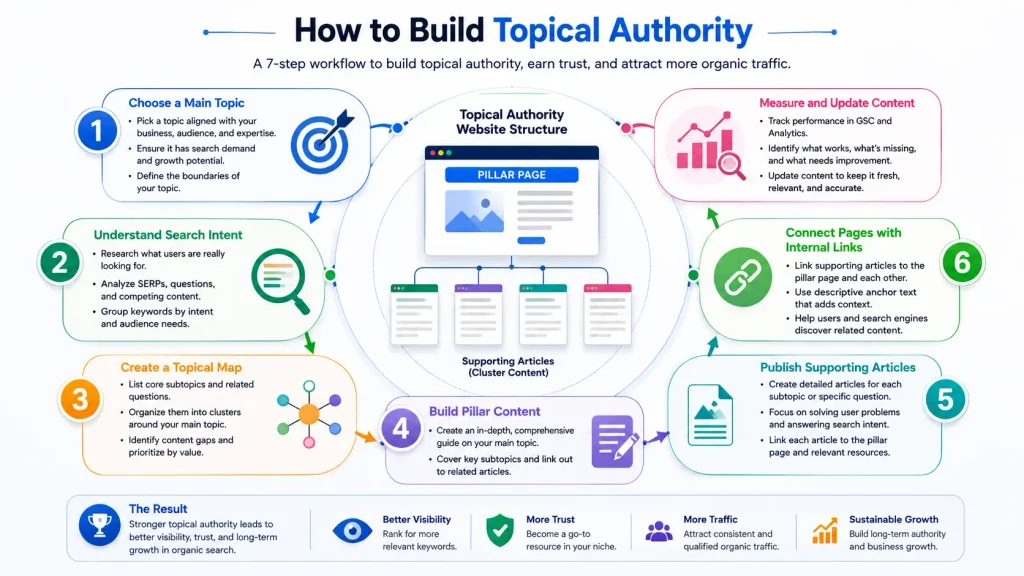
Choose a Focused Main Topic
Select a subject that connects to your audience, services, products, or editorial purpose. Check whether you can explain it with genuine knowledge and support it with enough related content.
A clear boundary prevents unrelated articles from being added simply because their keywords have search volume. It also helps readers understand what your website specializes in.
Understand Your Audience and Search Intent
Research the questions, concerns, and decisions your audience faces. Look at search results, customer conversations, support requests, industry discussions, and relevant analytics.
Match each page to one primary purpose. Do not force a commercial page to answer every informational question or turn a simple definition into an unnecessarily long guide.
Create a Topical Map
A topical map organizes the main topic into connected subtopics and supporting questions. It helps you see what to publish, what already exists, and where pages may overlap.
Prioritize the map by relevance and value. Some topics deserve detailed pages; others may fit naturally within a broader guide.
Organize Pillar and Supporting Articles
A pillar page introduces a broad subject and directs readers to deeper resources. Supporting articles answer specific questions in more detail.
Do not create a pillar page that repeats every supporting article. Give readers a useful overview, explain how the subtopics relate, and link to the detailed pages.
Cover Subtopics Without Repetition
Use a content brief to define the purpose, audience, search intent, key points, and boundaries of each article. Before drafting, compare the brief with existing pages.
Build Meaningful Internal Links
Add links where they help readers continue learning. Use concise, descriptive anchor text and link to the most relevant destination.
A useful cluster might connect a topical authority guide with a topical map resource, a semantic SEO explanation, and content strategy guidance. The connection should make sense in context.
Update Content Regularly
Review pages when facts change, new questions emerge, or performance data reveals a clear weakness. Improve accuracy, examples, navigation, and missing explanations.
How to Measure Your Topical Authority Progress
Topical authority is not represented by one official Google metric. Measure progress through several indicators that show whether your content is becoming more visible, useful, and connected.
Monitor Google Search Console Impressions and Clicks
Use the Performance report in Google Search Console to review clicks, impressions, click-through rate, and average position. Filter by page or query to understand how individual articles and topic groups perform.
Google for Developers
Impressions show how often your pages appeared in search results. Clicks show visits from those results.
Track Keyword Coverage by Topic Cluster
Create a list of relevant queries for each cluster and monitor whether your pages appear for them. Group keywords by intent and page rather than treating every close variation as a separate target.
A growing range of relevant queries can be a positive signal, but relevance matters more than the raw number. Ranking for unrelated terms does not demonstrate useful topical coverage.
Review Ranking Distribution and Organic Traffic
Track how many relevant queries appear in different ranking ranges over time. Look for broad patterns across the cluster rather than celebrating one keyword movement.
Google Analytics can help you review organic search traffic and landing-page engagement. Use the GA4 organic search traffic report to examine landing pages and outcomes such as enquiries, subscriptions, or purchases.
Audit Content Coverage and Internal Links
Review the topical map against the published website. Mark pages that are complete, pages that need improvement, and important questions that remain unanswered.
Use tools such as Google Search Console, Google Analytics 4, Ahrefs, or Semrush as supporting resources. Each tool has different data and limitations.
What Slows Down the Process of Building Topical Authority?
Several common mistakes can delay progress. The biggest is treating topical authority as a content-volume project instead of a quality and relevance project.
Publishing Too Many Low-Quality Articles
A large publishing schedule can create thin, repetitive pages that add little value. More URLs do not automatically mean better coverage. Review Google’s spam policies before using scaled or manipulative publishing tactics.
Targeting Unrelated Topics
Publishing about unrelated subjects can make the website’s purpose less clear to visitors. A business site should prioritize subjects connected to its audience and expertise.
Ignoring Search Intent
A page may include the right keywords but still fail if it does not answer the actual question. Review the wording of the query and the type of pages users find helpful.
Weak Internal Linking
Important articles can remain difficult to discover when they have no relevant links from other pages. Connect related resources naturally and check that navigation, categories, and contextual links support discovery.
Leaving Content Gaps Unaddressed
Publishing new articles while ignoring missing explanations in existing pages can waste resources. Use performance data and audience questions to decide whether to expand, update, combine, or remove content.
Changing Strategy Too Often
Frequent shifts in topic, audience, and publishing priorities make it difficult to build a coherent resource. Review progress at planned intervals, but avoid abandoning a sound strategy because of a short-term ranking change.
When Should You Expand Beyond Your Main Topic?
Expand when your core topic has useful coverage, readers need related information, and the new subject supports your website’s purpose. Do not expand only because another keyword looks attractive.
Look for signs that the current cluster is mature enough to support a related area. Important questions should have clear answers, existing pages should be maintained, and internal links should help readers navigate the subject.
Choose adjacent topics that naturally follow from the audience’s needs. For example, a website explaining topical authority may later cover content briefs, semantic SEO, or content audits.
Avoid adding unrelated categories simply to increase the number of indexed pages. A focused website with strong, useful coverage can serve readers better than a broad site with shallow information across many subjects.
Conclusion
How long does it take to build topical authority? For many focused SEO projects, six to twelve months is a reasonable planning range for developing meaningful coverage and looking for broader progress.
Frequently Asked Questions About Building Topical Authority
1. How long does it take to build topical authority for a new website?
A new website may need six to twelve months or longer to develop meaningful topical coverage and search visibility. The timeline depends on competition, topic size, publishing resources, technical setup, and content quality.
2. Can you build topical authority in three months?
You can establish a foundation in three months by researching a topic, creating a topical map, publishing core pages, and connecting them with internal links. Some pages may begin receiving impressions during that period.
3. Does topical authority improve Google rankings?
Useful, relevant coverage may help a website perform for related searches, but topical authority is not a guaranteed ranking switch or a published Google score. Rankings depend on many systems and signals, including relevance, quality, competition, and technical accessibility.
4. How many articles do you need to build topical authority?
There is no fixed article count. A narrow topic may be covered well with a small group of detailed pages, while a broad subject may need many more.
5. Does publishing more content build topical authority faster?
Not by itself. Publishing more useful content can fill important gaps, but repetitive or low-quality articles may waste resources.
6. Is topical authority more important than Domain Authority?
They describe different concepts. Domain Authority is a third-party metric used by SEO tools to estimate ranking potential, not a Google metric.
7. Can a small website build topical authority?
Yes. A small website can serve a focused audience with detailed, connected, trustworthy information.
8. How do you know if your website has topical authority?
There is no official score that confirms it. Review whether your pages cover important subtopics, appear for relevant queries, attract organic visitors, and connect logically.
9. Do backlinks help build topical authority?
Relevant backlinks can support discovery, referral traffic, and the reputation of useful resources. They do not replace strong content or complete topic coverage.
10. Should you focus on one topic before expanding your website?
Usually, it is sensible to build a solid foundation around one relevant topic before expanding widely. Complete the most important content, connect the pages, and review performance.