What Is Topical Authority? How It Works and How to Build It for SEO
Learn what topical authority means, why it matters for SEO, and how to build it through topic clusters, strategic content planning, helpful content, and internal linking. Follow a practical 10-step approach to improve topical relevance and strengthen your website's search visibility.

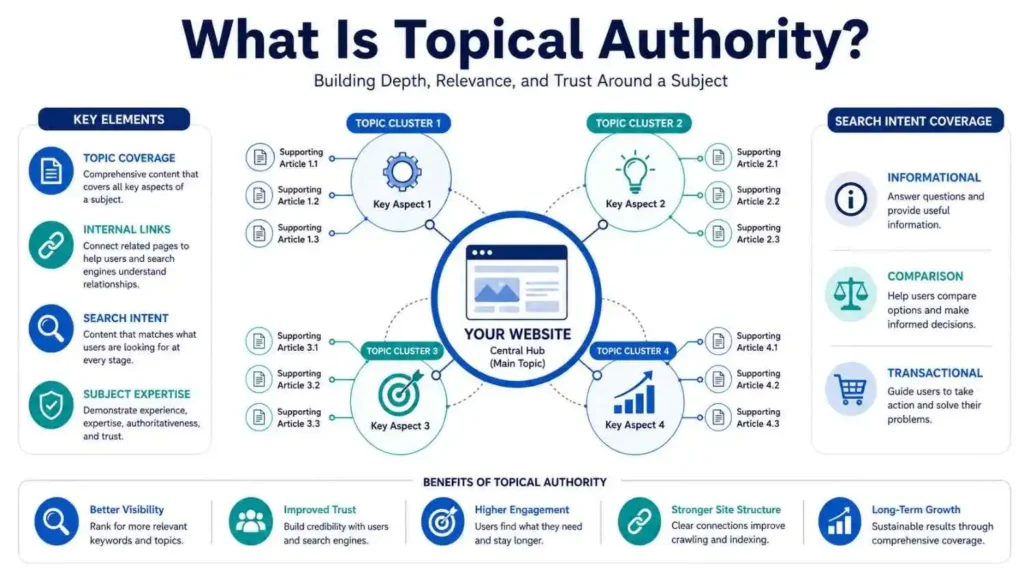
Search engines need to understand what a website is about, while readers need clear, reliable answers to their questions. Topical authority describes the depth and relevance a website demonstrates when it consistently publishes useful information about a subject and its related areas. It is not a badge, a public score, or a shortcut to higher rankings. It is a practical way to think about building a focused, connected library of content that serves an audience.
This guide covers the concept, its SEO role, and a practical process for building and measuring useful topic coverage.
What Is Topical Authority in SEO?
Definition of Topical Authority
Topical authority is the perceived depth of a website’s knowledge and coverage of a particular subject. A site develops it by publishing accurate, useful pages that address the main topic, its subtopics, and the questions people ask around them. The pages should connect logically and satisfy different search needs.
Imagine a website about home coffee. One short article about choosing a coffee maker gives readers limited coverage. A stronger resource library might explain grinders, brewing methods, water temperature, beans, storage, cleaning, and troubleshooting. Each page answers a distinct question, and together they help readers understand the wider subject.
How Topical Authority Differs from General Website Authority
General website authority is often used informally to describe a site’s overall reputation, strength, or ability to compete. Topical authority is narrower: it concerns a site’s demonstrated coverage of a particular subject. A website may be well known overall but have limited useful content about a specific topic. Another smaller site may provide much more focused coverage in that niche.
The phrase is an SEO concept, not a universally defined Google metric. Third-party SEO platforms may use their own scores or measurements, but those scores are not an official Google topical authority rating.
Why Topic Coverage Matters More Than Publishing More Content
Publishing more pages does not automatically create expertise. Repeated articles, thin pages, and unrelated subjects can make a site harder to navigate without helping readers. A better approach is to identify meaningful questions, answer them well, and connect pages where a link genuinely helps.
Why Does Topical Authority Matter for SEO?
Building Subject Relevance and Content Relationships
A connected group of pages can make the relationship between a main subject and its supporting questions clearer. Readers can move from a broad explanation to a detailed guide without starting a new search. For example, someone learning about coffee grinders may next need to understand burr types, grind size, and cleaning.
Helping Search Engines Understand Your Website
Search engines discover and interpret pages through content, links, and many other signals. Descriptive titles, useful headings, relevant internal links, and clear page relationships can help systems understand what a page covers and how it relates to other pages. Google recommends crawlable links and meaningful anchor text so users and Google can understand linked pages.
Supporting Long-Term Organic Search Visibility
A well-planned content library can help a website serve different stages of a search journey. One person may want a basic definition; another may compare options; a third may need instructions. Useful pages for these needs can attract relevant visitors over time.
However, topical coverage is only one part of SEO. Search results also depend on query relevance, competition, content quality, technical accessibility, location, freshness where relevant, and many other factors. No content structure guarantees a position.
How Does Topical Authority Work?
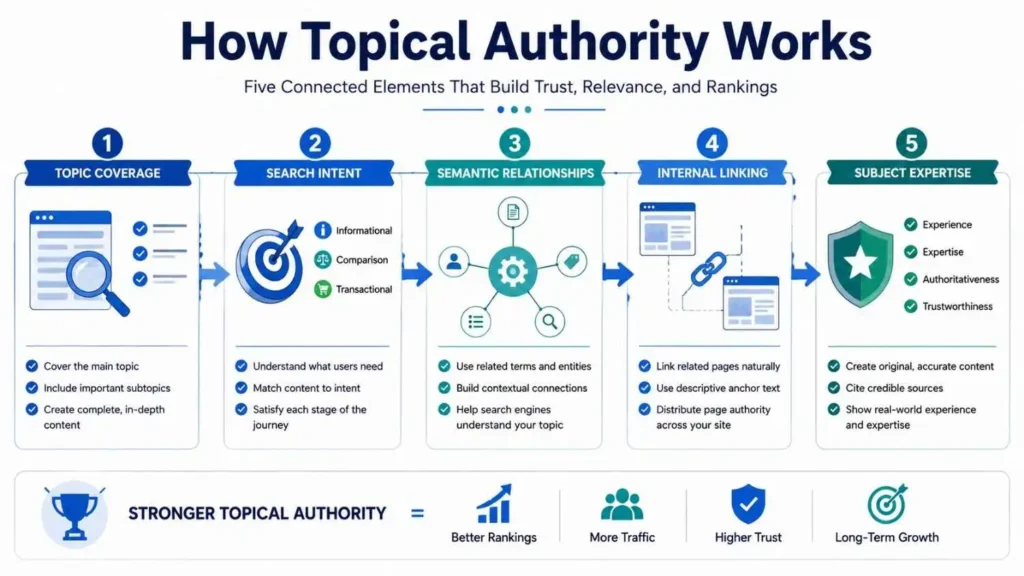
Topic Coverage, Content Depth, and Search Intent
Start by understanding the topic’s boundaries. List the main questions a target audience has, then group them by intent. Informational searches seek explanations. Comparison searches evaluate alternatives. Transactional searches show readiness to take action. A useful content plan addresses the intents that match the site’s purpose.
Depth means answering the question completely enough for the reader’s needs. It does not mean adding unnecessary length. A page about cleaning a coffee grinder should explain the safe steps, tools, frequency, and common mistakes. It does not need a long history of coffee.
Semantic Relationships and Related Entities
Topics contain related concepts, products, people, processes, and terminology. A page about espresso may naturally discuss pressure, extraction, grind size, dose, and brewing time. These relationships help explain the subject in context.
Content Consistency and Internal Linking
Internal links connect related resources. A guide to espresso extraction might link to a detailed page about grind size. The destination should add information that the reader may reasonably want next. Links should be contextual rather than inserted only to manipulate rankings.
The Role of Experience, Expertise, and Trust
Readers need reasons to trust important information. Show who created or reviewed a page, explain relevant experience where appropriate, cite reliable sources, and correct errors. First-hand testing, original examples, photographs, data, or a transparent method can make a page more useful than a rewritten summary.
Google describes experience, expertise, authoritativeness, and trustworthiness as concepts used in its quality guidance. Google also states that E-E-A-T itself is not a specific ranking factor. Treat it as a useful quality framework, not a formula or score.
What Is Topical Authority Compared With Other SEO Concepts?
Topical Authority vs Domain Authority
Topical authority concerns depth of coverage in a subject. Domain Authority is a third-party metric used by some SEO tools to estimate a domain’s ranking strength. It is not a Google metric. The two ideas measure different things, so a domain score should not be presented as proof of subject expertise.
Topical Authority vs Page Authority
Page Authority is another third-party metric, generally used to estimate the strength of an individual URL. Topical authority is broader and considers how a group of related pages covers a subject. A single page can perform well without a site having comprehensive coverage, and a large content cluster can include pages with different levels of performance.
Topical Authority vs Topical Relevance
Topical relevance describes how closely a page or site relates to a subject or query. Topical authority adds the idea of sustained, useful coverage and demonstrated knowledge across connected questions. Relevance is necessary for a page to match a topic, but publishing one relevant article does not establish broad expertise.
Topical Authority vs Keyword Authority
Keyword authority is not a standard, universally agreed SEO metric. People sometimes use the phrase to describe a site’s visibility for a group of related keywords. It is more useful to plan around topics and search intent than to treat a keyword list as a measure of expertise.
| Concept | Main focus | Common measurement |
| Topical authority | Depth and usefulness across a subject | No universal official score |
| Domain Authority | Estimated domain-level strength | Third-party tool metric |
| Page Authority | Estimated individual page strength | Third-party tool metric |
| Topical relevance | Relationship to a topic or query | Qualitative content assessment |
| Keyword visibility | Search presence for queries | Rankings, impressions, and clicks |
How to Build Topical Authority Step by Step
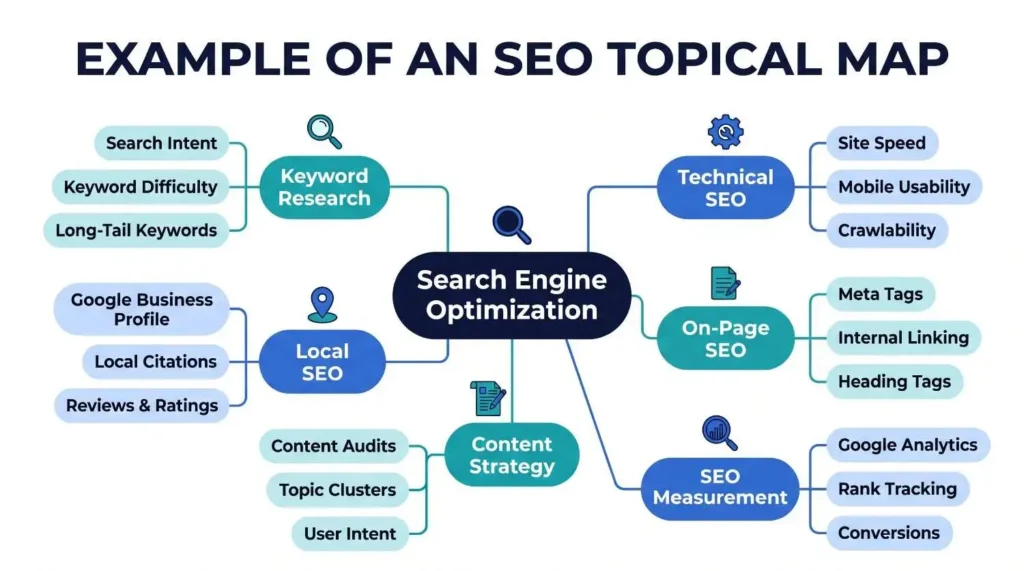
Step 1: Choose a Relevant Main Topic
Choose a subject that fits the website’s purpose, audience, and knowledge. A business should focus on topics connected to the problems it solves, products it offers, or expertise it can demonstrate. A publisher should consider its audience and editorial mission.
Avoid selecting a subject only because a keyword tool shows attractive demand. If the site cannot provide reliable information or a distinct perspective, it may struggle to create useful resources. Define the topic in one sentence and write down what is outside its scope.
Step 2: Understand Your Target Audience and Search Intent
Identify who needs the information and what they are trying to accomplish. Review customer questions, sales conversations, support requests, community discussions, and search results. These sources can reveal language and concerns that keyword tools may not show.
Step 3: Conduct Comprehensive Keyword Research
Research broad terms, long-tail queries, related questions, and comparison phrases. Use tools such as Google Keyword Planner, Google Search Console, and reputable SEO platforms to discover search language and estimate opportunity. Treat volume and difficulty figures as estimates, not facts about guaranteed traffic.
Group keywords by intent and topic rather than creating a separate page for every variation. Several phrases may express the same need and belong on one page. Separate pages are appropriate when the questions, intent, or required information are meaningfully different.
Step 4: Identify Main Topics and Supporting Subtopics
List the main themes, then group related questions beneath each one. Label every group by audience need and intent so each planned page has a distinct, useful purpose before drafting content.
Step 5: Create a Strategic Topical Map
A topical map organizes the main subject, subtopics, and planned pages. It is a planning tool, not a ranking signal. Start with one central topic, add major clusters, then list supporting questions under each cluster. Record the intended audience, search intent, proposed page type, and target query for each page.
Step 6: Organize Content into Topic Clusters
A topic cluster usually contains a broad pillar page and supporting pages that explore narrower questions. The pillar page introduces the subject and directs readers to deeper resources. Supporting pages answer specific questions and link back when the broader guide adds value.
Step 7: Create Helpful, In-Depth Content
Write each page to satisfy its own search intent. Answer the main question early, use clear headings, explain unfamiliar terms, and include examples. Add original analysis, first-hand observations, diagrams, screenshots, or data when they genuinely improve understanding.
Verify factual claims and cite sources for information that readers may need to check. Avoid copying competitors or rewriting the same explanations with different wording. Google’s people-first guidance asks creators to provide original value and content that leaves readers satisfied. Read the Google guidance on helpful, reliable, people-first content when reviewing your editorial standards.
Step 8: Build Relevant Internal Links
Link pages when the destination provides a useful next step. Use concise anchor text that describes the destination. For example, a general guide to brewing can link to a detailed explanation of water temperature using the anchor “water temperature for coffee.”
Step 9: Update and Improve Existing Content
Review pages when products, guidance, research, or user needs change. Check whether facts remain accurate, screenshots still match the interface, links work, and the page answers the original question. Add missing details when they improve the resource.
Step 10: Monitor Performance and Identify Content Gaps
Use Google Search Console to review impressions, clicks, queries, and pages. Look for relevant queries where a page receives impressions but does not fully answer the searcher’s need. Review pages with declining performance and compare them with current search results.
How to Create a Topical Map With a Practical Example
Understanding Pillar Pages and Supporting Articles
A pillar page covers a subject at a useful overview level. Supporting articles explain narrower questions in greater detail. The pillar should not repeat every supporting article; it should introduce the areas and help readers choose the next resource.
Organizing Topics and Subtopics
Consider a website focused on home coffee. Its central topic is “Home Coffee Brewing.” One cluster could cover equipment, with supporting pages about grinders, kettles, scales, and filters. Another cluster could cover brewing methods, with pages about pour-over, French press, AeroPress, and espresso. A third could cover coffee preparation, including grind size, water temperature, ratios, and storage.
Example of a Topical Map for a Digital Marketing Website
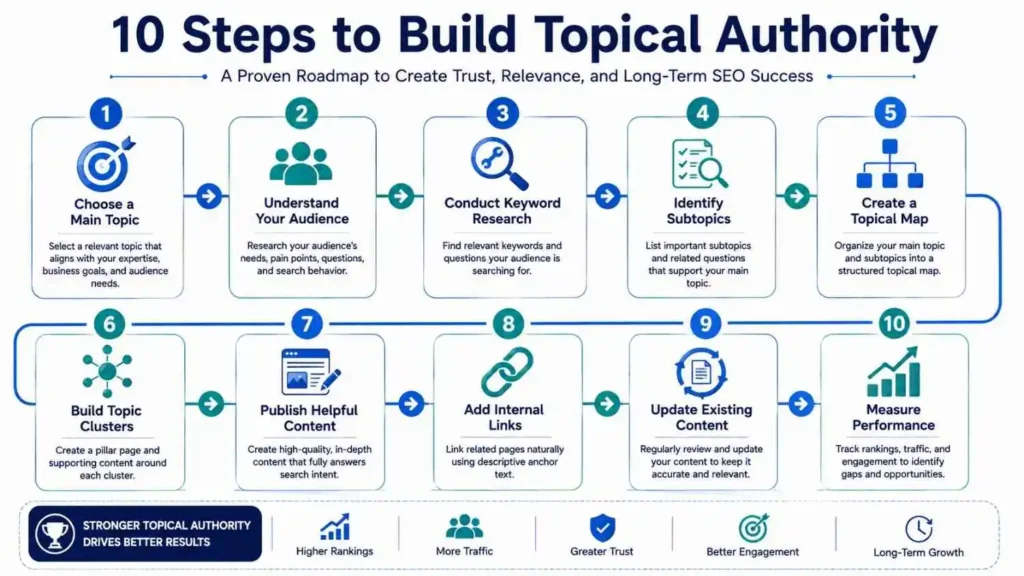
For a digital marketing website, the central topic might be “Search Engine Optimization.” Clusters could include keyword research, technical SEO, on-page SEO, local SEO, content strategy, and measurement. Under content strategy, supporting pages could cover topical maps, search intent, content briefs, topic clusters, and content updates.
How Internal Linking Strengthens Topical Coverage
Connecting Related Articles Naturally
Internal links help readers move between related resources and help search engines discover pages. Link from a broad guide to a detailed explanation when the destination adds useful context. A supporting article can also link back to its main guide when readers may benefit from the overview.
Using Descriptive Anchor Text
Write anchor text that accurately describes the destination. “How to choose a coffee grinder” is clearer than “click here.” Avoid repeating the same keyword-rich phrase in every link. Natural wording is usually more helpful and sets accurate expectations.
How to Measure Topical Authority and SEO Progress
Tracking Organic Impressions and Clicks
Google Search Console provides query and page performance data, including impressions, clicks, click-through rate, and average position. Compare relevant groups of pages over time. Look for growth in useful queries, not just a rise in total impressions.
Monitoring Keyword and Topic Coverage
Create a simple tracking sheet with the main topic, supporting subtopic, target page, intent, status, and performance notes. Review whether important audience questions have a useful answer. Track overlap between pages and identify subjects that deserve more depth.
Using Google Search Console and SEO Tools
Use Search Console for Google search performance and indexing information. Use analytics to understand visits and user journeys. SEO platforms can help with keyword discovery, competitor comparisons, backlinks, and rank tracking. Each tool has limitations, so validate important findings rather than treating any single dashboard as the complete picture.
Understanding Why There Is No Official General Topical Authority Score
Google has described a specific system called “topic authority” for news-related queries. It helps surface expert news sources for specialized topics and locations, using signals such as a publication’s relevance, original reporting, influence, and reputation. This is not the same as the broader SEO industry concept of topical authority for every type of website. Google has not published a general topical authority score that site owners can check. See Google’s explanation of news topic authority.
Common Topical Authority Mistakes to Avoid
Building topical authority requires more than publishing articles around similar keywords. Your content needs a clear purpose, useful information, and a logical relationship between pages. Avoid these common mistakes when developing your content strategy.
Publishing Too Many Unrelated Articles
Publishing articles about unrelated subjects can weaken your website’s overall content focus. For example, a website dedicated to SEO may confuse its audience if it regularly publishes unrelated content about cooking, fashion, and travel. Instead, prioritize subjects that match your website’s main purpose, audience, and expertise. This helps create a more consistent and useful content library.
Targeting the Same Search Intent Repeatedly
Creating multiple articles that answer essentially the same question can lead to keyword cannibalization and unnecessary content duplication. For example, publishing separate articles targeting slightly different versions of “what is keyword research” may not provide additional value. Review existing pages before creating new ones. If several pages serve the same intent, consider combining them into one stronger resource.
Creating Content Without a Clear Structure
A website with poorly organized content makes it difficult for readers to find related information. Publishing articles without topic clusters, meaningful categories, or relevant internal links can create disconnected pages. Organize content around main subjects and supporting topics. Use descriptive headings and contextual internal links to help readers navigate between related resources.
Prioritizing Quantity Over Reader Value
Publishing frequently does not automatically make a website more authoritative. Thin articles, repetitive explanations, and content created only to target keywords rarely provide lasting value. Focus on accuracy, practical examples, original insights, and complete answers. Before publishing, ask whether the article genuinely helps readers understand or solve their problem.
Conclusion
Topical authority is a useful way to plan focused, connected, reader-first content. Choose a subject that fits your expertise, research real audience questions, organize related pages, and link them where they help. Improve existing resources and measure progress with search data, feedback, and regular content reviews. There is no guaranteed article count or official general score. Sustainable results come from consistently helping readers understand a subject.
Frequently Asked Questions About Topical Authority
1. What is topical authority in simple terms?
Topical authority means a website provides useful, reliable information across a subject and its related questions. Instead of publishing one isolated article, the site builds connected resources that help readers understand the topic more completely.
2. How long does it take to build topical authority?
There is no fixed timeline. It depends on the subject’s size, competition, website history, publishing resources, content quality, and how quickly pages are discovered and evaluated. Focus on useful coverage and improvement rather than expecting a guaranteed result by a certain date.
3. Is topical authority a Google ranking factor?
The broad SEO concept is not a published Google ranking score or a confirmed standalone ranking factor. Google does describe a separate topic authority system for news-related queries. Do not confuse that specialized system with general topical authority strategies.
4. Does topical authority improve Google rankings?
A useful content structure may support relevance, discovery, and reader satisfaction, but it does not guarantee higher rankings. Google considers many signals, and each page must satisfy the query better than competing results to earn visibility.
5. What is the difference between topical authority and domain authority?
Topical authority describes a site’s depth of coverage in a subject. Domain Authority is a third-party SEO metric that estimates overall domain strength. Domain Authority is not an official Google metric and does not prove expertise in a particular subject.
6. How many articles do you need to build topical authority?
There is no required number. A focused subject may need only a few comprehensive resources, while a broad subject may require many supporting pages. Publish when a distinct audience need justifies a page, not to reach an arbitrary article count.
7. Are topic clusters necessary for topical authority?
Topic clusters are a useful planning method, but they are not a mandatory ranking formula. Use pillars and supporting pages when that structure makes information easier to explore. Other topics may work better as guides, categories, or sequential tutorials.
8. Can a new website build topical authority?
Yes. A new website can start by choosing a focused subject, answering important questions accurately, and organizing its resources clearly. It may take time to earn visibility and trust, but the site does not need to publish hundreds of pages before it can be useful.
9. How do you measure topical authority?
There is no universal official score. Review topic coverage, query impressions, clicks, page performance, content quality, internal links, and audience feedback. Third-party metrics can provide context, but none should be treated as a definitive topical authority measurement.
10. Does topical authority help with AI search visibility?
Clear, accurate, well-structured content can help people and systems understand a subject, but topical authority does not guarantee inclusion in AI-generated answers. Focus on original value, reliable sourcing, clear explanations, and pages that genuinely satisfy readers.