How to Choose a Web Designer in Oman
A practical guide to choosing a web designer in Oman, with questions to ask, a comparison scorecard and red flags to avoid.


To choose a web designer in Oman, start with your own goals, then compare candidates on evidence: relevant portfolio work, a clear process, written terms, ownership of your website and a plan for support after launch. Price matters, but it is only one part of the decision. This guide gives you a step-by-step method, questions to ask, a scorecard and red flags to watch for.
Write a short brief first, shortlist two to four designers or agencies, check their live work on a phone, ask about process, SEO and ownership, and compare written proposals with a simple scorecard. Pick the person or team whose evidence and communication match your project, not simply the lowest price.
What Do You Need Before You Hire a Web Designer?
Before you hire anyone, write down what the website must do, who it is for and which pages it needs, because a clear brief makes every quote easier to compare. Many projects go wrong because the buyer asks for a website without saying what success looks like. A short brief of one page is enough.
Include these points in your brief:
- State what the site should achieve, such as phone calls, bookings, quote requests or online sales.
- Describe who will use it, and whether they need Arabic, English or both.
- List the pages you expect, such as home, services, about, contact and any product pages.
- Say who will write the text and supply photos, because content delays are a common cause of late launches.
- Share two or three websites you like, and say what you like about each.
- Timeline and budget range. Give an honest range, so that designers can propose something realistic.
The type of professional you need also depends on the project. A web designer plans the look, layout and user experience. A web developer builds the functions behind it, such as booking systems or online payments. An agency usually offers both, plus project management, and a freelancer may cover both for a smaller project. Decide which mix you need before you compare prices.
How to Choose a Web Designer in Oman Step by Step
To choose a web designer in Oman, define your brief, shortlist candidates, review their portfolios, ask structured questions, compare written proposals, check references and agree the contract. The seven steps below turn a confusing search into a clear comparison, and each one produces something you can write down and use when you compare candidates side by side.
Step 1: Write your brief
Put your goals, audience, pages, content plan, timeline and budget range in one page. Send the same brief to every candidate. Identical information makes the quotes comparable, and you will quickly see who asks good questions in return, which is often the first sign of an experienced professional.
Step 2: Build a shortlist of two to four candidates
Collect names from recommendations, searches, social profiles and the portfolios of websites you admire. Ask other business owners in Oman who built their website and whether they would hire the same person again. Two to four candidates are enough to compare without wasting time.
Step 3: Review each portfolio
Open the live websites in the portfolio, on your phone first, and check whether the work is similar to your project in size, sector and function. The next section explains how to do this properly. A strong portfolio shows range and quality, not just attractive screenshots.
Step 4: Ask structured questions
Ask every candidate the same questions about process, SEO, ownership, timeline and support, and write down the answers. Clear answers show experience. Vague or evasive answers are useful information too. You will find a question list later in this guide.
Step 5: Compare written proposals
Ask each candidate for a written proposal that lists what is included, the stages, the timeline, the payment schedule and what costs extra. A proposal that is itemised and specific is easier to trust than a single price with no detail. If you are not a specialist, a second opinion from a trusted contact can help, and an SEO specialist can review the structure and SEO parts of a proposal with you.
Step 6: Check references
Contact one or two past clients and ask about communication, deadlines, problems and support after launch. Past clients can tell you what a portfolio cannot. Ask whether they would hire the designer again, whether the project finished on time and how problems were handled when something went wrong.
Step 7: Agree the contract
Put the scope, price, payment stages, timeline, ownership and support terms in writing before work starts. Do not rely on a verbal agreement. Both sides should know what is included, what happens if the scope changes and who to contact if something goes wrong after launch.
Freelancer vs Agency: Which Fits Your Project?
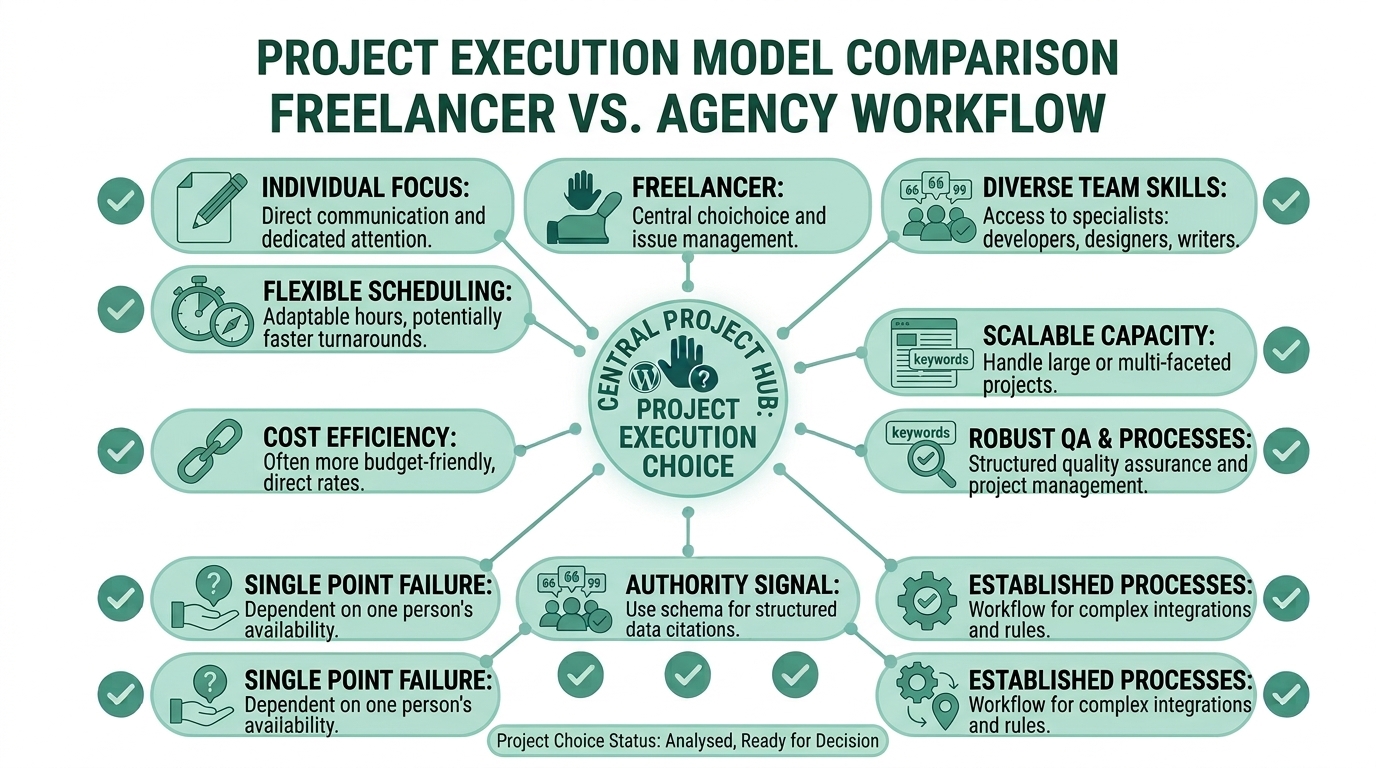
A freelancer suits smaller, well-defined projects and offers direct contact, while an agency suits larger projects that need a team, project management and more services. Neither is automatically better. The right choice depends on scope, budget, risk and how you like to work.
| Factor | Freelancer | Agency |
| Communication | One person, direct contact | A project manager and a team |
| Capacity | Limited if they are ill or busy | Others can cover absences |
| Range of skills | Often narrower, or relies on partners | Broader: design, development, content, SEO |
| Price | Often lower for small projects | Often higher, with a minimum project size |
| Risk | Depends on one person | Depends on staff turnover and process |
| Best for | Small business sites, landing pages | Larger sites, shops, custom functions |
Ask either type who will actually work on your project. Ask whether anyone will be subcontracted, and who will answer questions after launch.
Choose a Web Designer in Oman by Checking Their Portfolio
To choose a web designer in Oman with confidence, test the live sites in their portfolio on a phone, check speed and structure, and ask what happened after each project launched. A portfolio shows what a designer can build. Your own checks show how well it works.
Work through this list for three to five portfolio sites:
- Look for a project of a similar type and size to yours, such as a business site or an online shop.
- Mobile experience. Open each site on your phone. Check that the menu opens easily, text is readable and buttons are easy to press. A guide to responsive web design explains what good mobile layout looks like.
- Run key pages through Google PageSpeed Insights and compare the results with the targets in the table below. Slow portfolio sites suggest slow projects. See the guide to fast-loading design for the design choices that cause delays.
- Check that the menu is clear, the main pages are easy to reach and the headings make sense. A guide to website structure for SEO shows what to look for.
- Language support. If you need Arabic, open an Arabic page and check that the layout reads right to left and the text displays correctly.
- Ask what happened after launch. A portfolio shows what was built, not what it achieved.
Google’s Core Web Vitals guidance suggests these targets for good loading, responsiveness and stability:
| Core Web Vitals measure | What it shows | Google’s target |
| Largest Contentful Paint | How fast the main content loads | Within 2.5 seconds |
| Interaction to Next Paint | How quickly the page responds | Under 200 milliseconds |
| Cumulative Layout Shift | How stable the layout is | Under 0.1 |
Google also says that good scores do not guarantee top rankings, so use these figures as a quality check, not a promise. Real visitor data may differ from a single test, so test more than once.
How I Review a Designer’s Work
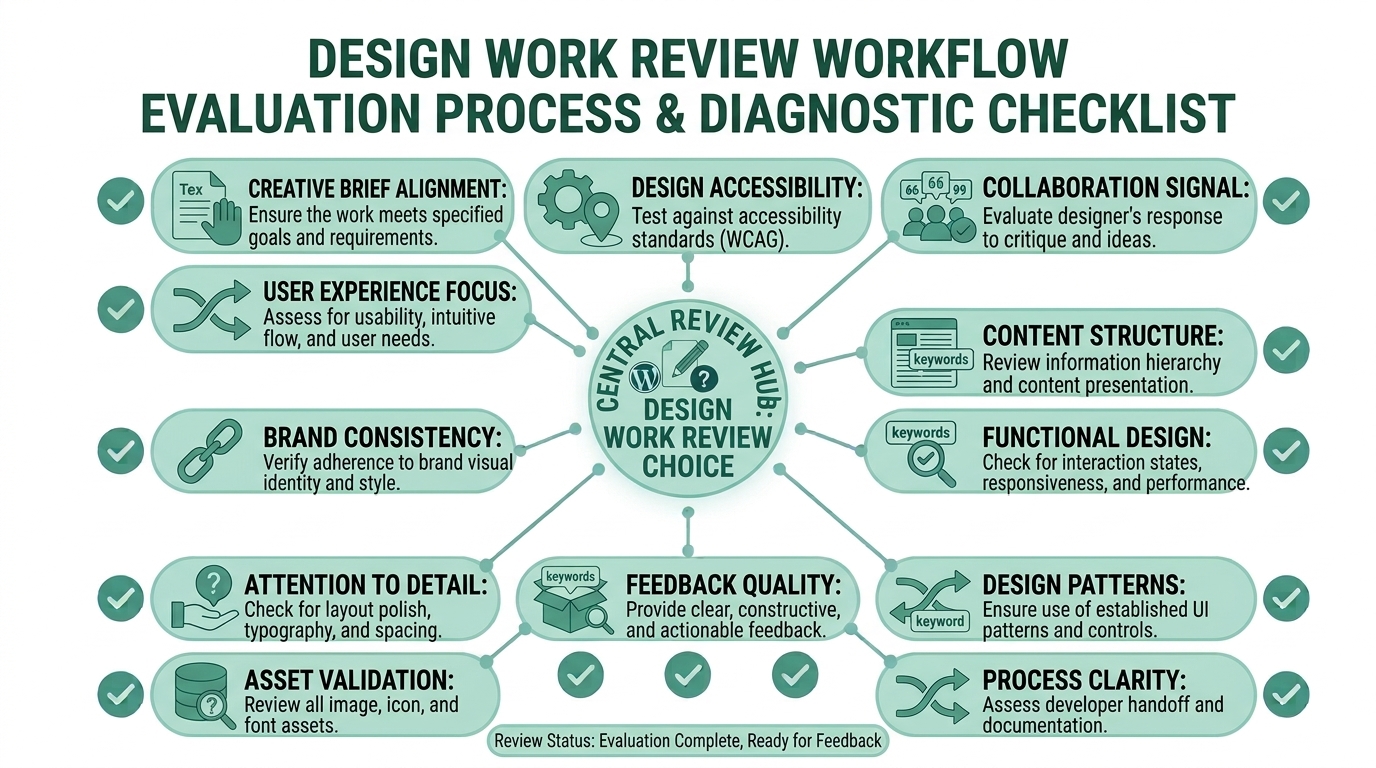
A simple way to review a designer’s work is to look at the site as a visitor, then as a search engine would, and note what you find in the same order every time. This is the method I recommend, and it draws on my work with website structure. It describes a process, not a set of results.
- Phone first. Open the home page and one inner page on a phone. Check the menu, the text size and how quickly the page becomes usable.
- Follow the links. Click through the main menu and a few internal links. Check that every link goes where you expect.
- Read the headings. A clear page has one main heading and sensible sub-headings. Pages that look like headings but are only large text are harder for search engines to read.
- Test speed. Run two or three pages through a speed test and compare the results with Google’s targets.
- Check the structure. Look at how pages are grouped and whether important pages are easy to reach.
- Note what is missing. Look for contact details, clear calls to action and pages that answer real customer questions.
I write these notes down and compare candidates side by side. You can do the same without technical knowledge. For a deeper look at how design affects search visibility, read how design affects your rankings.
Questions to Ask a Web Designer
Ask every candidate the same questions about process, SEO, ownership, timeline, payment and support, and compare the answers in writing. Good designers welcome questions, because clear answers prevent problems later.
“…you are responsible for the actions of any companies you hire…”
Source: Google Search Central, Do you need an SEO?
That advice comes from Google’s guidance on hiring an SEO, but it applies equally to a designer: you remain responsible for what the people you hire do on your behalf, so make sure you understand how they will work.
Use these questions as a starting point:
- What are the stages, from discovery to launch, and what do you need from me at each stage?
- Similar work. Which projects are most like mine, and can I see them live?
- Who does the work. Who will design and build my site, and will anything be outsourced?
- How do you plan structure, headings, speed and redirects, and is that included in the price?
- Who writes the text and prepares images, and what happens if my content arrives late?
- How long will the project take, and what could delay it?
- How many rounds of revisions are included, and what happens if the scope changes?
- Who owns the domain, hosting accounts, design files and code after launch?
- What happens after launch, how long are bugs fixed free of charge and what does ongoing support cost?
- How will we communicate, how often and how quickly will you reply?
A Scorecard to Compare Web Designers
A scorecard turns a gut feeling into a clear comparison by giving each candidate a score for the factors that matter most to your project. Score each factor from one to five, multiply by its weight and add the results. The example below is fictional and the weights are only a suggestion.
| Factor | Weight | Candidate A | Candidate B |
| Relevant portfolio | 25% | 4 | 3 |
| Process and communication | 20% | 3 | 5 |
| Mobile, speed and structure | 20% | 4 | 4 |
| SEO planning | 10% | 2 | 4 |
| Ownership and contract terms | 15% | 5 | 4 |
| Support after launch | 10% | 3 | 4 |
In this fictional example, Candidate A scores 3.6 and Candidate B scores 3.9. Change the weights to suit your project. If you must support Arabic, give language support its own row. If your budget is tight, add a row for price and give it a weight you are comfortable with.
Contract, Ownership and Payment Terms
A good contract states the scope, the price, the payment stages, the timeline, who owns what and what support is included, so nothing important depends on memory. I am not a lawyer, so ask a qualified adviser to review any contract that carries significant risk.
- List the pages, features and number of revisions included.
- Payment stages. Pay in stages tied to milestones, such as a deposit, design approval and launch.
- Ownership of the domain. The domain should be registered in your name, or you should have full control of it.
- Ownership of hosting and accounts. You should have admin access to hosting, the website admin area and analytics.
- Design and code. Agree in writing whether you receive source files and who owns the finished design and code.
- Backups and security. Ask who makes backups and who manages updates.
- Support period. Agree how long fixes are free, and what ongoing support costs.
- Changes and delays. Say how extra work is priced and what happens if either side causes a delay.
Red Flags to Look for Before You Hire
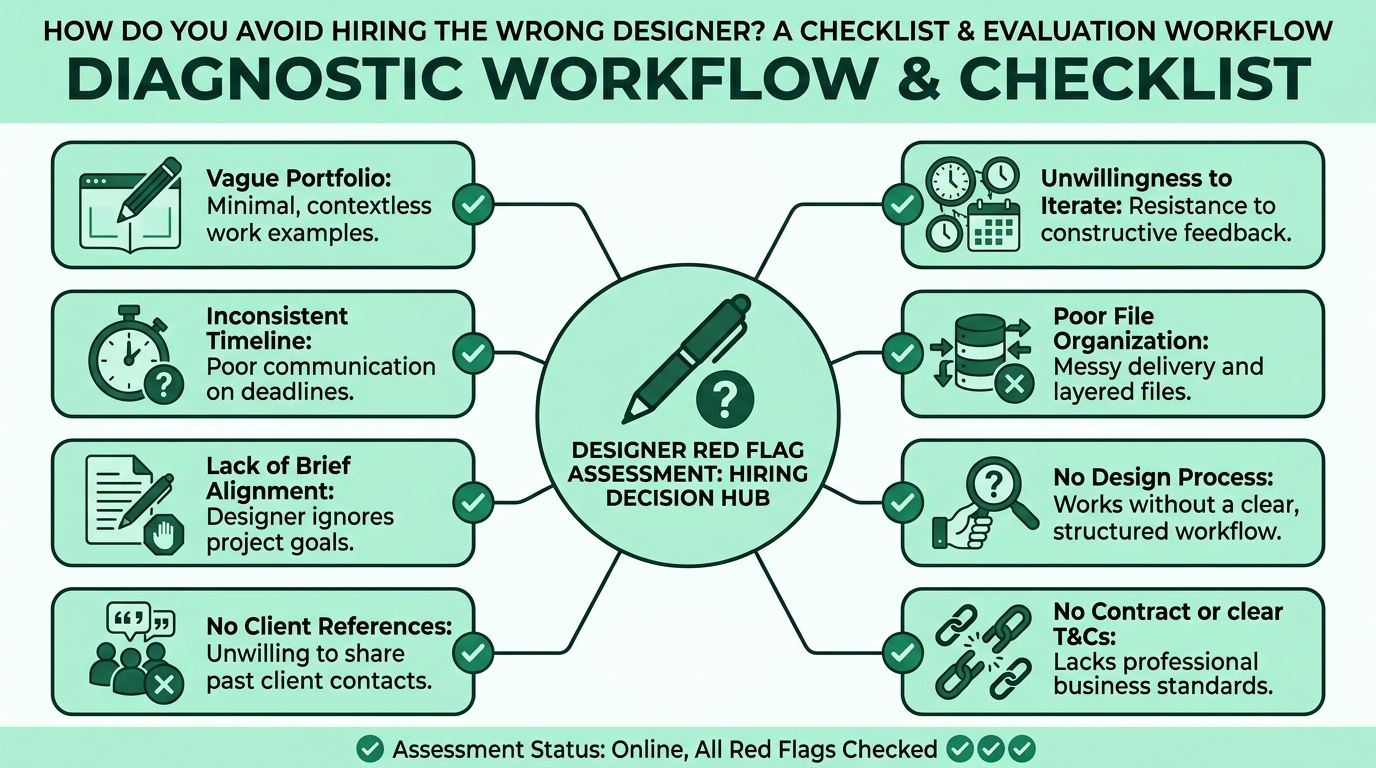
Red flags are signs of weak process, hidden costs or unclear ownership, and a single one is a reason to ask more questions rather than an automatic reason to walk away. Treat them as prompts to investigate.
- No live examples. The designer shows only screenshots, or cannot name any projects.
- Vague quotes. The price has no breakdown, or key items are missing.
- Pressure to decide quickly. You are pushed to pay or sign before you have compared options.
- No questions about your business. A good designer asks about your customers, goals and competitors.
- Unclear ownership. The designer keeps control of your domain, hosting or admin access.
- Promises of rankings. Nobody can guarantee a position on Google, so treat any such promise with caution.
- No plan for after launch. There is no mention of bugs, updates, backups or support.
- Template only, with no explanation. A template can be a fine starting point, but ask what will be customised.
Oman-Specific Things to Check
In Oman, check Arabic and English support, mobile use, communication habits and how the designer handles local content, because these affect how customers experience your site. These points depend on your audience, so decide which ones apply to you.
- Arabic and right-to-left layout. If customers read Arabic, ask how the designer handles right-to-left layouts, Arabic fonts and a language switcher. Ask to see a live bilingual project.
- Two language versions. Each language should have its own web address and fully translated content, not a copy of the same text.
- Mobile use. Many customers browse on phones, so mobile design should be tested first.
- Local content. Check that addresses, phone numbers, opening hours and currency display correctly.
- Working hours and holidays. Agree working days, response times and how public holidays affect the timeline.
- Communication channel. Agree whether you will use email, messaging apps or calls, and who your main contact is.
Choose a Web Designer in Oman With SEO in Mind
If you want customers to find your site through search, choose a designer who plans structure, speed, headings and redirects from the start, not as an afterthought. Design choices affect how search engines crawl and understand a site.
Ask whether the designer plans the page structure and menu before designing, and whether redirects are planned if you are replacing an old site. Ask how they handle page titles, headings, image sizes and mobile layout. No one can guarantee a top ranking, so be cautious of promises about search results.
For a clear explanation of what to expect, read the SEO friendly web design guide. It covers crawlability, mobile layout, speed, structure and navigation in more detail.
How Much Should You Expect to Pay?
The cost of a website depends on its size, functions, content and who builds it, so ask for itemised quotes instead of relying on average figures. I am not quoting prices here, because published averages are often out of date and hard to compare.
When you compare quotes, check what each one includes: the number of pages, design work, development, content, images, Arabic or bilingual support, SEO setup, training, hosting and support. A lower price that leaves out essential items can end up costing more. Ask each candidate to explain what is included and what is not.
Web Designer Selection Checklist
Use this checklist before you sign, and tick each point only when you have seen evidence or received a written answer.
- Brief written. Goals, audience, pages, content plan, timeline and budget range are on one page.
- Shortlist made. You have compared two to four candidates using the same brief.
- Portfolio checked. You have opened live sites on a phone and tested speed.
- Similar work seen. At least one project resembles yours in type or size.
- Questions answered. Every candidate answered the same questions in writing.
- Proposal itemised. Scope, stages, timeline and payment schedule are clear.
- SEO planned. Structure, headings, speed and redirects are included in the plan.
- Language support confirmed. Arabic or bilingual needs are covered, if relevant.
- Reference contacted. You spoke to at least one past client.
- Ownership agreed. Domain, hosting, admin access and files are in your name or under your control.
- Support defined. You know what happens after launch and what it costs.
- Contract signed. The scope, price and terms are in writing.
Next Step for Your Website
If you want help with your website project, you can start with the service that fits your stage, and I will explain exactly what is included. I offer web design services as well as website SEO, so I am not a neutral party, and you should compare me with other options using the scorecard above.
For a new or rebuilt site, see my web design service. For a review of an existing site or a proposal you have received, see my website SEO services. If you are not sure which fits, contact me for a website review and share your goals and current website address.
Conclusion
Choosing a web designer is easier when you start with a clear brief, compare evidence and put every important term in writing. Check portfolios on a phone, ask the same questions of every candidate, score the options fairly and confirm ownership before you pay. The best choice is the designer or team whose evidence, communication and terms match your project, not simply the lowest quote.
Frequently Asked Questions
These answers cover the questions people ask most often when they choose a web designer. Each answer starts with a direct response and then adds the detail you need to act on it, so you can read only the questions that matter to your own project.
How do you choose a web designer in Oman?
Choose by comparing evidence: write a brief, shortlist two to four candidates, check live portfolio sites on a phone, ask the same questions of each, compare itemised proposals and confirm ownership and support in writing. Price matters, but relevant work, clear communication and written terms matter just as much.
How do I hire a web designer?
Hire a web designer by writing a brief, comparing a short list, checking references and signing a contract that states the scope, price, payment stages, timeline and ownership. Avoid paying in full before work starts, and agree who owns the domain, hosting and files.
What should I ask a web designer before hiring?
Ask about their process, similar projects, who does the work, SEO planning, content, timeline, revisions, ownership and support after launch. Ask every candidate the same questions and keep their answers in writing, so that you can compare them fairly later.
Is it better to hire a freelancer or an agency?
A freelancer often suits smaller, defined projects, while an agency suits larger sites that need a team, project management and extra services. Neither is automatically better, so decide by project size, budget, risk and how closely you want to work with one person.
How do I check a web designer’s portfolio?
Open the live sites on a phone, test speed with Google PageSpeed Insights, check the menu and headings, and look for a project similar to yours. Then ask what happened after each project launched, because a portfolio shows what was built, not what it achieved.
What is the difference between a web designer and a web developer?
A web designer plans the look, layout and user experience, while a web developer builds the code and functions, such as booking systems or payments. Some professionals do both, and agencies usually offer both, so check who will cover each part of your project.
How much does a web designer cost in Oman?
Cost depends on the size of the website, its functions, content, language needs and who builds it, so I do not quote averages. Ask each candidate for an itemised proposal, and compare what is included, not only the total price.
Should my website support Arabic and English?
It should if your customers read both languages, with separate web addresses for each language, fully translated content and a layout that reads right to left in Arabic. Ask to see a live bilingual project, and test it on a phone.
Who should own my website, domain and hosting?
You should own or fully control your domain, hosting accounts, website admin access and analytics, and your contract should say who owns the design files and code. If a designer keeps control of these, you may struggle to move or update your site later.
How long does a website project take?
It depends on the size of the site, the number of revisions and how quickly you supply content and feedback, so ask each candidate for a written timeline. Late content and slow approvals are common causes of delays, so agree responsibilities early.