Local Citations and NAP Consistency: A Practical Fix-First Guide
Most local businesses do not have a citation problem. They have a record-keeping problem that surfaces as citation errors. Local citations and NAP consistency are easy to describe…


Most local businesses do not have a citation problem. They have a record-keeping problem that surfaces as citation errors. Local citations and NAP consistency are easy to describe and hard to keep clean after a move, rebrand, or new phone system. This guide gives you one fixed standard, a five-step audit, and an order for fixing what you find.
Write one approved version of your business name, address, and phone number. Compare every listing against it, fix the sources first, then recheck.
What Local Citations and NAP Consistency Mean
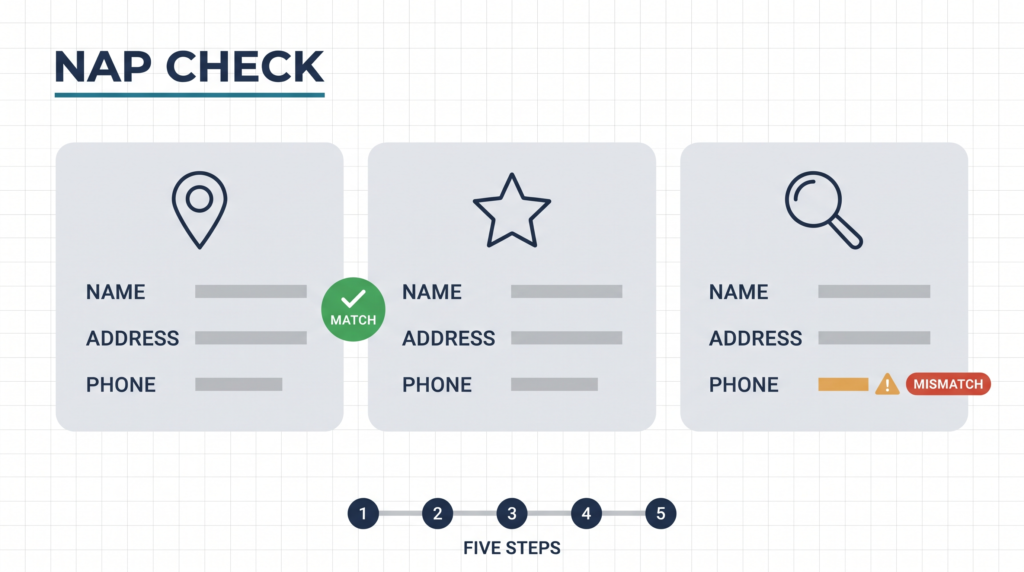
A local citation is any online mention of a business name, address, and phone number, and NAP consistency means those details agree everywhere they appear. NAP stands for Name, Address, and Phone number.
A citation needs no link or directory. A chamber of commerce page, a news article, a delivery app profile, and a Google Business Profile all count. A full NAP shows all three details; a partial mention shows only some.
What counts as a local citation
Structured citations have fixed fields, unstructured citations appear inside normal content, and partial citations miss at least one NAP detail. Directories, map apps, and review platforms create structured listings with name, address, phone, website, hours, and category. A news story or sponsor page creates an unstructured mention whose format you rarely control. Cleanup starts with structured listings, where most errors live.
If you are new to the topic, my collection of local SEO guides shows how citations sit alongside reviews, categories, and on-page signals.
What NAP consistency really means
Consistency means the same facts, not the same punctuation. Your name should read the same way, your address should point to the same door, and your phone should connect to the same line. Website, hours, and category are supporting details that help search engines confirm two listings describe one entity. Structured data on your own site should repeat the same details, and Google’s LocalBusiness documentation lists the fields it reads.
Why Inconsistent Business Data Costs You Visibility
Conflicting business details give search engines less reason to trust any single version, and they send customers to old phone numbers or closed locations. The ranking effect is indirect. The customer effect is immediate.
How search engines reconcile business details
Search engines collect business details from many sources, then decide which version looks most credible. Google describes local results as mainly based on relevance, distance, and popularity, and treats prominence as a sign of how well known a business is. A citation is not a lever that moves those factors; it is evidence for the entity behind them. When that evidence conflicts, the entity is harder to confirm, and topical authority cannot compensate.
Duplicates, lost calls, and split reviews
Duplicates cause the most visible damage because they divide reviews, photos, and questions between two pages. Google’s business profile guidelines state: “There should only be one profile per business, as this can cause problems with how your information displays on Google Maps and Search.” A customer who finds the older listing may call a dead number, and neither profile carries the full review history.
Structured and Unstructured Citations
Structured citations carry fixed fields and cause most consistency problems, while unstructured mentions add context but are harder to control.
| Type | Typical example | Who controls the format | Fix order |
| Structured | Yelp, Bing Places, Apple Business Connect | The platform | First |
| Unstructured | Local news mention, chamber page | The publisher | Later |
| Partial | Social post with a phone number | Varies | As time allows |
Unstructured mentions are harder to correct, so treat them as context rather than a to-do list.
How to Audit Local Citations and NAP Consistency in 5 Steps
Write one canonical NAP, search for every old version of your details, then check each listing against that standard and record the result in a single sheet. A written standard and a shared sheet stop the same cleanup from repeating.
Step 1: Lock your canonical NAP
Open your Google Business Profile, copy the name, address, and phone number exactly as they appear there, and treat that version as the only approved one. Then settle the format questions that cause most mismatches:
- Suite or unit number: “Suite 4” or “#4”
- Street type: “Street” or “St.”
- Business name: “LLC” included or left out
- Main phone: local number or tracked number
If the profile itself has a keyword-heavy name or an old suite number, fix that first through a proper Google Business Profile optimization process, not a one-off edit.
Step 2: Search every old version
Search your current phone number in quotes, then repeat the search with each former number, address, and business name. Add -site:yourdomain.com to hide your own pages and surface third-party listings. Check pages two and three, because scraped directories often sit there for years.
Step 3: Check core platforms and aggregators
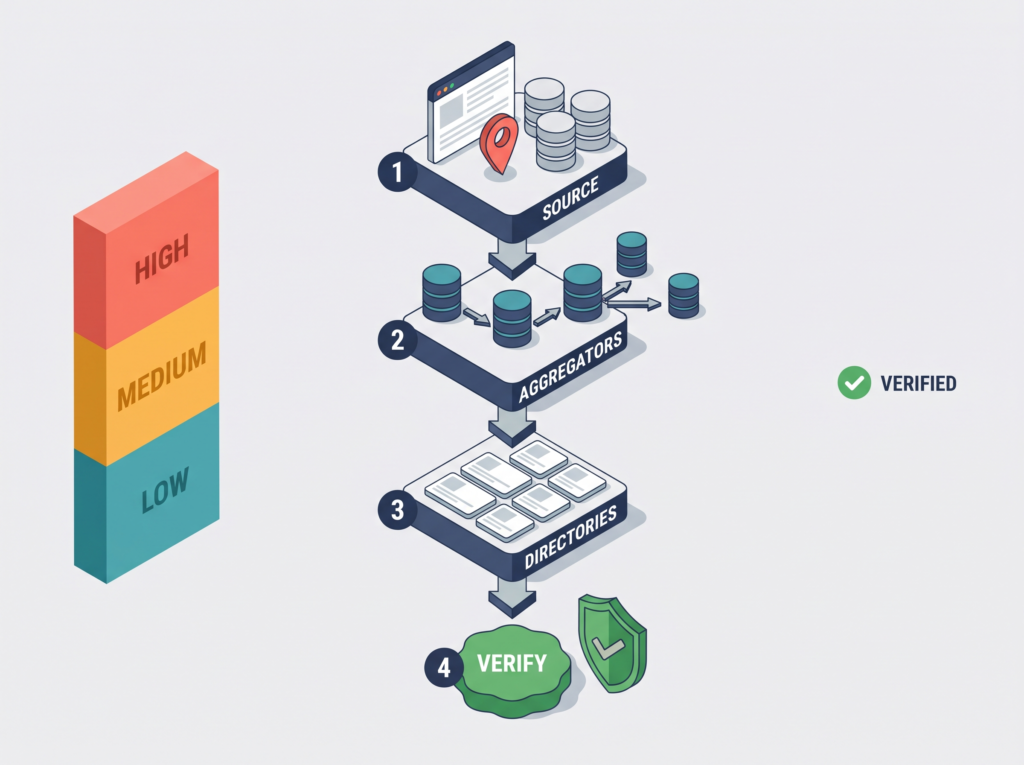
Start with the platforms most customers check, then follow the data back to the aggregators that feed smaller directories.
- Core platforms: Google Business Profile, Apple Business Connect, Bing Places, Yelp, Facebook, Better Business Bureau
- Aggregators: Data Axle, Neustar Localeze, Foursquare
An error there spreads to sites you will never visit, so give those records equal attention.
Step 4: Record findings in one sheet
Use five columns: listing URL, the field that is wrong, who can edit it, current status, and the date you last checked. Add logins and verification methods. The sheet becomes your proof of work and next quarter’s to-do list.
The Five NAP Errors Worth Fixing First
Wrong phone numbers and old addresses cause the most harm, duplicates split your signals, and formatting quirks matter least. Rank the work by consequence, not by how easy it is to fix.
| Error | Why it matters | Fix window |
| Wrong or old phone number | Customers call a dead line, and the number may now belong to another business | This week |
| Previous address | Sends customers to the wrong place and creates a second entity | This week |
| Duplicate listing | Splits reviews, photos, and ranking signals | Within two weeks |
| Name variation | Makes one business look like several | Within two weeks |
| Outdated hours or category | Sets wrong expectations and weakens relevance | Within a month |
How to Fix Citations in Priority Order
Fix the source first, then the directories that copy from it, and verify each change on the live page. Editing fifty small directories before correcting the aggregator record means the same bad data returns within weeks.
Fix the source, then the directories
Correct your website, your Google Business Profile, and the aggregator records before touching individual directories. When a directory pulls from an aggregator, its data changes on the aggregator’s schedule, not yours. Claimed listings you can edit directly usually update within days, while third-party feeds can take much longer.
What to do when you cannot claim a listing
Use the platform’s edit or support form, include the listing URL and the correction you want, and keep a screenshot with the date. If a duplicate cannot be removed, ask for a merge so reviews and photos move to the surviving listing. Some platforms rebuild duplicates from source data, so deletion without a source fix rarely lasts.
How Long Corrections Take, and Why Old Data Returns
Major platforms often update within days, while aggregator-fed directories can take weeks or months, and some old records reappear from cached feeds. Treat the first month after a fix as a monitoring period, not a finish line.
Old data returns for three common reasons: the listing was never claimed, so the platform serves its own copy; a scraper copied the wrong version years ago and still publishes it; or a duplicate was deleted rather than merged and the platform rebuilt it. Rechecking the exact pages you changed is the only reliable way to know what happened.
Does Your NAP Have to Match Exactly?
Match the underlying facts exactly, and stop treating punctuation as a ranking problem. Exact character matching sounds rigorous, but it is not what the guidelines require.
Google’s guidelines ask businesses to reflect their details accurately, and BrightLocal makes the practical point: “Today’s search engine algorithms are very smart, so you don’t need to worry about minor details, such as using slightly different abbreviations in your listings.” That does not excuse a wrong suite number or a dead phone. It does mean that a week spent changing “St.” to “Street” across forty directories is wasted.
Service Area and Multi-Location Businesses
Service area businesses should hide the street address and keep service areas consistent, while multi-location businesses need one profile, one page, and one phone number per location.
For a service area business, hide the street address, list the areas you actually serve, and keep those areas identical across platforms. Do not use a virtual office address to look local, because that risks suspension. For multiple locations, give each location its own profile and landing page with crawlable contact details, plus a tracked phone number. One shared number only works if a call center handles every call.
How Many Citations Do You Actually Need?
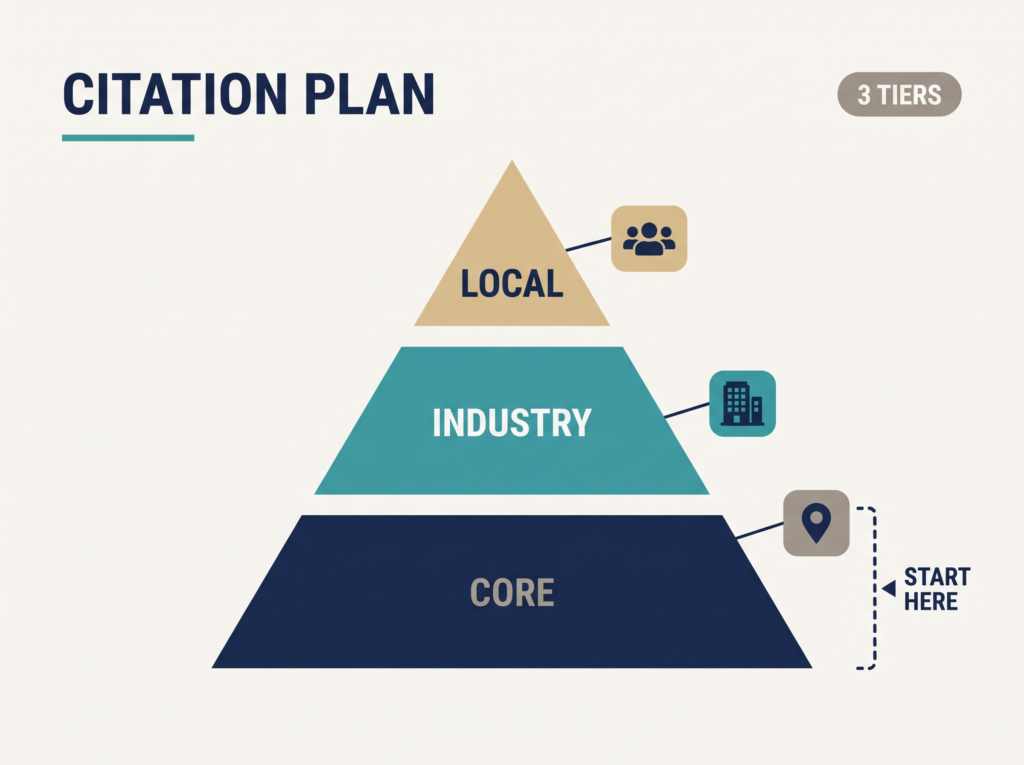
There is no fixed number, and any article that names one is guessing. The right count depends on your category, market, and how many listings you can keep accurate. A workable plan has three layers:
- Core platforms: Google, Apple, Bing, Yelp, Facebook, Better Business Bureau
- Industry directories your buyers actually use, such as health, legal, or home services portals
- Local organizations, suppliers, and events that mention real businesses
A hundred low-value listings create a hundred future maintenance tasks, and inaccurate listings cost more than missing ones.
A Quarterly Routine for Local Citations and NAP Consistency
Spend thirty minutes each quarter on the same short checklist. The routine prevents the slow drift that follows staff changes, new numbers, and platform updates.
- Search the current phone number and every old number
- Recheck the six core platforms for changed fields
- Look for new duplicate listings
- Update the date column in your audit sheet
- Rerun the check after a move, rebrand, or phone change
Conclusion
Clean business data is maintenance work, not a one-time project. Write the standard down, audit against it, fix the sources first, and recheck on a schedule. If you would rather hand the cleanup to someone who does this weekly, my local SEO service covers citation work.
Frequently Ask Questions
What is NAP consistency?
NAP consistency means a business name, address, and phone number appear the same way across its website, profiles, directories, and mentions. The goal is one verifiable set of facts, not identical punctuation.
Why does NAP consistency matter for local SEO?
Consistent details help search engines confirm that several listings describe one business. Conflicts weaken that confirmation, create duplicates, and send customers to outdated contact information.
How do I check my NAP consistency for free?
Search your phone number and address in quotes, then review each result. Start with Google, Apple Business Connect, Bing, Yelp, Facebook, and the Better Business Bureau, and log every mismatch.
Do small differences like St. versus Street hurt local rankings?
Usually not. Search engines treat common abbreviations as equivalent, so a missing period rarely matters. Wrong suite numbers, dead phones, and duplicates are the real problems.
How many local citations does a business need?
No fixed number exists. Most businesses need the core platforms, industry directories, and a few genuine local mentions. Accuracy and maintenance capacity matter more than volume.
Does fixing citations improve Google Maps rankings?
It can help, but no one can promise a ranking change. Google describes local results as mainly based on relevance, distance, and popularity. Cleanup supports the entity behind those factors.
How long do citation corrections take to appear?
Claimed listings often update within days. Aggregator-fed directories can take weeks or months, and some refresh only when their partner feed runs. Recheck the pages you changed.
Should I pay for a citation building service?
Pay when the list is large, the business has moved several times, or nobody internally owns the work. For one location with a short list, a spreadsheet is cheaper.
Do citations matter for AI search and chat assistants?
They can, because assistants pull business details from directories, maps, and websites. Consistent details reduce the chance of an assistant repeating an old phone number. No formatting trick guarantees a recommendation.
How often should I audit local citations?
Quarterly suits most single-location businesses, and monthly monitoring suits multi-location teams. Audit immediately after a move, rebrand, or phone change.