Local Keyword Research for Oman: 7 Smart Steps For Results
Learn how to research local keywords in Oman with seven practical steps. Discover relevant search terms, understand customer intent, organise service and location pages, optimise your Google Business Profile, and measure SEO performance.

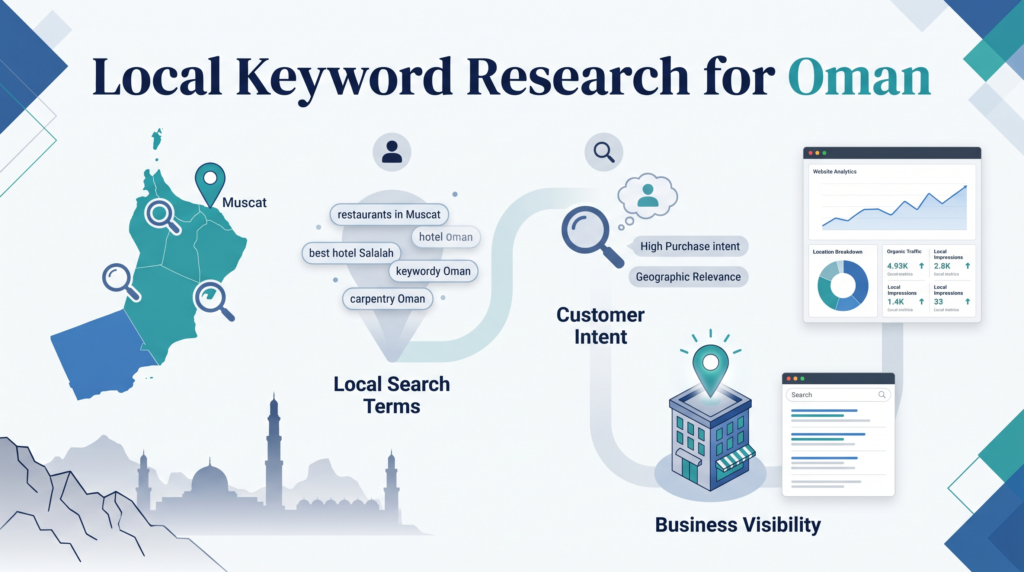
Local Keyword Research for Oman helps businesses identify the search terms people use when looking for nearby services, products, and providers. The goal is not to collect the largest possible list of keywords. It is to find relevant searches, understand what people need, and connect those searches to the right website pages and Google Business Profile (GBP).
A business serving Muscat may need a different keyword plan from one targeting Sohar, Salalah, Nizwa, or several cities across Oman. Language, location, service type, and search intent all affect which terms are worth targeting.
This guide explains a practical seven-step process for researching local keywords, organising them by intent, and using them to improve a local SEO strategy without stuffing pages with repetitive phrases.
TL;DR: Start with your services and target locations, then expand keyword ideas using search tools and real customer language. Group terms by intent, assign them to relevant pages, connect website content with your Google Business Profile, and measure performance using real search data.
What Is Local Keyword Research and Why Does It Matter in Oman?
Local keyword research is the process of finding and evaluating search terms people use when they need a business in a particular place. It helps a business understand how customers describe their needs, which locations they mention, and what information they expect to find.
For example, someone may search for “plumber in Muscat,” “AC repair near me,” or “Arabic-speaking dentist in Sohar.” Each query gives clues about the service, location, and customer requirement.
The purpose is to connect those clues to useful pages and accurate business information. A keyword list alone does not improve visibility. The business still needs relevant content, a well-structured website, a trustworthy business profile, and a service that matches the searcher’s needs.
Why local search terms differ between businesses
Two businesses in the same city can need different keyword plans. A plumbing company may focus on emergency repairs, leak detection, and water heater installation. A dental clinic may need terms related to check-ups, orthodontics, and specific treatments.
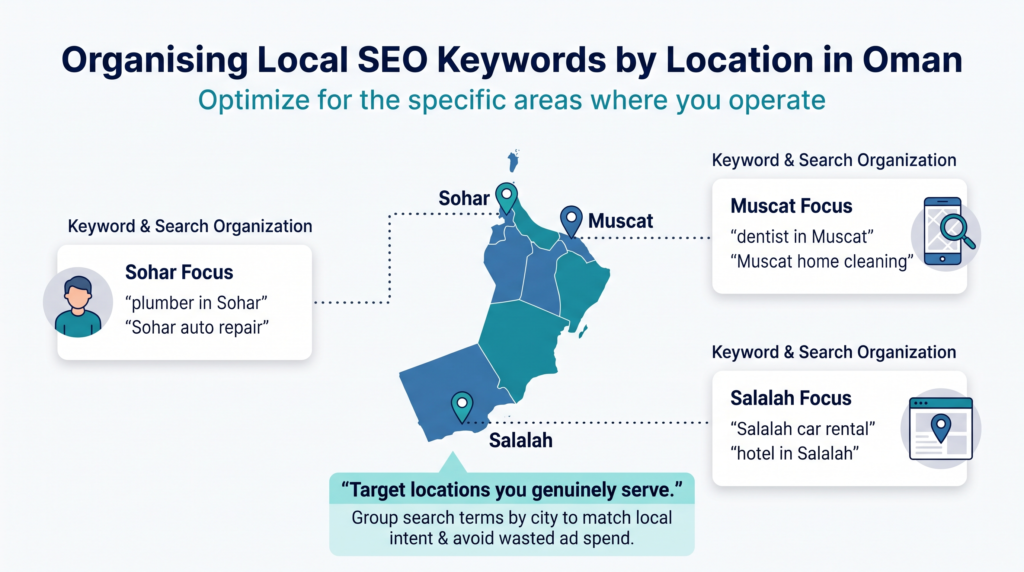
The target area also matters. A company serving customers only in Muscat should not build its entire strategy around searches for Salalah or Sohar unless it genuinely serves those areas. Keyword selection should reflect real services and actual service coverage.
Step 1: Define Your Services, Customers, and Target Areas
Start by documenting what the business offers, whom it serves, and where it can realistically provide the service. This creates a useful foundation before you open any keyword tool.
List every core service
Write down the services customers can actually book or buy. Be specific enough to distinguish different needs.
For example, an air-conditioning company might offer:
- AC installation
- AC repair
- AC maintenance
- Duct cleaning
- Commercial HVAC services
These services may share a broad category, but customers searching for a repair do not necessarily want an installation page. Keep the service list aligned with the business’s real offering.
Map the locations the business genuinely serves
For an Oman-based company, possible location modifiers include Muscat, Sohar, Salalah, Nizwa, Sur, Barka, Duqm, and Al Buraimi. These are research starting points, not a recommendation to target every city.
Create a simple service-area table:
| Business detail | Example |
| Main service | AC repair |
| Primary location | Muscat |
| Additional area | Seeb, if genuinely served |
| Customer type | Homeowners and businesses |
| Main action | Call or request a quote |
| Service availability | Emergency and scheduled repairs, if offered |
Use the business’s actual coverage rather than adding locations solely because they look promising as keywords. A page for a city where the company has no meaningful presence or service capability may mislead customers and produce weak content.
Understand the customer before selecting phrases
Consider what customers need to know before contacting the business. They may want an estimated price, availability, service details, business hours, or help with an urgent problem.
Customer questions often reveal more useful keyword ideas than broad industry terms. Ask sales staff what people say on calls, review legitimate customer enquiries, and note the phrases customers use when describing their problems.
Result of Step 1: A service list, realistic location list, target audience, and set of customer needs to guide the research.
Step 2: Build Keyword Ideas Using Tools and Real Search Language
Once the business and target areas are clear, expand the seed terms into a larger list of possible searches. Use tools to discover variations, but do not assume every suggestion has meaningful demand.
Start with seed keywords
A seed keyword is a short phrase describing a service or business. For an Oman-based business, examples could include:
- plumber Muscat
- AC repair Oman
- dentist Sohar
- pest control Salalah
- website design Oman
- local SEO Muscat
These are starting ideas, not verified search-volume findings. Their value depends on the business, the actual search results, and the needs of local customers.
Use Google Keyword Planner carefully
Google Keyword Planner can help generate related keyword ideas and provide estimates for search activity. Set the target location and language as closely as the tool allows to the intended audience.
For location and language options, consult Google’s guide to location and language targeting.
Keep in mind that advertising estimates are not a guarantee of organic search demand or SEO performance. A term with an attractive estimate may still be irrelevant, highly competitive, or too broad for the page you want to create.
Check Google Search suggestions and related questions
Enter a seed term into Google and observe the autocomplete suggestions and related questions that appear. These can reveal common ways people express a need.
For example, research around AC repair might suggest variations involving prices, emergency service, maintenance, or specific locations. Record the phrases you can actually observe; do not describe an idea as a live suggestion unless you have seen it in the search results.
Review relevant competitor pages as well. Notice the services they explain, the questions they answer, and the terminology they use. Use these observations to identify missing information—not to copy their text or assume their keyword rankings.
Review your own search data
If the site already receives impressions, Google Search Console can show queries associated with its pages. Use the Performance report documentation to understand the available data.
Existing queries can reveal terms that the site already appears for, including variations you may not have considered. Treat the data as evidence about your site’s visibility, not a complete record of every search made in Oman.
Result of Step 2: A working keyword list built from tools, customer language, search observations, and any available first-party search data.
Step 3: Research English and Arabic Search Terms
Oman’s audience may use English, Arabic, or a mixture of both when looking for local businesses. Research language choices based on the customers a business serves rather than assuming that one language fits every market.
Create separate language groups
For each important service, investigate relevant English and Arabic terms. A business serving Arabic-speaking customers may need Arabic service descriptions and landing-page content. A company whose customers commonly search in English may need a strong English-language page. Some businesses will benefit from both.
Do not translate a phrase word for word and assume it is how customers search. A natural translation may not match the wording used in real queries. Check local terminology, ask staff who communicate with customers, and compare candidate phrases in search results.
Consider bilingual content carefully
A bilingual website can help a business communicate with different audiences, but the structure should remain clear. If separate English and Arabic pages are needed, each should offer useful content in its language and guide visitors to the appropriate service or contact option.
Avoid publishing several nearly identical pages that differ only by a city name or a few translated words. Each page should have a clear purpose and meet the needs of its intended audience.
Include language as a research attribute
Add a language column to your keyword sheet. This allows you to distinguish English terms, Arabic terms, and phrases that need further validation. You can then decide whether a term belongs on an existing page, a properly structured language version, or nowhere yet.
Result of Step 3: A language-aware keyword list that reflects real customer communication instead of relying on literal translations.
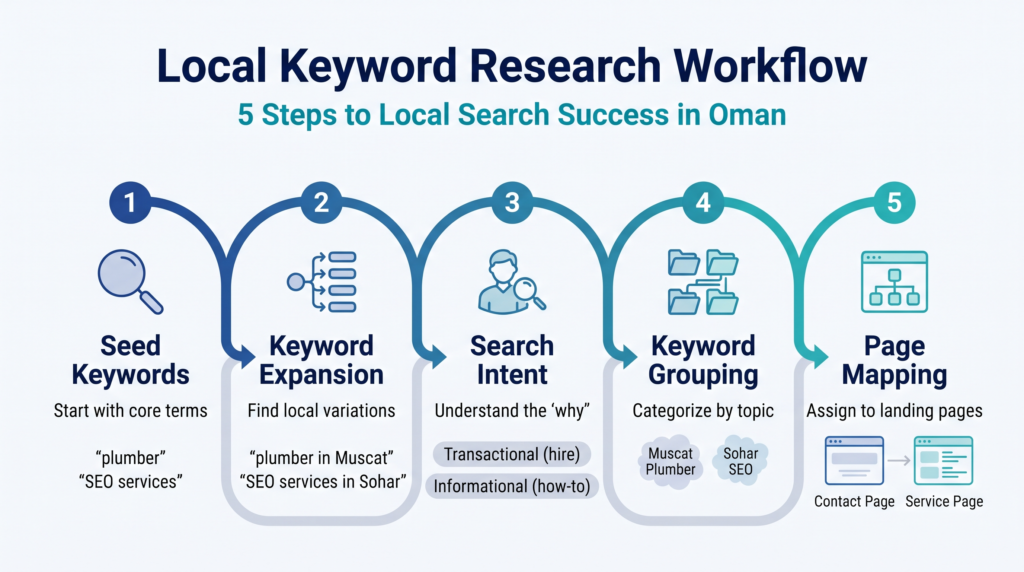
Step 4: Group Keywords by Search Intent and Business Value
Keyword grouping means organising related searches by the need behind them. This helps prevent a website from creating multiple pages that compete to answer the same question.
Separate service, location, and information intent
A local keyword list may include several kinds of searches:
| Intent group | Example query | Likely content |
| Service-focused | AC repair | AC repair service page |
| Location-focused | AC repair in Muscat | Muscat service page, if justified |
| Transactional | Emergency plumber Muscat | Relevant emergency service page |
| Informational | How often should AC be serviced? | Helpful blog post |
| Commercial research | Website design company Oman | Service or comparison-oriented page, based on intent |
| Brand-focused | Business name and phone number | Accurate contact and business information |
These examples illustrate how to classify a query; they are not claims about search volume in Oman. Review the actual search results and customer needs before deciding which page format is appropriate.
Prioritise relevance over volume alone
A broad term can attract a large audience but may not lead to relevant enquiries. A more specific phrase may better reflect what the business offers.
Evaluate each keyword against four questions:
- Does it describe a service the business provides?
- Does it match a location the business genuinely serves?
- Does it indicate a need the page can satisfy?
- Is there a sensible next step for the visitor, such as calling, booking, or reading further?
A keyword that fails these checks should not become a priority simply because a tool suggests search activity.
Avoid overlapping keyword targets
Suppose a company offers AC repair and AC installation in Muscat. These services may need separate pages because the needs are different. However, creating multiple pages with slightly different versions of “AC repair Muscat” may lead to repetitive content without giving users a distinct reason to visit each page.
Group close variants under one main topic when they express essentially the same need. Create a separate page when the service, audience, location, or intent justifies a genuinely different resource.
Result of Step 4: A smaller, organised keyword set grouped by customer need, with priorities based on relevance and business value.
Step 5: Map Each Keyword Group to the Right Website Page
Keyword mapping assigns each priority topic to a page that can satisfy the searcher’s intent. It turns a keyword spreadsheet into a content plan.
Assign one primary topic to each page
Each page should have a clear main purpose. Related secondary terms can support that purpose naturally, but the content should not try to answer every possible query on the website.
For example:
| Page type | Primary topic | Supporting content |
| Main service page | AC repair in Oman, if the page serves that scope | Repair types, process, service coverage |
| City service page | AC repair in Muscat | Relevant local coverage, availability, contact details |
| Supporting blog | Signs your AC needs repair | Symptoms, practical guidance, when to contact a technician |
| Contact page | Contact the business | Phone, enquiry form, accurate business details |
The main service page should explain the offering. A city page should provide genuinely useful information about service delivery in that area. A blog post should answer an informational question rather than repeat a sales page.
Build local pages only when they provide value
A business that serves multiple locations may need dedicated location pages. Those pages should explain the actual service, relevant coverage, and information customers need in each place.
Avoid publishing dozens of pages where only the city name changes. Thin or near-duplicate location pages can frustrate users and fail to provide a clear reason for each page to exist. Do not claim a local office, team, address, or project history unless it is accurate.
Connect the keyword plan to site structure
Use descriptive page titles, clear headings, readable URLs, and helpful internal links. A service page should link to related information where it helps visitors, while supporting articles can point readers toward the relevant service.
For broader guidance on planning connected topics and content, see this article on semantic SEO and the guide to content strategy briefs.
If you are reviewing a website’s broader organic visibility, a relevant website SEO service in Oman page explains the related service offering.
Result of Step 5: A keyword-to-page map that clarifies what each page should target and how the pages support one another.
Step 6: Align Website Keywords With Your Google Business Profile
A local keyword plan should support both the website and the business’s Google Business Profile where the business is eligible for a profile. The aim is consistent, accurate information—not adding keywords to every available field.
Keep business details accurate
Check that the business name, address or service-area information, phone number, website, hours, and services are accurate. Use the real business name rather than adding extra search terms to it.
Google explains the main factors that influence local results in its guidance on how to improve local ranking. Relevance, distance, and prominence all matter. Keyword research can help clarify relevance, but it cannot control a searcher’s distance or guarantee a particular ranking.
Match services to real customer searches
Review the services offered on the profile and make sure they reflect the business’s actual work. Use natural service names and provide useful details where the profile allows them. Do not add unrelated services simply to appear for more searches.
The website and profile should reinforce one another. If the profile links to an AC repair page, that page should explain AC repair clearly. If the business serves Muscat, its content should describe its real service coverage rather than imply it has locations across Oman without evidence.
For more detail on profile-related work, see the Google Business Profile optimization service in Oman.
Do not treat keywords as a substitute for trust
A keyword-rich profile cannot compensate for incorrect information, poor customer experience, or an unhelpful website. Reviews, accurate hours, relevant services, useful photos, and responsive customer communication can all contribute to how customers evaluate a business. Follow Google’s guidelines and avoid fake reviews or misleading business details.
Result of Step 6: A more consistent relationship between the website’s service content, the business profile, and the needs expressed in local searches.
Step 7: Measure Performance and Refine the Keyword Plan
Keyword research is not a one-time task. Once pages are published or improved, review performance and update the plan based on evidence.
Track queries, impressions, clicks, and conversions
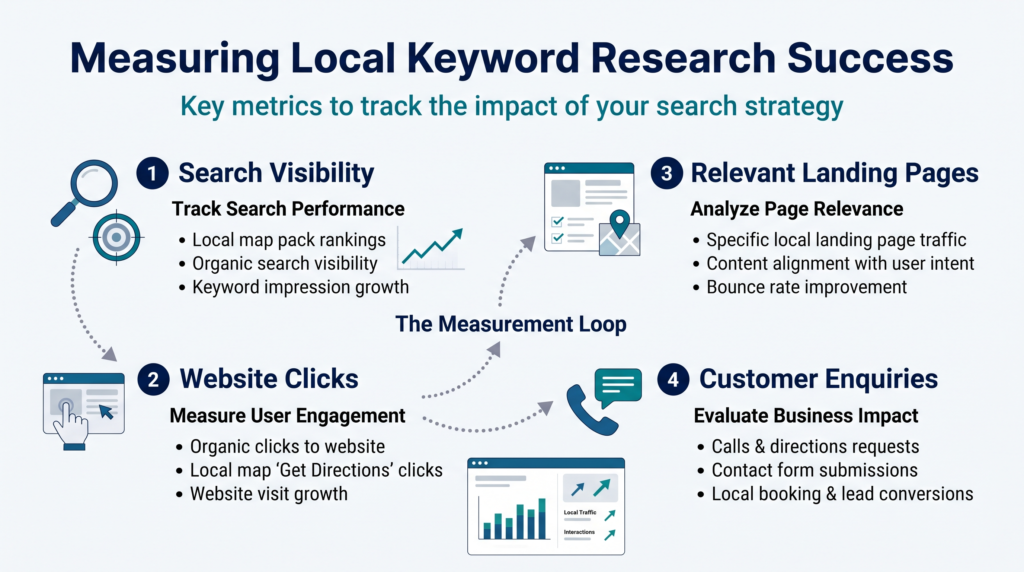
Use Google Search Console to review the queries that produce impressions and clicks, which pages appear in search results, and how performance changes over time. Compare similar periods carefully and consider changes to the website, seasonality, and other factors that may affect demand.
Search Console does not tell you every detail about a visitor’s intent, and impressions do not automatically translate into enquiries. Combine search data with meaningful business outcomes when you can measure them.
Useful measures may include:
- Search impressions and clicks for relevant queries
- Organic visits to priority service pages
- Calls, form submissions, or booking requests from organic visitors
- Whether enquiries relate to services and areas the business actually serves
- Pages that receive impressions but do not attract relevant visits or enquiries
Use analytics and call tracking only where they are properly configured and respect applicable privacy requirements. Keep the measurement process consistent so you can compare results over time.
Find gaps before creating new pages
If a service page receives impressions for a relevant phrase, examine whether the page answers that need clearly. It may need a better explanation, clearer service details, stronger internal links, or a more useful title.
If an important service has little visibility, check the basics before publishing more pages. Confirm that the page can be indexed, is internally linked, has a clear purpose, and provides useful content. Keyword selection is only one part of organic search performance.
Revisit language and location assumptions
Search behaviour can vary by service and audience. Review which terms are actually appearing in Search Console and which pages attract useful enquiries. Update the keyword sheet when customer language, services, or coverage changes.
Do not create a separate page for every new query. Some terms belong in an existing page’s content, while others may deserve a separate resource only if the user intent is meaningfully different.
Result of Step 7: A repeatable process for refining keyword priorities, improving existing pages, and identifying worthwhile content opportunities.
Common Mistakes to Avoid When Researching Local Keywords in Oman
Good keyword research depends as much on what you leave out as on what you include.
Choosing keywords based only on search volume
Search volume estimates can be useful, but a large number does not guarantee relevant leads. Prioritise phrases that match the business’s services, location, and customer needs.
Targeting places the business does not serve
Adding city names without a genuine service connection can mislead visitors. Keep location targeting aligned with actual operations and the information the business can support.
Translating keywords without local validation
Literal translations may not match how customers speak or search. Validate terms with local customer language, search results, and relevant first-party data wherever possible.
Publishing near-duplicate location pages
Changing a city name while leaving the rest of the page almost identical rarely creates meaningful value. Each location page needs a real purpose and useful, accurate details.
Stuffing keywords into pages or profile fields
Repeating a phrase unnaturally can make content harder to read. Use the primary term where it makes sense, then explain the service clearly with natural variations. Do not use keyword density as a substitute for quality.
Google’s guidance on creating helpful, reliable, people-first content is a useful reference when reviewing whether a page serves readers rather than simply targeting queries.
Conclusion
Effective local keyword research begins with the business’s real services, target customers, and service areas. The process then expands keyword ideas, validates English and Arabic terms, groups queries by intent, maps them to suitable pages, aligns website content with the Google Business Profile, and measures the results.
For a business in Oman, the most useful keyword plan is not necessarily the longest one. It is the one that helps the right customers find accurate information about the services they need in the places the business genuinely serves.
Start with one important service and one primary location. Research the language customers use, map the best keyword group to the most suitable page, and improve that page before expanding the plan. Over time, use real search and enquiry data to guide the next improvement rather than assuming every keyword deserves its own page.
Frequently Asked Questions
1. What is local keyword research for Oman?
Local keyword research for Oman is the process of identifying search terms people use to find services and businesses in specific Omani locations. It considers service relevance, language, location, customer intent, and the pages that can answer those searches.
2. Which tools can I use for local keyword research?
Google Keyword Planner, Google Search, and Google Search Console are useful starting points. Keyword Planner helps generate ideas and estimates, Google Search reveals visible suggestions and results, and Search Console shows queries associated with your site’s performance.
3. Should I target “Oman” or a specific city?
Choose the location based on the business’s actual coverage and the searcher’s likely need. A business serving customers throughout the country may need broader national content, while a service provider focused on Muscat may benefit more from a relevant Muscat page. Do not target locations without a genuine service connection.
4. Should I research Arabic and English keywords separately?
Yes, when the business serves audiences that search in both languages. Research each language using natural local phrasing rather than relying only on direct translations. Then decide whether separate language pages or a single-language page best serves the audience.
5. How do I choose the best local keyword?
Choose a phrase that accurately describes the service, matches the intended location, reflects the customer’s need, and can be answered by the page. Search volume and competition estimates can help, but relevance and intent should guide the final choice.
6. Should every service have a separate page?
Create separate pages when services meet different needs and require different explanations. For example, installation and repair may deserve separate pages. Avoid splitting closely related terms into multiple pages if those pages would provide essentially the same information.
7. Do I need a separate page for every city in Oman?
No. Create a location page when the business genuinely serves that area and can provide useful, accurate information for customers there. Do not generate near-identical pages for every city simply to include more location keywords.
8. How does keyword research support a Google Business Profile?
It helps you understand the services and customer needs that should be represented accurately in the profile and on the linked website. Keyword research does not replace Google’s profile guidelines or guarantee local rankings.
9. How often should I update my keyword research?
Review it after meaningful changes to services, locations, website pages, or customer demand, and periodically check Search Console data. The right review schedule depends on how quickly the business and its search performance change.
10. Can local keyword research guarantee higher Google rankings?
No. Keyword research can improve relevance and help organise useful content, but rankings also depend on factors such as location, competition, business prominence, and the quality of the result. No keyword plan can guarantee a specific ranking or number of leads.