Local Pack Ranking Factors Explained: What Actually Moves Your Rankings
A practical breakdown of the local pack ranking factors that matter, covering Google Business Profile signals, reviews, proximity, and behavioral engagement.

Local pack ranking factors determine which three businesses Google shows at the top of a local search result, above the standard organic listings. For any business owner or marketer managing local visibility, understanding these factors is the first step toward appearing in that coveted 3-pack. This guide breaks down what actually influences local pack placement, based on Google’s own published guidance and how local SEO practitioners interpret it in practice.
What Is the Local Pack and Why It Matters
The local pack is the block of three business listings Google displays alongside a map for location-based searches, such as “plumber near me” or “dentist in Muscat.” It sits above traditional organic results, which means it captures a large share of clicks before a searcher ever scrolls further down the page.
How the Local Pack Differs From Local Organic Results
The local pack and local organic results are ranked differently, even though they often appear on the same search results page. Local organic rankings behave more like traditional SEO, weighted toward website content, backlinks, and on-page optimization. Local pack rankings lean more heavily on Google Business Profile signals and the searcher’s physical location. A business can rank well in one without ranking well in the other.
Why Ranking in the Local Pack Drives More Clicks
Businesses that appear in the local pack typically receive a disproportionate share of clicks compared to standard organic listings for the same query. The map, business name, and star rating are visible without any scrolling, which makes the local pack a high-value target for any business that depends on nearby customers.
Google’s Three Core Local Pack Ranking Factors
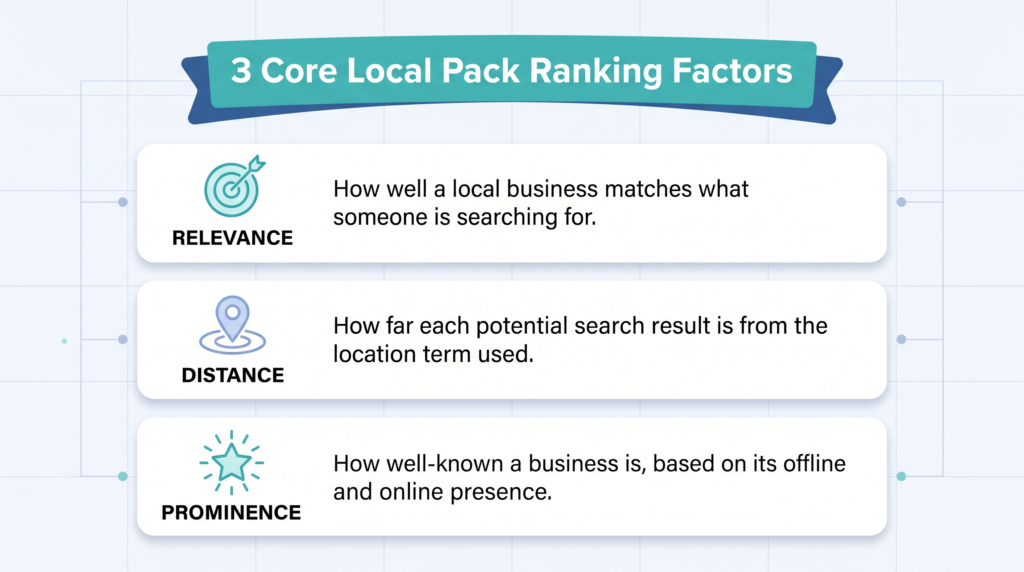
According to Google’s official local ranking guidelines, local search rankings are primarily determined by relevance, distance, and prominence. Every other signal discussed in local SEO research ultimately feeds into one of these three categories.
Relevance: Matching Search Intent
Relevance measures how well a business profile matches what the searcher is looking for. This depends on the accuracy of the business category, the services or products listed, and how closely the business description aligns with the search query.
Distance: Proximity to the Searcher
Distance refers to how close a business is to the location used in the search, whether that’s the searcher’s current location or a location typed into the query. Distance is widely considered one of the most influential ranking factors, and it is also the factor businesses have the least direct control over.
Prominence: How Well-Known Your Business Is
Prominence reflects how recognized a business is, both online and offline. Review volume, average rating, backlinks, citations, and general brand visibility all contribute to prominence. A business with strong prominence can sometimes outrank a closer competitor with weaker signals.
Local Pack Ranking Factors Explained: Google Business Profile Signals
Among all this ranking factors, Google Business Profile completeness and accuracy consistently rank as the most influential. A fully optimized, accurate profile gives Google clear signals about what a business offers and where it operates.
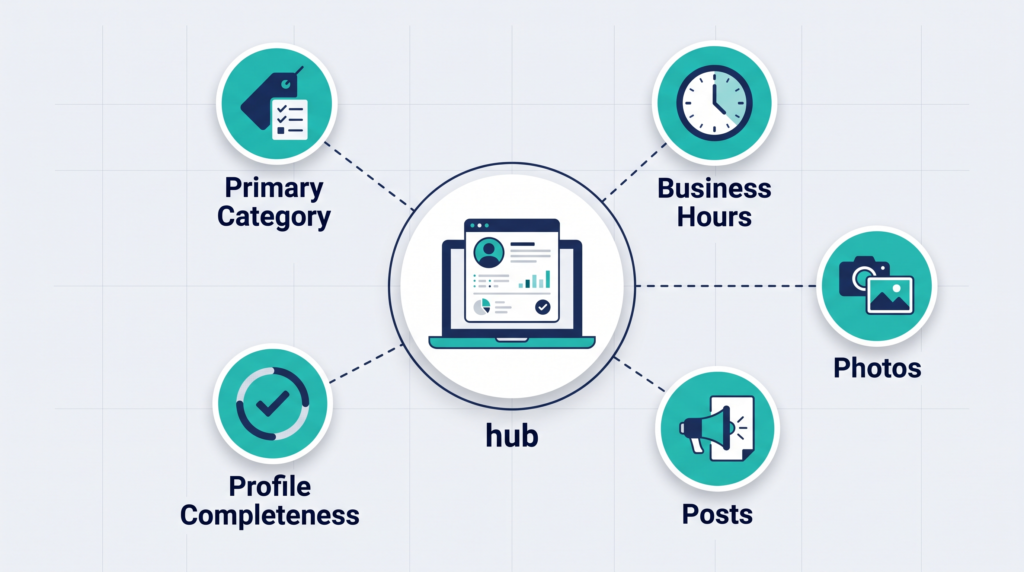
Primary Category Accuracy
Choosing the correct primary category is one of the clearest relevance signals a business can send. An inaccurate or overly broad category can prevent a business from appearing for its most valuable search queries, even if every other signal is strong.
Business Name, Hours, and Attributes
Consistent business name formatting, accurate operating hours, and relevant attributes (such as wheelchair accessibility or outdoor seating) all contribute to how well Google understands and trusts a profile. Inconsistent or outdated information can quietly erode local pack visibility over time.
Photos, Posts, and Profile Completeness
Profiles with regularly updated photos and posts tend to show stronger engagement signals. While a single photo won’t move rankings on its own, a consistently maintained profile supports both relevance and prominence over time.
Review Signals and Their Role in Local Pack Rankings
Review signals are one of the fastest-moving categories among local pack ranking factors, and their influence has grown in recent years.
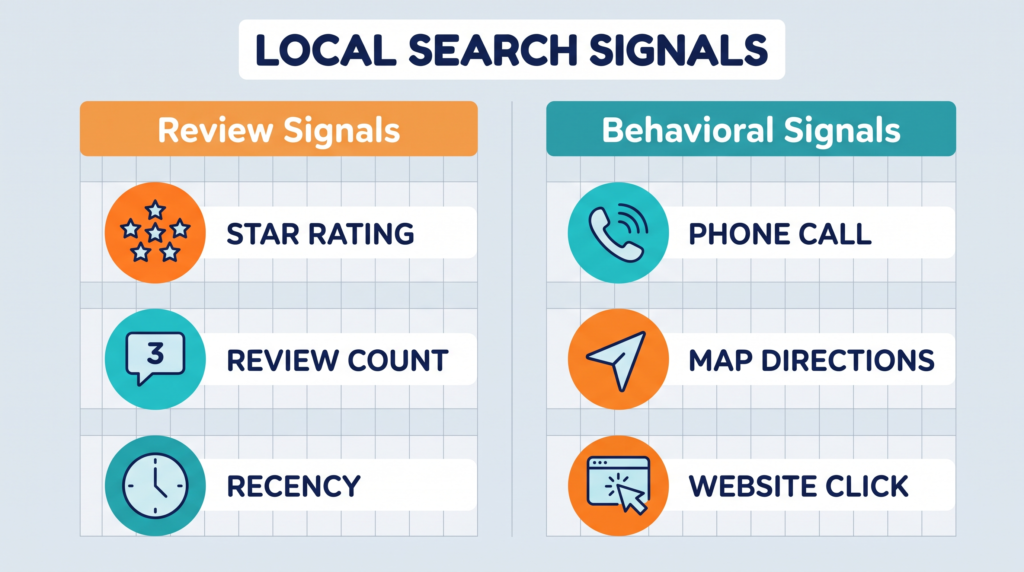
Review Volume and Average Rating
A higher volume of reviews, combined with a strong average rating, signals prominence to Google and builds trust with searchers. Businesses don’t need a perfect five-star rating; consistency and volume often matter more than a flawless score.
Review Recency and Velocity
Recent reviews tend to carry more weight than older ones, since they reflect the current state of a business. A steady, natural flow of new reviews is generally more effective than a large batch collected all at once.
Responding to Reviews
Responding to reviews, both positive and negative, demonstrates active business management. While a response itself may not directly move rankings, it supports the broader prominence and trust signals that do.
On-Page and Website Signals That Support Local Pack Rankings
Website signals carry less weight in the local pack than in local organic results, but they still matter, particularly for relevance.
NAP Consistency Across the Web
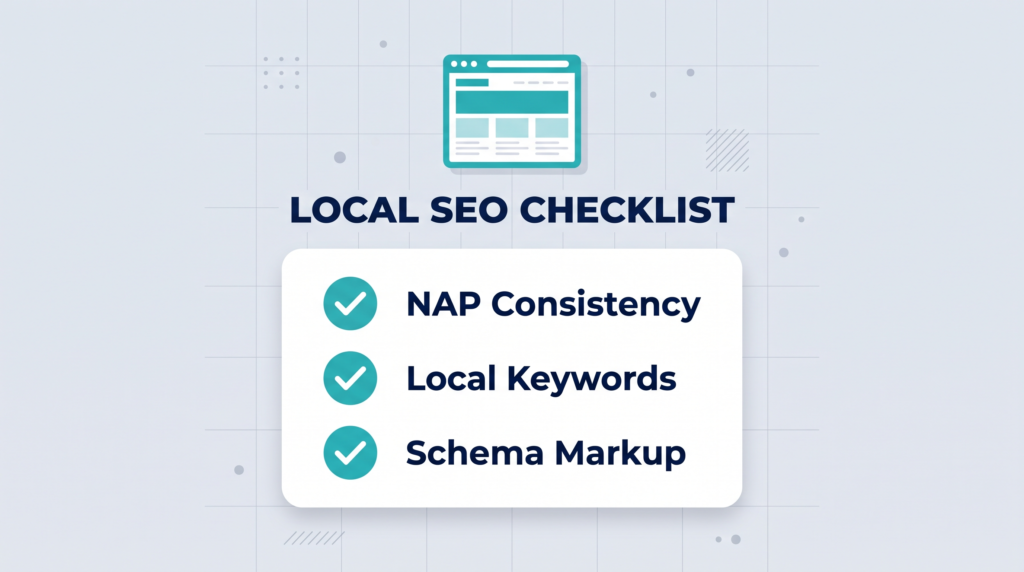
NAP, which stands for name, address, and phone number, should match exactly across a business website, Google Business Profile, and any directories or citations. Inconsistent NAP data can create confusion for Google about which business information is accurate.
Local Keywords in Titles and Content
Using local SEO content writing that naturally reflects location and service terms helps reinforce relevance. This should read naturally rather than forcing a city name into every heading.
Local Business Schema Markup
Schema markup gives search engines structured data about a business, including its address, hours, and service area. While schema alone won’t guarantee local pack placement, it removes ambiguity that could otherwise weaken relevance signals.
Proximity and Distance: What You Can and Can’t Control
Distance is one of the ranking factors a business has the least ability to change directly, which makes it important to understand its limits.
Why Distance Is Hard to Influence Directly
A business’s physical address is fixed, and Google uses that location, along with the searcher’s location, to calculate proximity. No amount of content or reviews will change the physical distance between a business and a searcher.
Strategies to Compete Despite Distance
Businesses farther from a searcher’s location can still compete by strengthening relevance and prominence. A well-optimized profile with strong reviews and clear service area information can sometimes offset a distance disadvantage, particularly for service-area businesses that don’t rely on foot traffic.
Behavioral Signals: Clicks, Calls, and Direction Requests
Behavioral signals reflect how real users interact with a business listing, and their influence on this factors has increased.
How User Actions Feed the Ranking Model
Clicks, calls, website visits, and direction requests all provide Google with data about how useful a listing is to searchers. A profile that consistently drives engagement sends a positive signal, independent of reviews or on-page content.
Improving Engagement on Your Listing
Clear photos, an accurate category, complete business hours, and a compelling business description all make a listing more likely to earn a click or a call. Small improvements to profile completeness often lead to measurable gains in user engagement.
Citations and Backlinks: Still Relevant?
Citations and backlinks remain part of the local pack ranking factors conversation, though their relative weight has shifted compared to earlier years.
Local Citation Consistency
Accurate, consistent citations across directories still support prominence and trust, particularly for newer businesses that haven’t yet built a strong review history or backlink profile.
The Shrinking Weight of Backlinks in Local Pack
Backlinks continue to matter more for local organic rankings than for the local pack itself. For local pack visibility specifically, Google Business Profile completeness, reviews, and behavioral signals tend to carry more direct influence.
Common Mistakes That Hurt Local Pack Rankings
Many businesses unintentionally damage their own local pack visibility through avoidable errors.
Inconsistent or Incomplete GBP Data
An incomplete profile, an inaccurate category, or mismatched NAP data across the web can quietly suppress visibility, even when other signals are strong.
Ignoring Reviews and Engagement
Failing to respond to reviews or letting a profile go stale for months at a time can weaken prominence signals over time, even if the business itself hasn’t changed.
How to Track Local Pack Performance
Tracking local pack performance requires tools built specifically for location-based rank tracking, since standard keyword rank trackers don’t capture map-based results accurately.
Grid Tracking Tools
Grid-based rank tracking tools show how a business ranks across multiple points surrounding its location, offering a more complete picture than a single search from one location.
Monitoring Key Local Metrics Over Time
Tracking review growth, profile views, and direction requests alongside pack ranking position helps identify which improvements are actually influencing visibility.
Conclusion
Local pack ranking factors come down to three core principles: relevance, distance, and prominence. Google Business Profile accuracy, review signals, consistent website information, and genuine user engagement all feed into these principles in different ways. No single factor guarantees a spot in the local pack, but consistent, accurate profile management gives a business the best foundation to compete for local visibility.
FAQs
What are the most important local pack ranking factors?
Google Business Profile accuracy, review signals, proximity to the searcher, and behavioral engagement are generally considered the most influential ranking factors.
How is the local pack different from local organic results?
The local pack relies more heavily on Google Business Profile signals and proximity, while local organic results depend more on traditional website SEO factors like content and backlinks.
Can a business improve its distance ranking factor?
A business’s physical address can’t be changed to improve distance, but strengthening relevance and prominence can help offset a distance disadvantage.
Do reviews really affect local pack rankings?
Yes, review volume, average rating, and recency are widely recognized as meaningful factors that also influence searcher trust.
How important is the Google Business Profile category?
Choosing the correct primary category is one of the clearest relevance signals and can significantly affect which searches a business appears for.
Does website content matter for local pack rankings?
Website content matters more for local organic rankings, but accurate, consistent on-page information still supports relevance in the local pack.
What is NAP consistency and why does it matter?
NAP consistency means a business’s name, address, and phone number match exactly across its website, Google Business Profile, and online directories, which helps Google trust the business information.
Do backlinks still matter for local pack rankings?
Backlinks have more influence on local organic rankings than on the local pack itself, though they still contribute to overall prominence.
How can a business track its local pack ranking position?
Grid-based local rank tracking tools show ranking performance across multiple points around a business location, offering a more accurate picture than a single search.
How often should a Google Business Profile be updated?
Regular updates, including new photos, accurate hours, and periodic posts, help maintain profile completeness and support ongoing prominence signals.