Service Page Copywriting: How to Write Service Pages That Convert
Learn how to write service pages that convert. This guide covers seven steps, a pre-publish checklist, and extra care rules for health, finance, and legal pages.

Service page copywriting is the practice of writing a page that helps the right visitor understand one service, trust the provider, and take one clear next step. A service page converts when it answers the visitor’s main questions in the order they ask them. This guide explains how to write service pages that convert, using seven steps, a pre-publish checklist, and extra care rules for sensitive industries.
A service page that converts names the service and the outcome, answers buyer questions in order, states what is included, shows only real proof, and asks for one next step. Write for people first, then check keywords, structure, and facts.
What Is Service Page Copywriting and Why Does It Affect Conversions?
Service page copywriting is writing the words on a page that sells one specific service, so a visitor becomes an enquiry, a booking, or a purchase. A conversion is any completed action you want, such as a form submission, a phone call, or a quote request. The copy affects conversions because visitors decide within seconds whether the page matches their problem, and unclear wording gives them a reason to leave.
Good copy does three jobs. It confirms the visitor is in the right place, it removes doubt about the provider and the process, and it makes the next step easy. Design, speed, and pricing also matter, but the words carry an explanation that no layout can replace.
I work in Local SEO, Google Business Profile optimization, website structure, and content briefs, so I treat each service page as one part of a larger site rather than a standalone sales letter. The page has to fit the site’s structure, the searcher’s intent, and the business’s real capacity to deliver.
How is a service page different from a blog post?
A service page helps a visitor decide to hire or buy, while a blog post helps a visitor learn. A blog post can cover a broad question and point readers to several next steps. A service page focuses on one offer, one audience, and one action. The two work together: blog posts answer early questions, then link to the service page for readers who are ready to act.
What Should You Decide Before Writing a Service Page?
Decide the reader, the search intent, and the single action before you write any copy. Writing without these decisions produces generic pages that try to please everyone and convince no one. Spend the first hour on answers, not on sentences.
Who is the reader and what problem do they have?
The reader is the specific person who searches for your service, and their problem is the situation that made them search. Collect their words from sales calls, emails, reviews, and support messages. A homeowner with one leaking pipe and a property manager with ten leaking buildings need different copy, even when the service is the same.
What search intent should the page match?
Most service page searches have commercial intent, which means the searcher is comparing providers and wants to know whether you fit. Check the search results for your target phrase and note which page types appear. If most results are service pages, a service page fits. If most are guides, you may need a guide first. A topical map helps you decide which pages a site needs, so each service page targets one clear intent and does not compete with another.
Which single action should the page ask for?
Pick one primary action, such as request a quote, book a call, or buy now. Every section should move the reader toward that action. Secondary links, such as a pricing PDF or a related article, can exist, but they should not compete with the main button.
How to Write Service Pages That Convert in 7 Steps
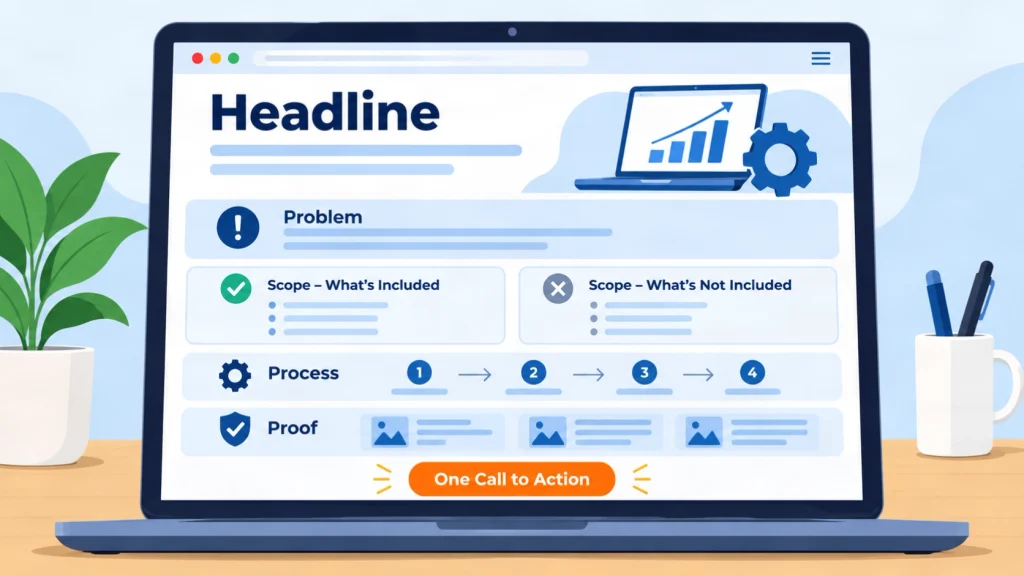
Name the service, state the problem, define the scope, explain the process, show proof, answer objections, and place one clear call to action. The steps below follow the order in which most buyers ask their questions.
Step 1: Name the service and the outcome in the headline
The H1 should state what you do, for whom, and what result the reader can expect. “Our Services” says nothing. A hypothetical example of a clearer headline is “Bookkeeping for Freelancers: Accurate Monthly Accounts Without the Paperwork”. Keep promises realistic, because an exaggerated headline loses trust faster than a plain one.
Step 2: Describe the reader’s problem in plain words
Open with the problem as the reader would describe it, then show that you understand why it matters. Use their vocabulary, not industry jargon. Two or three short sentences are enough. The aim is recognition: the reader thinks, “This page is about my situation.”
Step 3: Define what the service includes and excludes
State clearly which deliverables, tools, and limits the service covers. Readers compare providers, and missing scope is a common reason for hesitation. A short list works well here:
- What you deliver, such as the number of pages, reports, visits, or sessions
- Who the service suits, and who it does not suit
- What is not included, so the reader does not assume it is
- A typical timeline, if you can state one honestly
Stating exclusions can feel risky, but it filters out poor-fit leads and builds trust.
Step 4: Explain your process in numbered stages
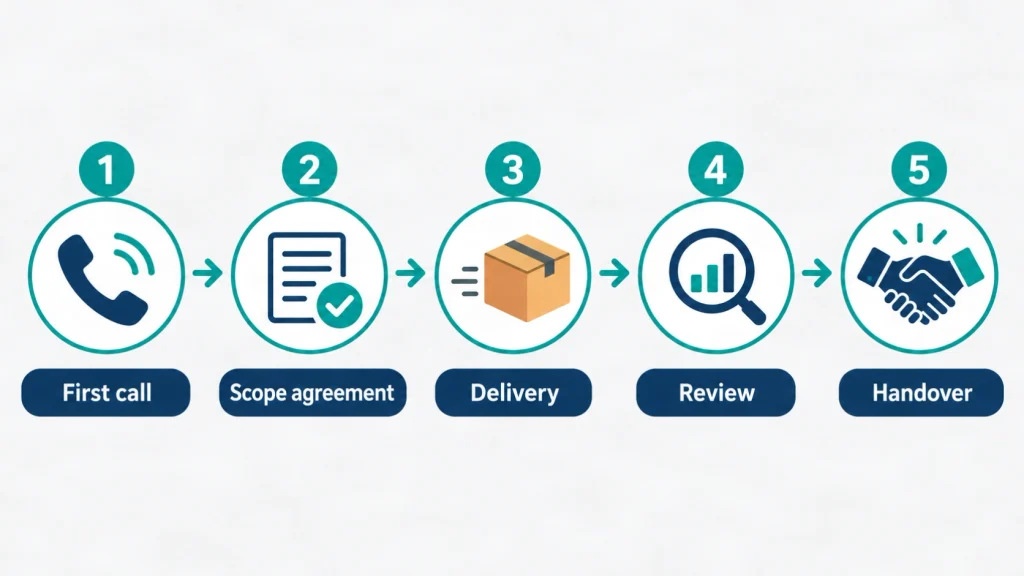
Show the process in three to five stages so the reader knows what happens after they contact you. A simple version is first call, scope agreement, delivery, review, and handover. A process reduces uncertainty, and uncertainty is a common barrier to enquiry. Use plain labels and one sentence per stage.
Step 5: Show proof that is real and checkable
Use proof that a reader could verify, such as dated reviews, named clients who gave permission, licenses, certifications, or documented results. Do not invent testimonials, numbers, or case studies. If you have no case studies yet, describe your method, your qualifications, and your guarantees in factual terms. Nielsen Norman Group research found that web users disliked boastful promotional language, wanted straight facts, and trusted sites less when they saw exaggeration (Nielsen Norman Group).
Step 6: Answer objections, price, and timing questions
Answer the questions that stop people from contacting you: cost, time, risk, and what happens next. If you can publish a price, do so. If you cannot, explain what affects the price and give a clear way to request a quote. A short FAQ block on the service page is a good place for these answers.
Step 7: Place one clear call to action where the reader is ready
Use one specific call to action, and repeat it after the opening, after the proof, and at the end of the page. Label the button with the action, such as “Request a quote”. Avoid pressure tactics. Tell the reader what happens after the click, for example a reply within one working day, only if that statement is true.
How Do You Use SEO Keywords in Service Page Copy Without Stuffing?
Use the primary keyword where it naturally describes the page, and cover related terms through clear explanations instead of repetition. Google states that its ranking systems prioritize “helpful, reliable information that’s created to benefit people” (Google Search Central), so copy written mainly to repeat phrases works against the purpose of the page.
Where should the primary keyword appear?
Place the exact primary keyword in the H1, the opening paragraph, the title tag, the meta description, the URL slug, and one or two relevant subheadings. Then use natural variants in the body. There is no fixed density target, and repeating a phrase to reach a percentage harms readability.
How do supporting keywords fit into service page copy?
Supporting keywords describe the same offer from other angles, so use them only where they clarify the sentence. A page that sells writing, for example, may mention website content writing, SEO website content writing, and site content writing once each, in the scope list or a heading. The person who types web content writing services and the person who types website content writing services want the same thing, so one page can cover both without repeating either phrase. Pairing the copy with website SEO work helps the title, headings, internal links, and page structure support the words.
How Do E-E-A-T and YMYL Affect Service Pages?
E-E-A-T stands for experience, expertise, authoritativeness, and trust, and it is a quality framework, not a numeric ranking score. Service pages show it through visible, checkable details: who provides the service, what qualifies them, how to make contact, and where claims come from.
How do you show experience and expertise honestly?
Show experience through specifics you can verify, such as a described process, dated reviews, real project descriptions, and named credentials. If you lack proof, say what you do and how you do it instead of inventing results. A named provider, a real contact route, and clear policies all support trust. Local businesses should also keep the business name, address, and phone number consistent across the website and the Google Business Profile optimization work, so readers can confirm they have found the right business.
What extra care do YMYL service pages need?
Pages about health, money, law, or safety need accurate, current, sourced claims, because readers may act on them in ways that affect wellbeing or finances. YMYL means “your money or your life”. Follow these rules:
- Name the qualified professional and state credentials that a regulator or licensing body can confirm.
- Cite primary sources, such as government agencies, regulators, and standards bodies, for factual claims.
- Never promise outcomes, cures, or guaranteed returns.
- Add a last-reviewed date, and change it only when the content has been reviewed.
- State that the page gives general information and not individual professional advice.
- Have a qualified professional review the copy before publication.
If the topic is serious, write fewer claims and verify each one.
How Do You Make a Service Page Easy to Scan?
Break the page into short sections with meaningful subheadings, one idea per paragraph, and the key point first. Jakob Nielsen wrote that people rarely read web pages word by word and instead “scan the page, picking out individual words and sentences” (Nielsen Norman Group). In that 1997 research, 79 percent of test users always scanned a new page and only 16 percent read word by word. The study is old, so treat the percentages as a historical finding, but the habit it describes remains a sensible guide for web writing.
Practical ways to write for scanners:
- Use descriptive subheadings instead of clever ones.
- Keep paragraphs short and give each one a single job.
- Use lists for scope, steps, and requirements.
- Bold only the direct answer in each section.
- Check spacing, button size, and mobile loading speed with the designer, because layout choices belong to web design as much as to copy.
How Do You Write Service Pages for AEO and GEO?
Write each section so its first sentence answers one question, names the entities involved, and explains how they relate. AEO, or answer engine optimization, aims to make passages easy for search features and assistants to extract. GEO, or generative engine optimization, aims to make content easy for AI-generated answers to understand. Neither practice can guarantee that any AI system will cite your page.
Useful habits for both:
- Use question-style subheadings for questions people really ask.
- Define each term in one sentence before explaining it.
- Name the service, the audience, the location, and the provider instead of relying on “it” or “we” in key sentences.
- Add a FAQ section built from real customer questions.
- Cite sources for factual claims, and give context for any statistic: who measured it, when, and how.
- Keep names, prices, and service details consistent across the website.
When Should You Hire Website Content Writing Services?
Hire website content writing services when the page needs specialist research, many pages must follow one standard, or you lack time to interview customers and check facts. Providers use different labels for similar work, including web content writing services, SEO website content writing, and site content writing. The label matters less than the process, so ask how the provider researches, verifies facts, and handles revisions.
Free content writing websites and templates can help with grammar and structure, but they cannot supply your business facts, customer language, or proof. Use them for editing, not for the substance of the page.
A good provider asks for your service details, customer questions, and verifiable proof before writing. Ask for samples from your industry and ask who checks the facts. I offer an SEO content writing service, so treat this section as a disclosure as well as advice: compare providers on process and evidence, not on promises of rankings or traffic, because no writer can guarantee either.
Service Page Copywriting Mistakes That Lower Conversions
The most common mistakes are vague headlines, features without outcomes, unsupported claims, competing calls to action, keyword-first writing, and missing local details. Each one makes the visitor work harder or trust you less.
- Vague headlines. “Welcome to our services” does not tell the reader what they can buy.
- Features without outcomes. Listing what you do without saying why it matters leaves the reader to guess.
- Unsupported claims. Words such as “leading” or “trusted” with no evidence reduce credibility.
- Competing calls to action. Three different buttons split the reader’s attention.
- Keyword-first writing. Repeating a phrase in every sentence makes the copy awkward and weakens trust.
- Missing local details. A local service page without the service area, address, or opening hours leaves common questions open, and Local SEO work connects those details to the page.
Service Page Copywriting Checklist Before You Publish
Before publishing, confirm that the page names the service, serves one intent, states scope and process, shows verifiable proof, answers objections, and offers one action. Use this checklist:
- The H1 names the service and outcome and contains the primary keyword.
- The opening paragraph states the offer and uses the primary keyword naturally.
- The page has one reader, one search intent, and one primary action.
- The scope list says what is included and what is not.
- The process appears in three to five stages.
- Every proof item can be verified.
- Price, timing, and risk questions are answered.
- Facts, names, and numbers are checked, and a qualified professional has reviewed any YMYL claims.
- The title tag, meta description, and URL slug match the page.
- The page reads well and loads quickly on a phone.
After publishing, measure the conversion rate: completed actions divided by visits to the page, multiplied by 100. Change one element at a time so you know what caused any difference, and avoid drawing firm conclusions from very small numbers of visits.

Conclusion
Service page copywriting works when the page answers real questions in a clear order, backs its claims with proof, and asks for one next step. Start with the reader, the search intent, and the action. Then apply the seven steps, check the page against the checklist, and take extra care when the topic touches health, money, law, or safety. Keywords support this work, but they do not replace it. Update the page when services, prices, or regulations change, and keep every claim something you can defend.
FAQs
What is service page copywriting?
Service page copywriting is the writing of a page that explains one service and persuades the right visitor to take one action. It covers the headline, scope, process, proof, objection handling, and call to action.
How long should a service page be?
A service page should be as long as it takes to answer the buyer’s main questions, with no fixed word count. A simple, low-risk service may need a few hundred words, while a complex or high-cost service usually needs more detail on scope, process, and proof. Cut any sentence that does not help the reader decide.
How many calls to action should a service page have?
Use one primary call to action and repeat it in two or three places. Different buttons for different goals split attention. A phone number can sit beside the main button when calling is the same action in another form.
Should a service page show prices?
Show prices when you can state them accurately, and explain the factors that affect cost when you cannot. A starting price helps qualify visitors, while hiding all cost information can raise doubt. State whether the price includes taxes or extras where that applies.
Where should the primary keyword go on a service page?
Put it in the H1, the opening paragraph, the title tag, the meta description, the URL slug, and one or two relevant subheadings. Keep the rest of the copy natural and write for the reader first.
What is the difference between a service page and a landing page?
A service page is a permanent part of the website that explains one service, while a landing page is usually built for a specific campaign with a narrower goal. Landing pages often limit navigation to keep focus, and service pages usually sit inside the site structure and link to related pages. Many principles in this guide apply to both.
How do you write a service page without case studies?
Describe your method, qualifications, guarantees, and real customer feedback, and leave out any result you cannot verify. Add case studies later, with client permission. Invented proof damages trust and may break advertising rules in some places.
Can AI write service pages?
AI can help draft or edit a service page, but a person must verify the facts, add real experience, and approve the final copy. AI does not know your pricing, process, or customers unless you supply them. For health, finance, law, or safety topics, a qualified professional should review the page.
How often should you update a service page?
Update it whenever the service, price, process, contact details, or relevant regulations change. A routine review every six months is a practical habit, not a rule. Avoid changing the date unless the content has actually changed.
How do you know if a service page converts?
Divide the number of completed actions by the number of visits and multiply by 100 to get the conversion rate. Track form submissions, calls, and booking clicks in your analytics tool. Compare pages with similar traffic sources and change one element at a time, because small numbers of visits can mislead.