How to Build an SEO Content Calendar in 7 Proven Steps
An SEO content calendar links each page to a keyword, intent, owner, and date. Learn the 7 steps, a scoring method, and a copyable template.


An SEO content calendar is a schedule that links each planned page to a target keyword, a search intent, an owner, a publish date, and a review date. This guide shows you how to build a content calendar step by step, with a copyable template and a simple scoring method.
TL;DR: Set one goal, group keywords by intent, choose topics, score them, assign dates and owners, write from briefs, and review results every quarter. A calendar organizes your work. It does not promise rankings.
What Is an SEO Content Calendar?
An SEO content calendar is a planning document that schedules content by search demand, not only by dates. Each row connects a topic to a keyword, the search intent behind it, a format, a writer, a deadline, and a refresh date.
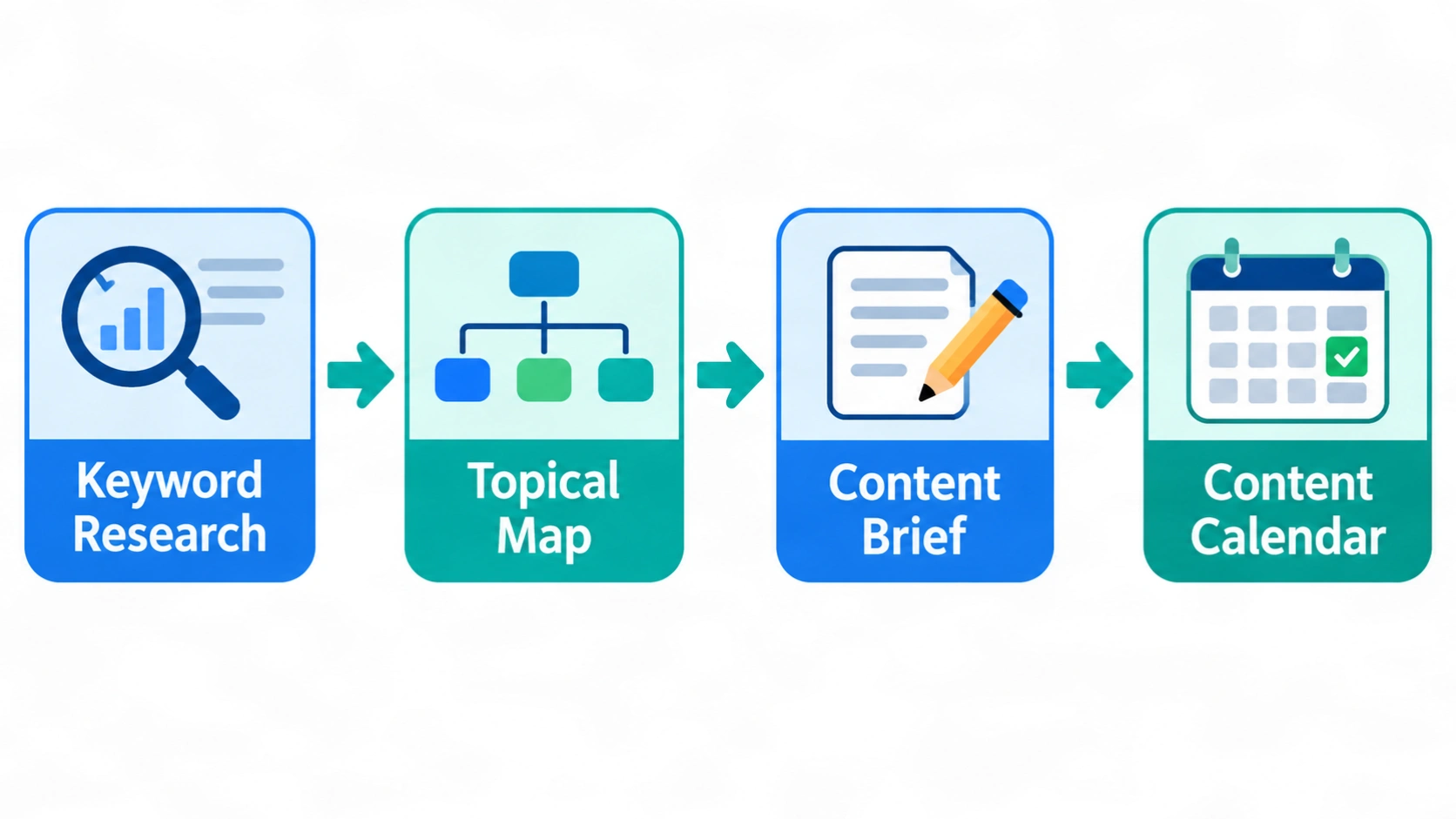
The calendar sits at the end of a planning chain. Keyword research finds the queries. A topical map groups them into related subjects. Content briefs describe each page. The calendar then decides what gets written, by whom, and when.
This order matters. A calendar built before research becomes a list of guesses. If you are new to topical maps, my topical map service page explains how related topics connect. The content strategy and briefs category covers the planning layer in more detail.
How Is an SEO Content Calendar Different From an Editorial Calendar?
A general editorial calendar tracks what is published and when, while an SEO content calendar also tracks keyword, search intent, and update dates. The table shows the main differences.
| Feature | Editorial calendar | SEO content calendar |
|---|---|---|
| Main purpose | Track publishing dates | Plan content around search demand |
| Starting point | Ideas, events, campaigns | Keyword research and search intent |
| Key columns | Title, writer, date | Keyword, intent, URL, brief, review date |
| Review cycle | After publishing | Every quarter, with refresh decisions |
| Best for | News, events, campaigns | Guides, service pages, local pages |
Why Does an SEO Content Calendar Matter?
An SEO content calendar matters because it turns a content strategy into scheduled, measurable work. Research from the Content Marketing Institute (CMI) shows that most teams already have a strategy, yet many still struggle to act on it.
CMI’s B2B Content and Marketing Trends: Insights for 2026 report, published in October 2025, surveyed 1,015 B2B marketers. These findings matter most for planning:
- 97% of respondents said they have a content strategy.
- Of the marketers who reported improvement, 74% credited strategy refinement.
- The top challenges were creating content that prompts action (40%), resource limits (39%), and measuring effectiveness (33%).
- Among effective teams, 65% pointed to content relevance and quality as what moved results.
Most respondents were North American B2B marketers, so treat these numbers as a benchmark, not a forecast for your site. A calendar still helps with the second and third challenges. It shows your real capacity, and it gives you dates to measure against.
The bigger prize of faster production is time for “the slower, deeper work of thinking.”
Ann Handley, chief content officer at MarketingProfs, in CMI’s 2026 B2B report (October 8, 2025)
How to Build an SEO Content Calendar in 7 Steps
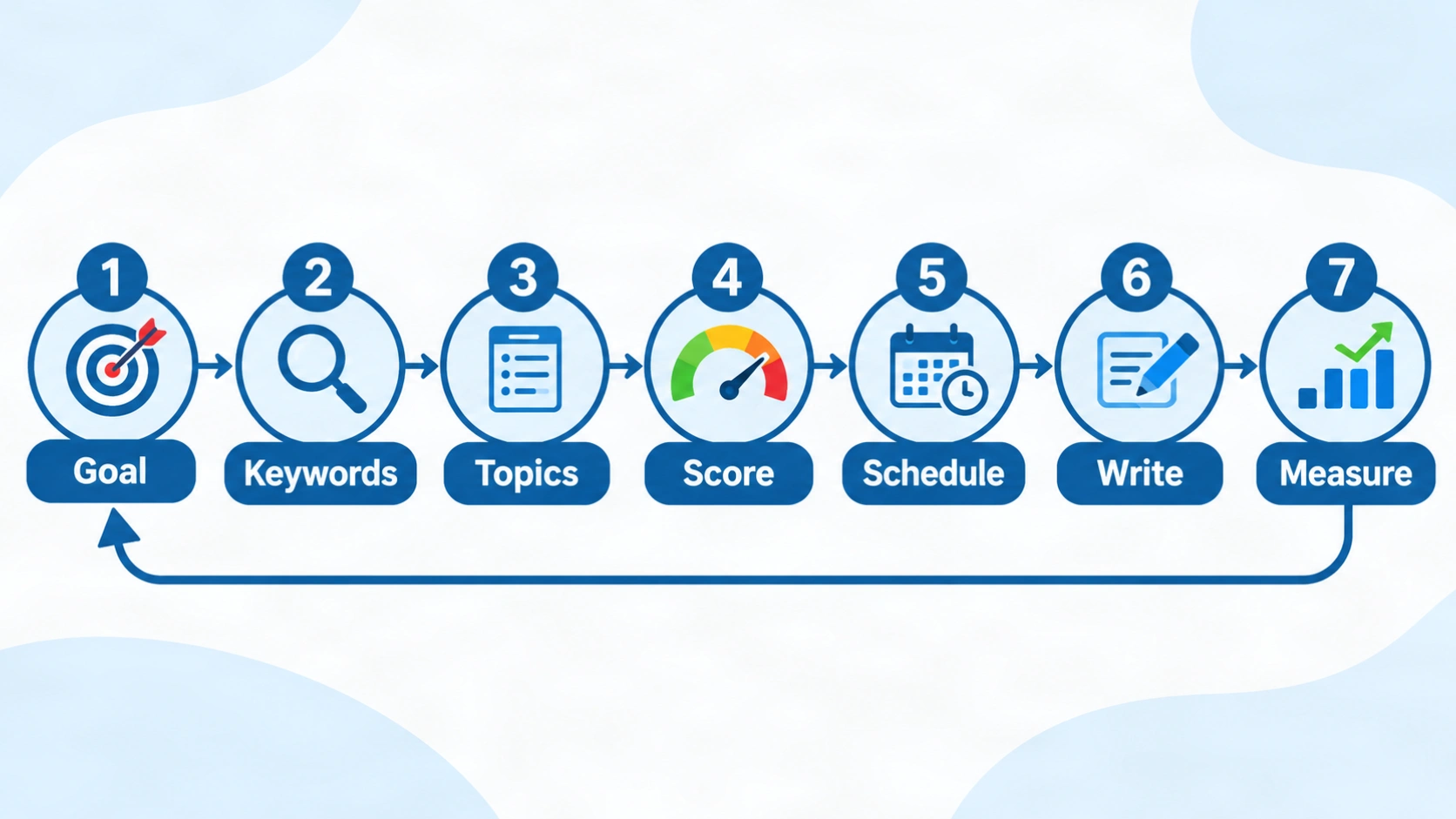
You build a content calendar in seven steps: set a goal, research keywords, choose topics, score them, schedule them, write from briefs, and measure results. Each step has its own section below.
- Set one goal and a content writing strategy.
- Research keywords and group them by search intent.
- Choose content writing topics from real demand.
- Score and rank every topic.
- Assign dates, owners, and formats.
- Write from briefs using content marketing writing tips.
- Publish, measure, and refresh.
Plan one quarter first. Twelve weeks is long enough to see a pattern and short enough to change course.
Step 1: Set a Goal and Write a Content Writing Strategy
A content writing strategy is a short written plan that states who you write for, what problem each page solves, and how you will measure success. Without it, a calendar is only a list of dates.
Useful content writing strategies share three parts: audience, goal, and proof. Audience means the specific reader and the question they type into search. Goal means one outcome, such as qualified contact requests or local calls. Proof means the evidence you can add, such as a documented process, a screenshot, or a sourced figure.
Write the goal in one sentence. For example: “Publish 12 guides this quarter that help small business owners compare local SEO options and contact us.” Then pick two measures, such as non-branded clicks in Google Search Console and contact form submissions.
Keep the strategy to one page. Google also asks creators to explain why a page exists. If the main reason is to attract search visits, the page is not people-first content.
Step 2: How Do You Research Keywords and Search Intent?
Start with a seed list from your services, expand it with real search data, and group the results by search intent. Search intent is the task the searcher wants to finish, such as learning, comparing, or hiring.
Use four quick sources:
- Seed terms: your services, your products, and the questions customers ask.
- Autocomplete and related searches: note repeated phrases and question patterns.
- Search Console queries: find searches where you already earn impressions but few clicks.
- Google Trends: check seasonality before you fix a date. Google explains the basics in its Google Trends guide.
Then sort keywords into informational, commercial, transactional, and local groups. Plan one page per intent, not one page per synonym. For example, “content calendar template” and “SEO content calendar template” probably want the same page, so check the live results before you split them.
This guide does not quote keyword volumes, because they differ by tool, country, and month. Use your own keyword tool and Search Console data.
Step 3: Where Do Content Writing Topics Come From?
Good content writing topics come from five sources: customer questions, keyword gaps, competitor pages, your own data, and seasonal events. Use each source to fill a different part of the calendar.
| Source | What to look for | Example topic type |
|---|---|---|
| Customer questions | Sales calls, emails, chat logs | Cost and process guides |
| Keyword gaps | Queries where you rank poorly or not at all | Missing how-to guides |
| Competitor pages | Questions they leave unanswered | Checklists and comparisons |
| Your own data | Search Console and analytics | Updates to aging posts |
| Seasonal events | Trend peaks and local buying periods | Timed planning guides |
Next, group topics into clusters around one central subject. A cluster has one pillar page and several supporting pages that answer narrower questions. For this article, the pillar is the SEO content calendar, and the supporting pages could cover a content calendar template, a content writing strategy, and topic scoring. My topical authority category explains why clusters help a site look focused.
Content marketing writing works best when each topic starts with the reader’s question and promotes your service second. A topic that only sells has no clear search intent.
Step 4: Score and Prioritize Each Topic
Score each topic from 1 to 5 on four factors, apply the weights below, and publish the highest totals first. This is a simple framework prepared for this guide. Adjust the weights for your site.
The formula is: Priority score = (Business value x 3) + (Search demand x 2) + (Ease of ranking x 2) + (Low effort x 1). For “Low effort” and “Ease of ranking,” 5 means easy and 1 means hard. The maximum score is 40.
| Example topic | Value | Demand | Ease | Low effort | Score |
|---|---|---|---|---|---|
| Content calendar template | 4 | 5 | 3 | 4 | 32 |
| Content writing strategy guide | 5 | 4 | 2 | 3 | 30 |
| Refresh an older post | 4 | 2 | 4 | 5 | 29 |
| Local content ideas list | 3 | 3 | 4 | 5 | 28 |
These inputs are placeholders to show the math. They are not data from a real site. Take demand and difficulty from your own tools, not from guesses.
Mix quick wins with one or two larger guides each month. A calendar filled only with easy topics grows slowly, and a calendar filled only with hard topics stalls.
Step 5: Assign Dates, Owners, and Formats
Give every topic one owner, one publish date, one format, and one review date, and schedule only what your team can finish. Capacity is a common reason calendars fail, and CMI’s finding that 39% of marketers cite resource limits supports this.
Start from your real output. If one writer finishes two quality guides a month, schedule two. Leave one open slot each month for updates and urgent topics. A calendar that is missed every week teaches the team to ignore it.
Publish supporting pages before or alongside the pillar page. This way, internal links work from day one, and readers can move through the cluster.
Pick a format that matches the intent. Use a guide for learning, a comparison for choosing, a checklist for doing, and a service page for hiring. If you run a local business, add Google Business Profile updates as separate rows. My local SEO service page describes how local pages and profiles work together.
Step 6: Content Marketing Writing Tips for Every Draft
The most useful content marketing writing tips are to write from a brief, answer the question first, add original evidence, and edit for plain language. Each tip fits into a calendar row.
- Write from a brief. A brief lists the keyword, intent, outline, sources, and internal links, so the writer starts with direction.
- Answer first. Put the direct answer in the first sentence under each heading, then explain.
- Add something original. Google’s self-assessment questions ask whether content offers original information and avoids simply rewriting other sources. A process, an example, or a sourced figure helps.
- Use AI with human review. In CMI’s data, 87% of marketers using AI for content creation said productivity improved, while 12% said content quality decreased. Google also suggests explaining how content was made when readers might wonder.
- Protect trust. Google states that “trust is most important” among the E-E-A-T qualities, as noted in its helpful content guidance, last updated October 5, 2026.
- Skip word-count targets. Google says it has no preferred word count, so write until the question is answered.
If you want a team to draft from approved briefs, see my SEO content writing service.
Step 7: Publish, Measure, and Refresh
After publishing, review impressions, clicks, and conversions every quarter, and update a page only when you add real value. Search Console shows impressions and clicks by page and query.
Use these rules of thumb. They are guides, not guarantees:
- Impressions up, clicks flat: improve the title and opening paragraph.
- Clicks up, conversions flat: improve the next step and the internal links.
- Impressions flat: recheck the search intent and the keyword choice.
Google lists changing page dates without substantial changes as a warning sign. So update the visible date only when the page truly changed. Record each real update in the calendar’s review column.
SEO Content Calendar Template You Can Copy
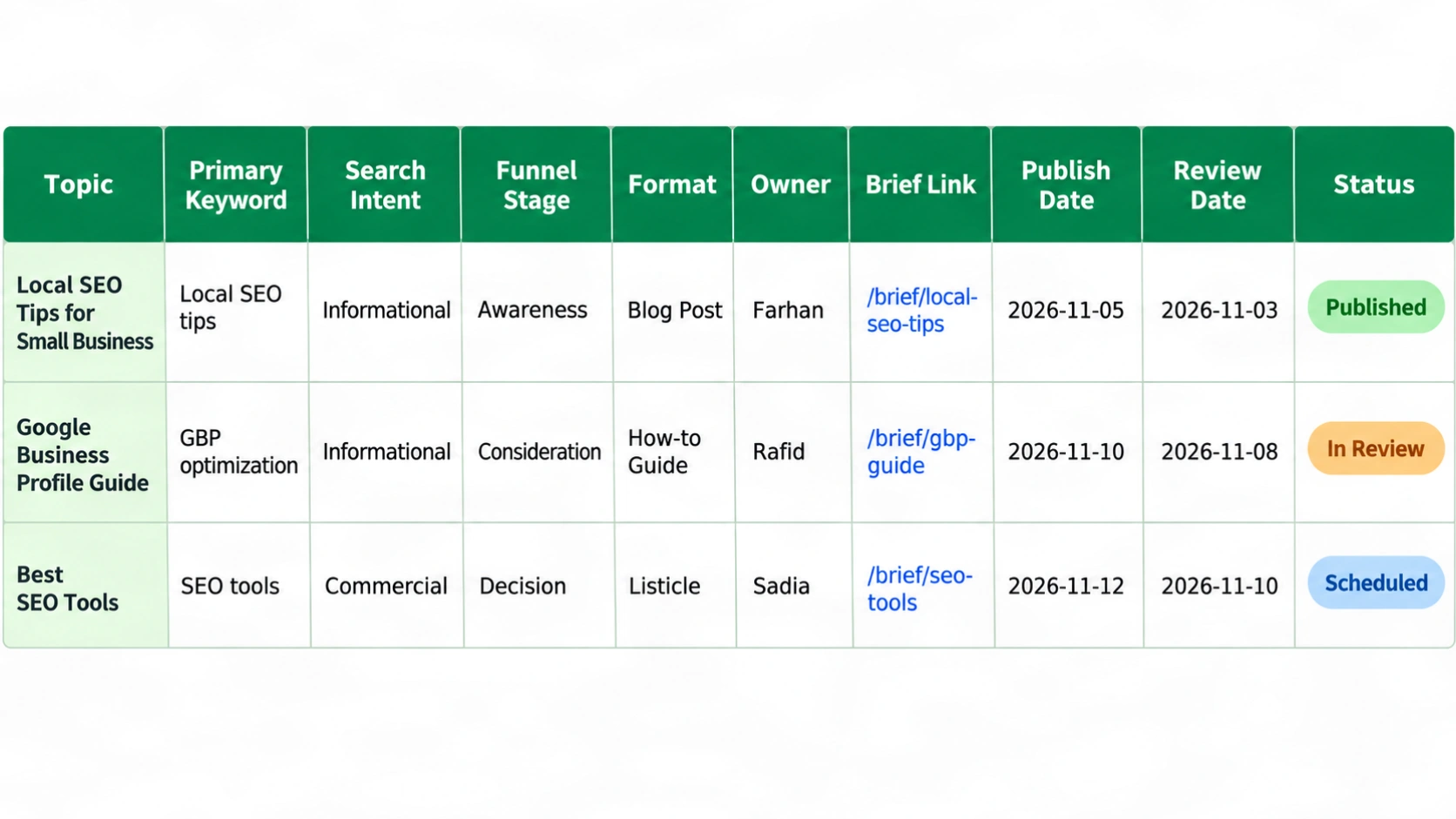
A simple SEO content calendar template needs ten columns: topic, primary keyword, search intent, funnel stage, format, owner, brief link, publish date, review date, and status. Copy the table into Google Sheets or Excel.
| Column | What to enter | Example |
|---|---|---|
| Topic | Working title | How to plan a quarterly content schedule |
| Primary keyword | One main query | content calendar template |
| Search intent | Learn, compare, hire, or local | Learn |
| Funnel stage | Awareness, consideration, decision | Awareness |
| Format | Guide, checklist, comparison, update | Checklist |
| Owner | One named person | Writer A |
| Brief link | URL of the content brief | Shared document link |
| Publish date | Planned date | Week 3 |
| Review date | Date to check results | 90 days after publishing |
| Status | Idea, Briefed, Drafting, Review, Published, Refresh due | Briefed |
The example values are illustrative, not client data. Add a column for the target URL after you publish. Color-code the status column so the team can scan it in seconds.
What Are Common SEO Content Calendar Mistakes?
The most common mistakes are planning by date instead of intent, scheduling more than the team can write, creating one page per synonym, and never reviewing results. Each has a simple fix.
- Dates before research: run keyword and intent research first.
- Overloaded schedule: cut the plan to your real monthly output.
- One page per synonym: merge near-identical queries into one page.
- No briefs: write a brief for every row before drafting.
- No review column: set a review date when you schedule the page.
Who Wrote This Guide, and How?
I am Forkan Mahmud, an SEO consultant who works with SERP Panda and manages much of my work from Oman. For about five years, I have worked with European clients on Local SEO, Google Business Profile optimization, website structure, topical maps, content briefs, and content optimization, together with a team.
That background shapes how I plan calendars. I treat the calendar as the last planning layer, after research, topical maps, and briefs. I have not included client results here, because I have no verified case-study figures to publish. The scoring matrix and template are a framework prepared for this guide. Every statistic and quote links to its source, and I opened those sources on October 31, 2026.
What Are the Limits and Risks of an SEO Content Calendar?
A calendar organizes work, but it cannot guarantee rankings, traffic, or sales, because search results depend on many factors outside your plan. Competitors, search updates, and site quality all change outcomes.
Keep these limits in mind. The CMI data comes mostly from North American B2B marketers. Tool metrics differ by provider. The scoring formula is a decision aid, not a prediction.
Be extra careful with health, money, legal rights, and safety topics. Google says its systems give more weight to strong E-E-A-T for these topics, which it calls Your Money or Your Life (YMYL). I am an SEO consultant, not a doctor, lawyer, or financial advisor. Have a qualified professional review pages in these areas, cite official sources, and state clear limits. This matters for healthcare and dental sites and law firms in particular. If a topic could affect someone’s safety, direct readers to a qualified professional or official guidance.
This guide was reviewed on October 31, 2026, and is due for another review by April 30, 2027.
Conclusion
You build an SEO content calendar by researching first, scoring topics, scheduling within your real capacity, and reviewing results every quarter. Start with one quarter and one goal. Use the template above, adjust the weights to your site, and record every real update. If you want help turning a topical map into a working schedule, contact me.
Frequently Asked Questions
What is an SEO content calendar?
It is a schedule that connects each planned page to a keyword, search intent, owner, and date. Teams use it to publish what searchers want in a steady order, instead of choosing topics week by week. It also records when each page needs a review, so older content does not go stale.
What should an SEO content calendar include?
At minimum, include the topic, primary keyword, search intent, format, owner, publish date, review date, and status. Add a brief link and a target URL if your team uses them. Extra columns are fine, but each one should help someone make a decision, or it will not get updated.
How far ahead should I plan an SEO content calendar?
Plan the next 12 weeks in detail and the following six to twelve months in outline. Detailed plans go out of date as search results and business priorities change. A quarterly review lets you move topics, remove weak ideas, and add new questions from Search Console.
How often should I publish new content?
Publish at the pace your team can sustain with quality. Google states it has no preferred word count, and it also gives no fixed publishing rate in the guidance reviewed for this article. Start with a small, reliable schedule, such as two guides a month, and increase it only when quality stays high.
What is the best content calendar template?
The best content calendar template is the one your team will update every week. A spreadsheet works for most small teams because it is free to copy and easy to filter. Use the ten columns in this guide, then add fields only when a real need appears.
What are the best content writing strategies for beginners?
Beginners should pick one audience, one goal, and one question per page. Write from a brief, answer first, and add one piece of evidence, such as a sourced figure or a documented process. Then review results after 90 days. Simple, repeatable content writing strategies beat complex plans that nobody follows.
How do I choose content writing topics for a new website?
Start with the questions your customers already ask in emails, calls, and chats. Then check search results to see what a page needs to answer. Choose topics that connect to your services, and group them into clusters. A new site gains focus when its topics support each other.
How is content marketing writing different from SEO writing?
Content marketing writing aims to help a defined audience and lead toward a business goal, while SEO writing shapes a page so searchers and search engines can understand it. The two work together. A page should read well for a person first, then use clear headings, sources, and links.
How often should I update old posts?
Review each post on the date set in your calendar, often every three to six months, and update only when something changed. Real changes include a new statistic, a changed policy, or a missing question. Google warns against changing dates when the content has not substantially changed.
Can I use AI to help with my content calendar?
Yes, AI can help with brainstorming topics and drafting outlines, but a person should review facts, sources, and tone. In CMI’s survey, 12% of AI content users said quality decreased. Google also suggests explaining how content was produced when readers might wonder. Never publish unverified statistics or quotes.