How to Write an SEO Content Brief
An SEO content brief gives a writer the keyword, search intent, audience, outline, and linking rules for one page. This guide shows how to write one in eight steps, with a copy-ready template and a worked example.

Learning how to write an SEO content brief gives you a repeatable way to turn one keyword into one clear writing assignment. A good brief tells the writer who the reader is, what the page must answer, and what proof to include. This guide explains each part, with a template, a sample brief, and tool options.
A content brief is a short document that gives a writer the goal, reader, keywords, structure, and sources for one page. Build it from search intent and a review of the top results, not from a keyword list. Keep it flexible so the writer can add real expertise.
What Is an SEO Content Brief?
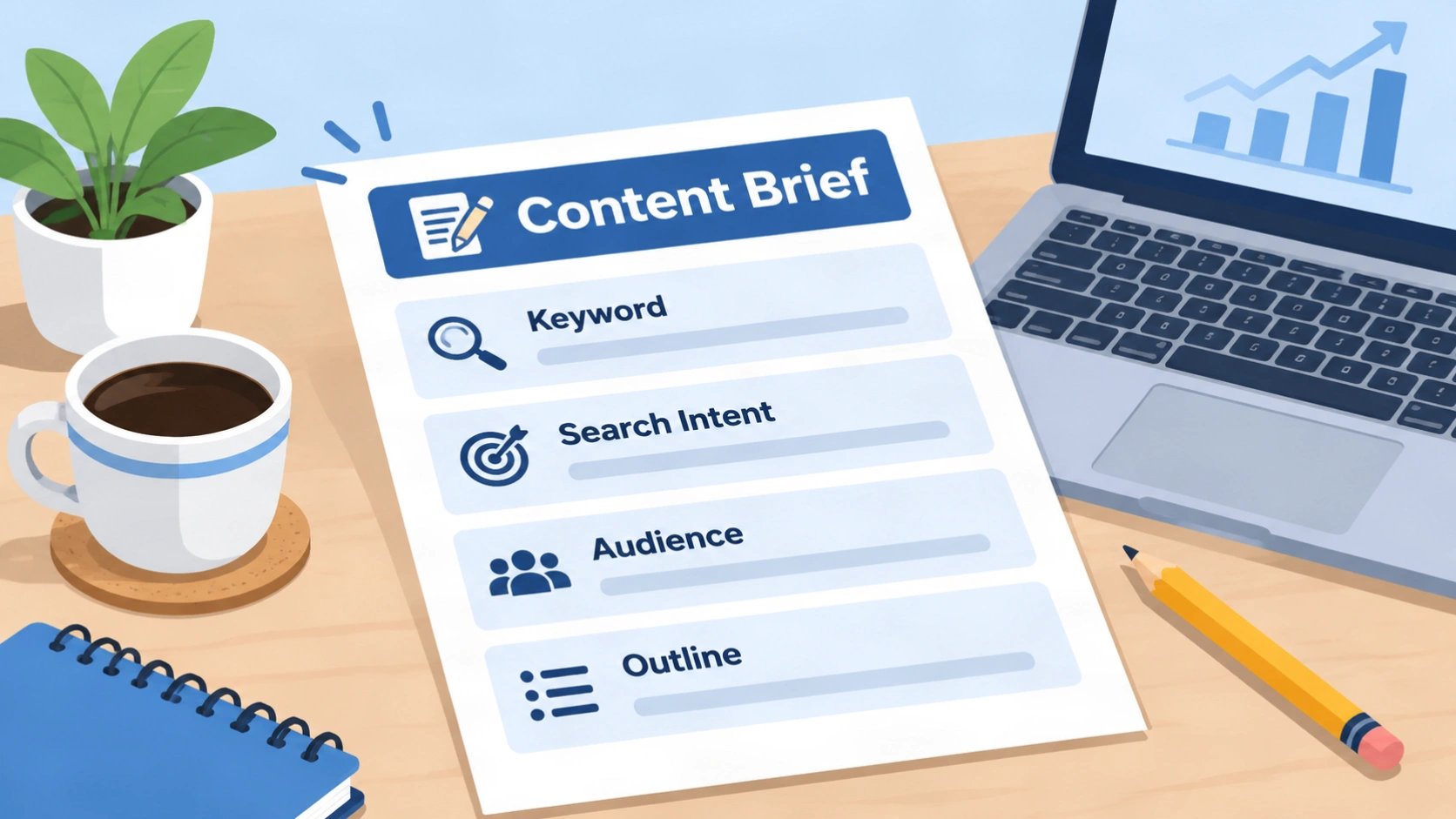
An SEO content brief is a document that tells a writer what to create for one page that targets one search query. It combines audience details, search intent, keywords, structure, and source rules in one place. Writers use it as a plan, and editors use it as a review checklist.
A basic content brief only names the topic. An SEO content brief also explains what searchers want and how the page should answer it. It connects keyword research, SERP analysis, the outline, the writer, and the editor in one workflow.
What Is the Difference Between a Content Brief, an Outline, and a Creative Brief?
A content brief guides one piece of content, an outline lists its headings, and a creative brief guides a whole campaign. The brief can contain the outline, but it also holds goals, audience, and rules. eesel’s guide to content briefs draws the same line between a single asset and an entire campaign.
| Document | Scope | Main purpose | Usually owned by |
|---|---|---|---|
| Creative brief | Whole campaign | Sets message, channels, and brand direction | Marketing lead or brand team |
| Content brief | One page or article | Gives the writer goal, reader, keywords, structure, and sources | SEO strategist or editor |
| Outline | Headings of one article | Shows the order of sections | Writer or strategist |
Why Does an SEO Content Brief Matter?
An SEO content brief matters because it removes guesswork before writing starts. The writer knows the target, the editor knows what to check, and SEO decisions are made once instead of during every revision. Backlinko says briefs help teams reduce revisions and speed up writing.
I did not find a study that measures briefs alone. Research on written plans and on brief contents points in the same direction. The table shows what each figure measures, who produced it, and when.
| Figure | What it measures | Source and year |
|---|---|---|
| 37% vs 61% | Share of B2B marketers with a documented content marketing strategy: all respondents vs top performers | Content Marketing Institute, B2B Content Marketing report, 2017 |
| 44% | Share of North American B2B marketers with a documented content strategy, asked for the first time | Content Marketing Institute and MarketingProfs, 2014 report |
| 84% | Share of marketers who called themselves ineffective at content marketing and had no documented strategy | Content Marketing Institute, 2014 report |
| 67.45%, 64.71%, 50.29%, 49.71% | Share of marketers who include a topic, keywords, audience details, and content objectives in a brief | Semrush data as reported by ClickUp (original report not opened) |
The Content Marketing Institute figures come from North American B2B surveys and are several years old. They show a link between documentation and results. They do not prove that documents cause success.
Joe Pulizzi, founder of the Content Marketing Institute, explained the 2014 finding in the report’s press release. Only 44% of B2B marketers had a documented strategy, and he said the ones who did were more effective:
“those who do rate themselves as more effective in all areas of content marketing”
Joe Pulizzi, founder, Content Marketing Institute, press release, October 2013
What Is in a Content Brief? Core Elements Explained
A content brief usually contains a goal, reader profile, primary keyword, secondary keywords, search intent, competing URLs, structure, word count, links, and writer notes. The ClickUp figures above show a common gap. Many briefs list a topic and keywords but leave out the audience and the objective. Start with the goal and the reader to avoid that gap.
Which Elements Does Every SEO Content Brief Need?
Every SEO content brief needs a goal, a reader, a primary keyword, search intent, a structure, and sources. The table shows what to write for each element and why it helps.
| Element | What to write | Why it helps the writer |
|---|---|---|
| Goal | What the page should achieve (education, lead, sign-up) | Sets tone and call to action |
| Reader profile | Role, knowledge level, main problem | Keeps language and depth right |
| Primary keyword | The one phrase the page targets | Sets the title, H1, and opening |
| Search intent | What the searcher wants to learn or do | Decides format and the first answer |
| Secondary keywords and questions | Related phrases and questions | Covers subtopics without extra pages |
| Competing URLs and SERP notes | Top pages and what they do well or miss | Shows gaps to fill |
| Structure | Heading list or topic areas | Guides coverage |
| Word count | A range based on matching top results | Sets depth and budget |
| Links and sources | URLs with anchor ideas | Supports navigation and trust |
| Writer notes | Tone, examples, limits | Prevents rework |
Which Optional Elements Make a Brief Stronger?
Original data, expert input, proof requirements, and a “do not cover” list make a brief stronger. Backlinko suggests adding internal research, outside research, podcasts, and whitepapers as references.
Two additions deserve a place in most briefs. A proof requirement lists the evidence the writer must supply, such as a sourced number, a screenshot, or a first-hand example. A “do not cover” list names topics that belong on other pages, which helps avoid two pages competing for the same query.
How to Write an SEO Content Brief Step by Step
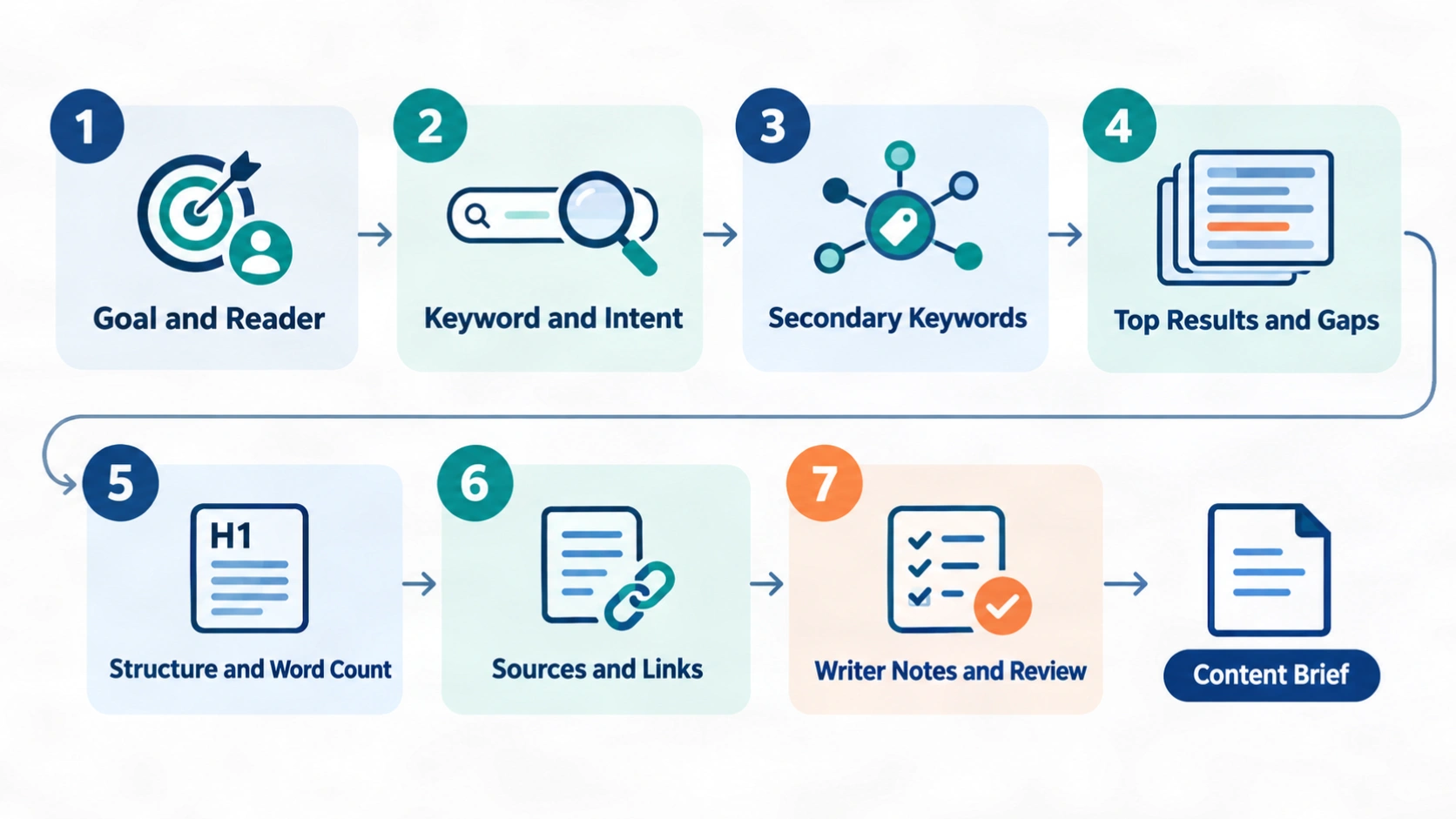
To write an SEO content brief, define the goal and reader, confirm search intent, gather keywords, study the top results, set the structure, add sources and links, then review the brief with the writer. The seven steps below follow that order.
Step 1: Define the Goal and the Reader
Start with one sentence for the page goal and one for the reader. For example: “Teach small business owners how to choose a Google Business Profile category, then invite them to book a call.” A clear goal sets the call to action. A clear reader sets the vocabulary and the depth.
Step 2: Choose the Primary Keyword and Confirm Search Intent
Pick one primary keyword, then open the search results to see what searchers actually receive. If the top results are mostly step-by-step guides, a sales page will not match the intent. Write the intent as one plain sentence, such as “The reader wants steps and a template.”
Google’s own documentation says SEO works best when it supports content written for readers:
“SEO can be a helpful activity when it is applied to people-first content”
Google Search Central, Creating helpful, reliable, people-first content, documentation accessed October 2026
Search volume and difficulty change by tool and country, so pull them from your own tool on the day you write the brief.
Step 3: Gather Secondary Keywords and Questions
Secondary keywords are related phrases that support the primary keyword but do not need their own page. Backlinko points to the People Also Ask box and Google Keyword Planner as places to find them. Search autocomplete, related searches, and customer questions from sales calls also work.
Add related entities as well as phrases. Entities are the people, tools, concepts, and processes a topic connects to. Listing them is the core idea behind semantic SEO, and it helps the writer explain relationships, not just repeat terms.
Step 4: Study the Top Results and Find Gaps
Open the top-ranking pages and note their format, depth, headings, visuals, and unanswered questions. Review five to ten pages that match your intent. For each one, record the page type, the main headings, and what it skips.
Call something a gap only when several pages miss it. Then write one sentence on your angle, meaning what this page will add that the others do not. Do not copy competitor headings or wording.
Step 5: Set the Structure and Word Count
Give the writer a heading list or topic areas, plus a word-count range based on pages that match the intent. Use questions as headings when searchers ask questions. Backlinko warns that SEO tools can count menus, comments, and footers, which inflates word counts. Count the visible article text yourself before you set the range.
Step 6: Add Sources, Internal Links, and Proof Requirements
List the exact URLs the writer should cite or link, and the evidence the writer must supply. For internal links, give the target URL and a natural anchor idea, and use only pages you have verified. For outside sources, prefer primary ones such as Google Search Central, government sites, standards bodies, and original research.
Step 7: Add Writer Notes and Review the Brief
End with short notes on tone, examples, and limits, then ask the writer to read the brief before starting. Ask one question: “What is unclear?” Fix the answer in the brief itself so the next writer does not hit the same problem.
SEO Content Brief Template You Can Copy
Copy the template below into Google Docs or Notion and fill every field before you assign the article.
SEO CONTENT BRIEF

1. Basics
Working title:
Page type (blog post, service page, guide):
Target market and language:
Publish URL or slug:
Due date:

2. Goal and reader
Goal of the page (one sentence):
Reader (role, knowledge level, main problem):
Next step for the reader (call to action):

3. Keywords and intent
Primary keyword:
Search intent (informational, commercial, transactional, navigational):
Secondary keywords and variations:
Questions to answer (People Also Ask, forums, sales calls):
Related entities and terms to explain:

4. Competition
Top competing URLs (5 to 10):
What they cover well:
What they miss:
Our angle (what only this page will add):

5. Structure
Suggested headings (H1, H2, H3):
Word count range:
Format notes (table, checklist, steps, images):

6. Links and sources
Internal links (URL and anchor idea):
External sources to cite (URL and the claim each supports):
Proof the writer must supply (data, example, screenshot):

7. Writer notes
Tone and reading level:
Do not cover (belongs on other pages):
Words or claims to avoid:
Review checklist:
SEO Content Brief Example
This example shows a filled brief for a blog post about optimizing a Google Business Profile. It is illustrative. Volume, difficulty, and competitor data must come from your own tools, so those fields are left open.
| Field | Example entry |
|---|---|
| Working title | How to Optimize a Google Business Profile for a Local Service Business |
| Goal | Teach small business owners the steps, then invite them to book a consultation |
| Reader | Local service business owner, no SEO background, wants more calls |
| Primary keyword | how to optimize a Google Business Profile |
| Search intent | Informational how-to, reader expects ordered steps |
| Secondary keywords | business categories, business description, photos, reviews, posts (verify in your tool) |
| Questions to answer | Which category should I choose? How long does optimization take? |
| Competing URLs | [Add after reviewing the top 5 to 10 results] |
| Our angle | A step order that starts with accurate categories and services |
| Structure | H1, one H2 per step, FAQ at the end |
| Word count | [Set from the SERP review] |
| Internal links | [Add 2 verified URLs with anchor ideas] |
| Proof required | One real screenshot of the category settings |
| Do not cover | Suspension appeals (separate page) |
How to Write an SEO Content Brief for Freelance Writers and In-House Teams
A content brief for writers should be specific about goals and sources, and flexible about wording and structure. Freelancers do not know your product, brand voice, or past articles, so give them more context. In-house writers may need less background but still need intent, links, and limits. Surfer sends a link to its style guidelines with every brief, which helps when several writers work on one site.
If you would rather hand the research and brief creation to a specialist, see my SEO content brief service.
Should the Brief Be SEO-Led or Writer-Led?
Use an SEO-led brief for technical topics and content updates, and a writer-led brief for experienced writers on open topics. An SEO-led brief gives the exact sections to cover. A writer-led brief gives topic areas and lets the writer choose the structure. Leigh McKenzie of Backlinko describes the suggested structure this way:
“a starting point for discussion rather than a rigid template”
Leigh McKenzie, Backlinko, How to Create a Content Brief, updated April 2025
How Do You Check a Draft Against the Brief?
Check the draft with a short pass: intent met, each heading answered, sources linked, gaps covered, and limits stated. Work through these in order:
- Does the opening answer the main question?
- Does every heading start with a direct answer?
- Are all required sources and internal links present and correct?
- Did the writer supply the proof the brief asked for?
- Does the page avoid topics on the “do not cover” list?
Content Brief Tools: How to Write an SEO Content Brief Faster
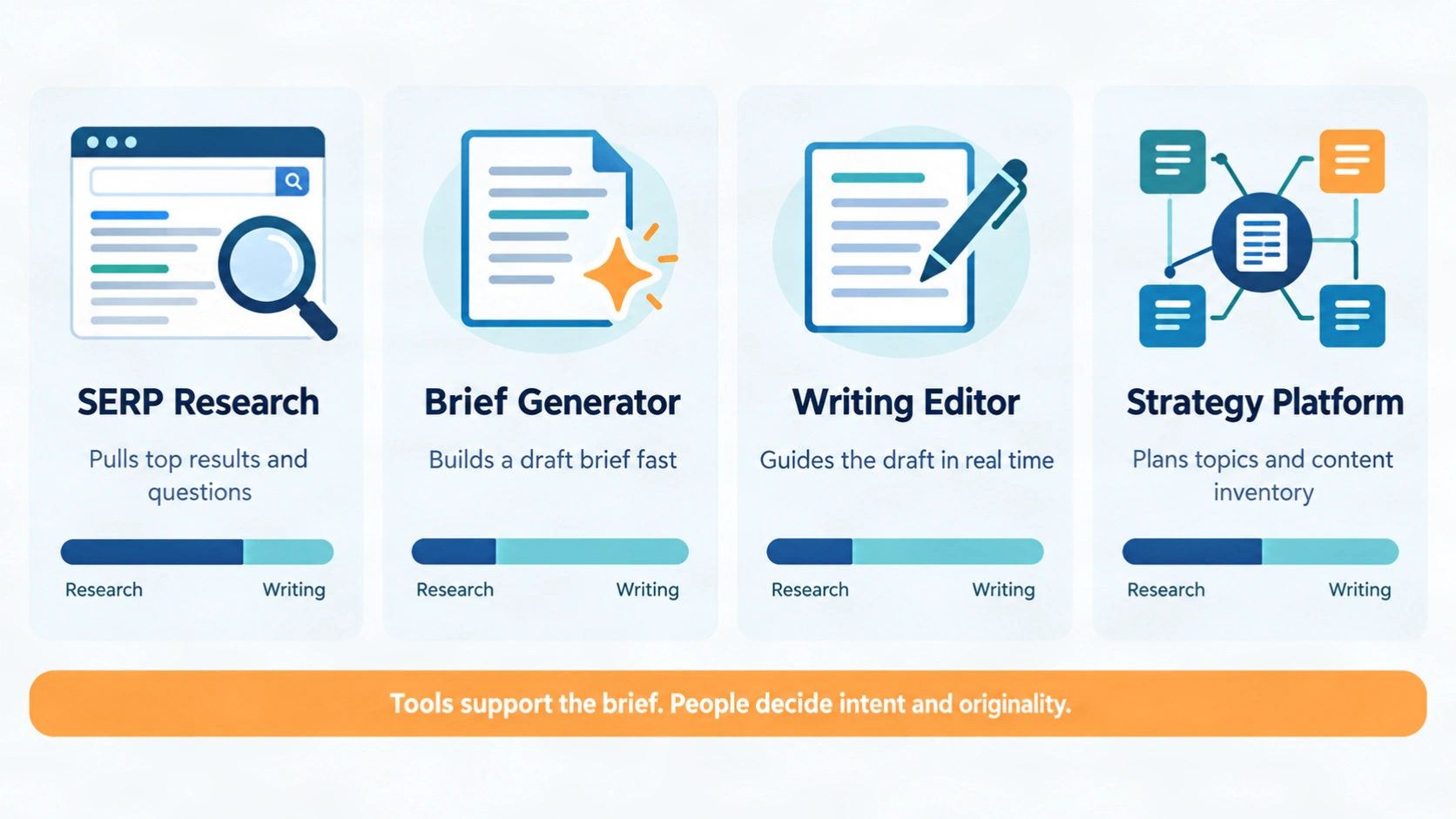
Content brief tools speed up SERP research, keyword suggestions, and outlines, but they do not replace human judgment about intent and originality. The table lists common options by best use.
| Tool | Best use |
|---|---|
| Semrush SEO Content Template | Teams already using Semrush that want a generated brief |
| Frase | Fast SERP-based briefs and outlines |
| Surfer SEO | A writer editor with real-time guidelines |
| Clearscope | Editorial content reports built from top results |
| MarketMuse | Content strategy, topic modeling, and content inventory |
| Thruuu | SERP extraction and downloadable brief templates |
| Content Harmony | Standardized briefs for multi-writer teams |
These descriptions draw on Semrush, Thruuu, Rankability, and The Rank Masters. Features and prices change, so confirm them on each vendor’s site before you buy.
Which Free Options Work for Content Briefs?
Google Docs, Google Search, and Google Keyword Planner are enough to build a solid brief at no tool cost. Use Search for People Also Ask questions, autocomplete, and related searches. Thruuu also offers free downloadable brief templates. The template in this guide works in any document editor.
What Do Content Brief Tools Miss?
Content brief tools miss intent nuance, brand facts, and first-hand experience. They show what the top pages have in common, which can push a writer toward the average. Google’s advice for the AI era points the other way:
“Focus on making unique, non-commodity content”
Google Search Central, Top ways to ensure your content performs well in Google’s AI experiences on Search, May 2025
Use the tool output as research, then add the angle and proof that only your site can offer.
[Image Placeholder – Paste Your image here
Common Mistakes When Writing an SEO Content Brief
The most common mistakes are listing keywords without intent, copying competitors, demanding keyword counts, writing overlong briefs, and skipping review.
- Keywords without intent. A keyword list does not tell the writer what the reader wants. Always add the intent sentence.
- Copying competitor outlines. Matching the average gives the reader no reason to choose your page. State your angle instead.
- Exact keyword quotas. Forcing repeated phrases makes the text worse for readers, which goes against Google’s people-first guidance. Ask for natural use in the title, opening, and key headings.
- A brief longer than the article. Long briefs go unread. Keep instructions that change the writing and cut background.
- No review or update. Briefs age as search results change. Review the template and active briefs on a regular schedule.
Experience Behind This Guide
This guide comes from my work as an SEO consultant with around five years of experience, mostly with European clients. I manage much of my work from Oman and work with SERP Panda. My core work covers Local SEO, Google Business Profile optimization, website structure, topical maps, content briefs, and content optimization, together with a team.
This guide reflects that workflow. It does not include client results or case-study figures, because none are published here.
Limits of This Guide
This guide does not promise rankings, traffic, or AI citations. It does not quote search volume or keyword difficulty, because those depend on the tool, date, and country. The statistics come from older B2B surveys and one secondary report, and they show association, not cause. The brief example is illustrative, tool details can change, and People Also Ask questions vary by location.
Conclusion
A strong SEO content brief is short, specific, and built from the search results. Start with the goal and the reader, confirm intent, find real gaps, and give the writer sources and limits. Then keep the structure flexible so the writer can add experience and proof. Copy the template, fill it for your next article, and revise it after each review.
Frequently Asked Questions
How long should an SEO content brief be?
A brief should usually fit on one to two pages. That is long enough to cover goal, reader, keywords, structure, and sources, and short enough for a writer to read before starting. Complex technical topics may need more detail, but if the brief runs longer than the article, cut background and keep only instructions that change the writing.
Who should write a content brief?
An SEO strategist, content editor, or the writer’s manager usually writes it, because that person knows the goal and the site. An experienced writer can draft the brief, but a strategist should review search intent and links. The key rule is that one named person owns the final version.
What is the difference between a content brief and an outline?
An outline lists the headings of one article, while a brief explains why the article exists and how to write it. The brief holds the goal, reader, keywords, sources, and rules, and it may include a suggested outline. Think of the outline as one section inside the brief.
What is the difference between a content brief and a creative brief?
A content brief covers one piece of content, while a creative brief covers a campaign. Creative briefs set message, channels, and brand direction. Content briefs turn that direction into instructions for one page. A marketing team often needs both, with the creative brief written first.
Do you need a content brief for every article?
No, but any article meant to rank or convert benefits from one, especially when several writers work on the site. A short brief works for a quick update: goal, reader, keyword, and links. Skip it only when the writer is also the strategist and keeps the same notes elsewhere.
How many keywords should a content brief include?
There is no fixed number. Include one primary keyword, then only the secondary keywords and questions that match the same search intent. Group them by topic so the writer sees sections, not a pile of terms. If a phrase needs its own page, list it under “do not cover” instead.
Can AI write an SEO content brief?
AI can draft a brief, but a person should check intent, sources, and gaps. Google says it focuses on the quality of content rather than how it is produced, in its guidance about AI-generated content. A brief is judged by the page it leads to, so verify every link, number, and competitor claim before sending it.
What should a content brief tell writers to avoid?
It should tell writers to avoid copying competitor wording, stuffing keywords, making unsourced claims, and covering topics that belong on other pages. Add brand-specific banned phrases and claims that need client approval. Clear limits protect the writer as much as the brand.
How do you add search intent to a content brief?
Write one sentence that states what the searcher wants to do, then note the page types that currently satisfy it. For example: “Reader wants step-by-step instructions, and results are mostly guides.” This line tells the writer the format, the depth, and what to answer first.
How often should you update a content brief template?
Review the template every few months and after any major change in your process or in search results. Update it when writers ask the same questions repeatedly, when edits repeat the same fixes, or when your site adds new pages to link. Keep dated versions so older briefs still make sense.