Content Gap Analysis: 7 Proven Tips
A complete guide to content gap analysis: find missing topics, analyze competitor content gaps, use the right tools, and build a topical map that drives sustainable organic growth.

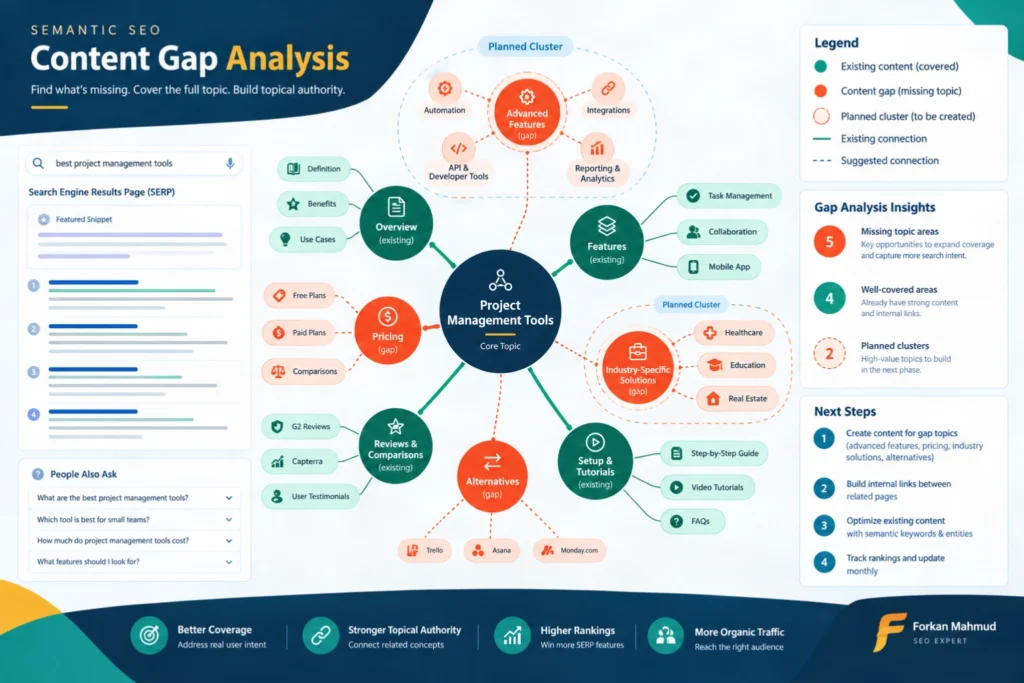
Content gap analysis is the process of finding topics, questions, and formats that your audience searches for but your website does not answer well. This guide shows how to do gap analysis step by step, which tools to use, and how to turn the results into a clear publishing plan. You will also get a copy-ready template.
This process compares your pages with competitors, search data, and real audience questions. You list the missing or weak topics, score them, and fix the best ones first. Repeat it every few months, because search results and competitor pages keep changing.
What Is Content Gap Analysis?
Content gap analysis is the process of finding relevant topics your website has not covered, or has covered poorly, by comparing it with competitors, search data, and audience needs. Shopify describes it as closing the space between the topics you already rank for and the topics that could be valuable for you to rank for. shopify
Think of your site as a map of one subject, such as local SEO. Searchers ask many related questions about that subject. It shows which questions your pages answer well, which they answer weakly, and which they skip.
The subject also has connected entities: the tools, people, concepts, and tasks around it. A good gap review checks those relationships too. If you want a deeper look at that idea, read what semantic SEO is and how entities connect topics.
I use this process as the step before a content brief. In my work on topical maps and content briefs, a gap list tells me what a page must add before I write the first heading.
What Counts as a Content Gap?
A content gap is any place where your content fails to meet what searchers need. It is not always a missing blog post. Sometimes the page exists but is thin, old, or built in the wrong format.
| Gap type | What it looks like | Typical fix |
|---|---|---|
| Missing topic | Competitors have a page on the topic and you have none | Publish a new page |
| Shallow coverage | Your page skips steps, examples, or evidence | Expand the page |
| Outdated content | Facts, tools, or screenshots are old | Update and re-date it |
| Intent mismatch | Your page type differs from what results show, such as a guide where searchers want a tool list | Rebuild around the intent |
| Format gap | Competitors use tables, templates, or video and you use plain text | Add the missing format |
Content Gap Analysis vs Keyword Gap Analysis
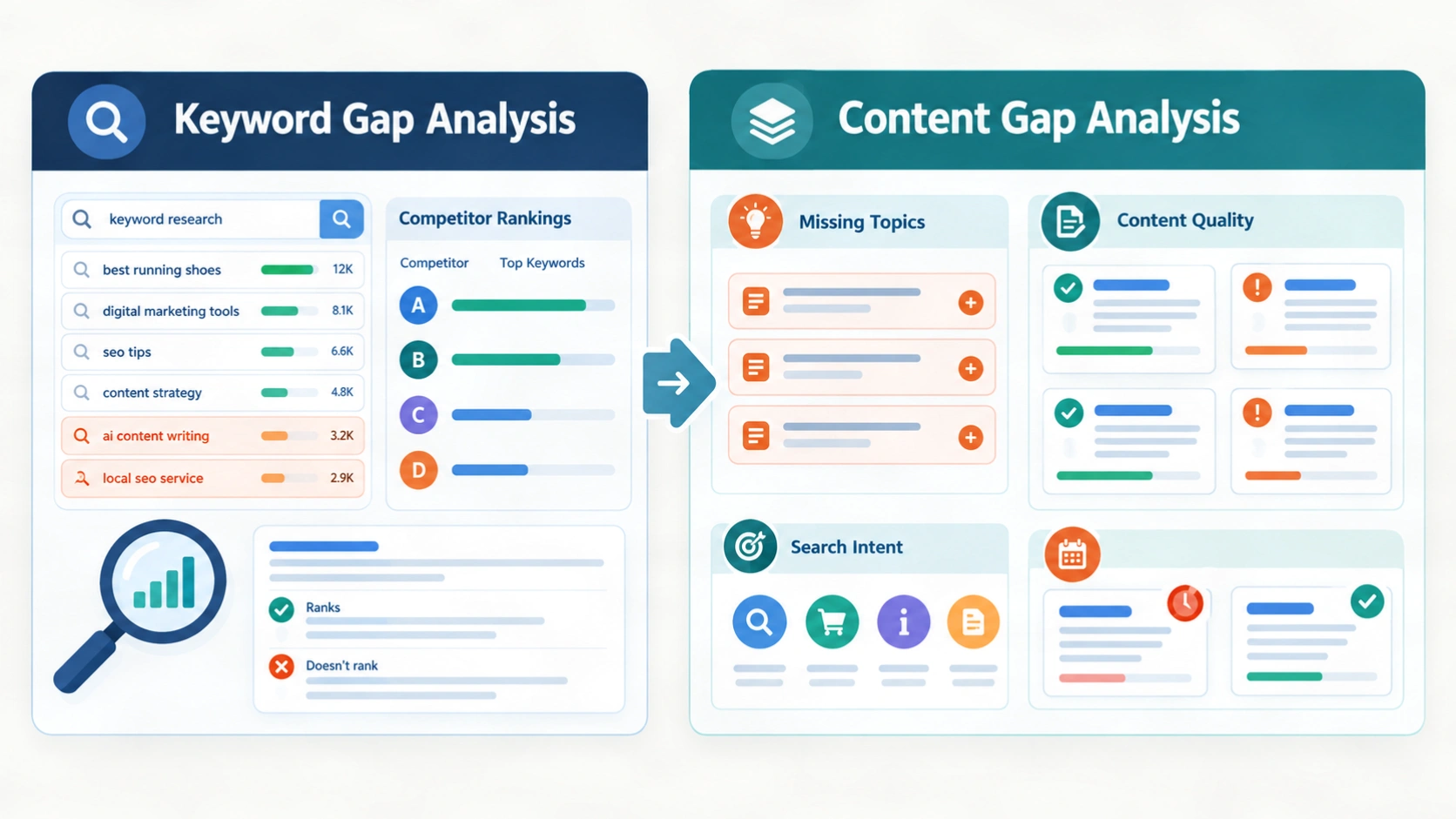
Keyword gap analysis lists search terms that competitors rank for and you do not, while content gap analysis also checks topics, depth, intent, and your existing pages. Shopify draws the same line: the broader process also looks at underperforming pages and topics that both you and competitors could be missing. shopify
A keyword gap is one input to the larger review. For example, a keyword report may show that you lack the term “content gap template.” The broader review then asks a better question: does that need a new page, a section inside an existing guide, or a downloadable file?
Why Does Content Gap Analysis Matter for SEO?
It matters because most published pages earn no search traffic, and gap work points you toward topics with real demand. Ahrefs studied about 14 billion pages in its Content Explorer database and found that 96.55% get zero traffic from Google, while 1.94% get one to ten visits a month. These figures come from Ahrefs’ own index and its traffic estimates, so treat them as a strong signal, not an exact count. Ahrefs’ 2023 search traffic study also advises choosing topics with organic traffic potential and matching search intent. ahrefs
Clicks are also harder to win. A 2024 SparkToro study using Datos clickstream data found that 58.5% of US Google searches ended with no click, and only 360 clicks per 1,000 US searches went to the open web. You can read the SparkToro and Datos zero-click study for the method and the EU numbers. searchengineland
Because of this, each page needs a clear reason to exist. Google’s May 2025 guidance on AI search tells site owners to focus on “unique, non-commodity content”. Its February 2023 post on AI-generated content asks for “original, high-quality, people-first content”. Google also says SEO can help when it is applied to people-first content. google
This work shows where you can add something that competitors do not offer. It does not promise rankings. It only helps you choose work with a better chance of being useful.
How to Do Content Gap Analysis Step by Step
To run one, set a goal, pick real competitors, audit your pages, compare keywords, check search intent, score each gap, and publish in priority order. The seven steps below follow that order.
Step 1: Set a Clear Goal for the Analysis
Start with one business goal, such as more consultation requests, more coverage of a topic cluster, or better results for a single service page. A gap list with no goal turns into a long wish list. Your goal tells you which gaps to ignore.
For example, a local SEO consultant who wants more enquiries should focus on gaps close to the service, not on every SEO question online.
Step 2: Choose Real Search Competitors
Pick three to five sites that rank for your target topics, even if they are not the businesses you see as rivals. Search five to ten of your core queries and write down the domains that appear again and again.
Blogs, tool vendors, and publishers can be search competitors for a service business. Track them separately from direct business competitors, because they compete for the same clicks.
Step 3: Audit Your Existing Content
List every relevant page with its URL, main topic, target query, last update date, and search performance. Build this in a spreadsheet.
Google Search Console’s Performance report shows queries and pages with clicks, impressions, and average position. Read the Search Console Performance report guide to see how the Queries and Pages tabs work. Pages with many impressions but few clicks often have a quality or intent gap. google
Step 4: Run a Keyword Gap Analysis
Enter your domain and your competitor domains into a keyword gap tool to list the terms they rank for and you do not. Export the list, then group terms by topic instead of by synonym.
Keep terms that two or more competitors rank for, because a shared pattern is stronger evidence than a single page. Do not treat every row as a gap. Some terms are off-topic, too broad, or too far from your goal.
Step 5: Check Search Intent on the Results Page
Open the results for each shortlisted query and note the page type, format, headings, and questions that top pages answer. Look at whether results show guides, tool lists, templates, or product pages.
Check People Also Ask boxes and related searches too. Compare at least three pages before you call something a gap. If only one competitor covers a topic, it may be a one-off choice, not a real need.
Step 6: Score and Prioritize Each Gap
Score each gap on three questions: business fit, evidence you can add, and effort. Give each a score from 1 to 3. This “Fit, Evidence, Effort” filter is a practical method, not an industry standard.
- Fit: Does the topic lead toward your service or goal?
- Evidence: Can you add first-hand notes, data, screenshots, or client questions that competitors lack?
- Effort: How much time will the page take?
Start with gaps that have high fit, high evidence, and low effort. A gap you cannot fill better than competitors is a weak opportunity, even when the keyword looks attractive.
Step 7: Brief, Publish, and Review
Turn each chosen gap into a content brief with the target query, search intent, required sections, sources, and internal links, then review results after a few months. A brief keeps the writer focused on the gap you found.
Run the full analysis again on a schedule. Shopify suggests every six to 12 months. Fast-moving niches may need it every quarter. Search results change with time, place, and device, so one old spreadsheet loses value quickly. shopify
Follow seven steps to identify content gaps, analyze competitors, prioritize opportunities, and improve your SEO content strategy.
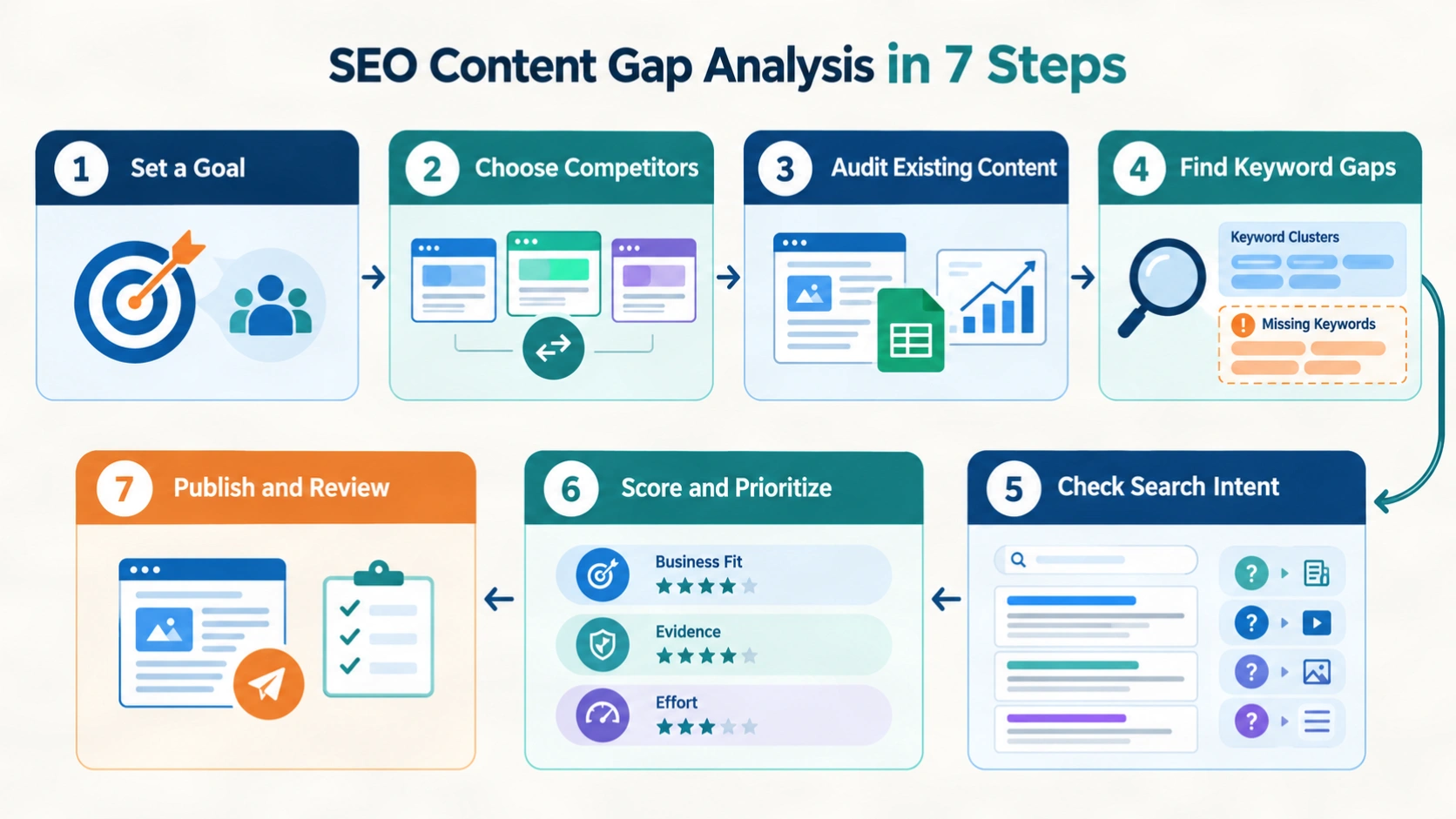
Follow seven steps to identify content gaps, analyze competitors, prioritize opportunities, and improve your SEO content strategy.
Which Content Gap Analysis Tools Should You Use?
Use Google Search Console for gaps on your own site, Ahrefs or Semrush for competitor gaps, and a manual results review for intent. No single tool covers all three jobs.
| Tool | Best use | Limit |
|---|---|---|
| Google Search Console | Shows queries and pages where your site already appears | Covers your site only, and rare queries are hidden |
| Ahrefs Content Gap (Site Explorer) | Compares your domain with competitors | Search volume and traffic values are estimates |
| Semrush Keyword Gap | Shows shared, unique, and missing keywords with intent labels | Number of competitors depends on your plan |
| Manual results review | Shows intent, format, depth, and unanswered questions | Slow, and the sample is small |
Ahrefs says you can run a gap analysis with its Site Explorer. Semrush’s Keyword Gap tool compares your domain with competitors and shows shared keywords, your unique keywords, and keywords where competitors rank and you do not. ahrefs influencermarketinghub
Treat every volume, difficulty, and traffic number as an estimate. Use the data to rank ideas, not to predict results.
How Do You Find Missing Topics for SEO Without Paid Tools?
You can find missing topics for SEO by combining Search Console queries, search result features, and questions from real customers. Free methods work well for small sites.
- Search Console queries: Find queries that bring impressions but have no dedicated page.
- Autocomplete and related searches: Type your topic into Google and note the suggestions and related searches.
- People Also Ask: Record the questions that repeat across several queries.
- Customer language: Review emails, sales calls, and support chats for questions your site never answers.
- Competitor headings: Read the H2 and H3 headings of the top pages and mark topics you lack.
Write your own answers. Use competitor headings to spot coverage, not to copy structure.
What Is a Competitor Content Gap and How Do You Spot One?
A competitor content gap is a topic, question, or format that competitors cover and your site does not. It is the most common gap type, and the easiest to find with a keyword gap tool.
To spot one, list the headings from three to five top pages for the same query. Mark each topic that appears on at least two competitor pages and not on yours. That overlap is a stronger signal than a single page.
Then look in the other direction. Note what none of the competitors answer well, such as clear examples, limits, or a usable template. These unanswered points are often your best chance to add original value.
Not every competitor topic fits your site. Skip topics that do not match your audience, goal, or expertise.
Content Gap Template You Can Copy
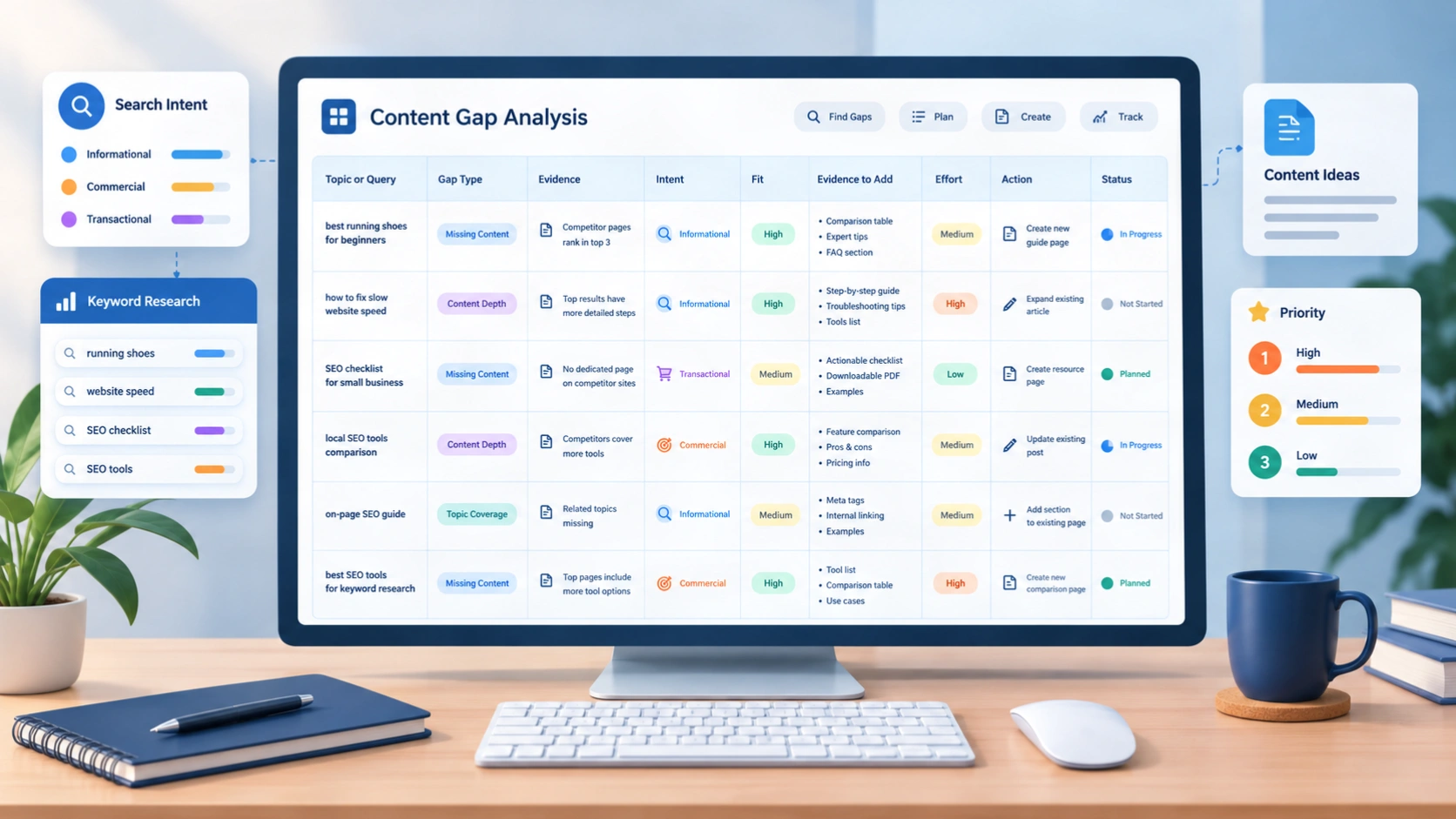
A content gap template is a spreadsheet that records each gap, its evidence, its score, and the action you will take. Copy the columns below into Google Sheets or Excel.
| Topic or query | Gap type | Evidence | Intent | Fit (1-3) | Evidence we can add (1-3) | Effort (1-3) | Action | Owner | Status |
|---|---|---|---|---|---|---|---|---|---|
| Example: content gap template | Missing topic | Two of four competitors include a template section | Informational | 3 | 2 | 1 | Add a template section to the main guide | Writer | To do |
The example row is illustrative only. Replace it with your own data. Sort by the three scores to build your publishing order.
Use a content gap analysis template to organize missing topics, evaluate opportunities, assign priorities, and track content improvements.
What Mistakes Should You Avoid in Content Gap Analysis?
The biggest mistakes are copying competitors, chasing every keyword, and treating the review as a one-time task. Each one wastes time or weakens your site.
- Copying page structures. Matching competitors adds nothing new. Cover the same need with your own examples and evidence.
- Publishing every gap. A long gap list does not mean you need a long calendar. Use the scores.
- Ignoring existing pages. Updating a weak page is often faster than writing a new one.
- Skipping intent. A keyword can look perfect, but the wrong page type will not satisfy the searcher.
- Never repeating the review. Competitors update pages, and search results shift.
What Are the Limits of Content Gap Analysis?
It cannot predict rankings or traffic; it only shows where the evidence suggests you could be more useful. Tool numbers are estimates, and search results differ by the time, place, device, and history of the person searching. This guide does not promise rankings, traffic, or AI citations. google
Conclusion
This process gives your content plan a base in evidence. You compare your site with competitors and real search behavior, find the missing or weak topics, and score them by fit, evidence, and effort. Then you brief, publish, update, and review on a schedule.
Start small. Pick one topic cluster, run the seven steps, and fill the top three gaps. If your gap list covers many related subtopics, a topical map can organize them into clusters and a clear publishing order. My topical map service for SEO is built for that step.
Frequently Asked Questions
What is content gap analysis in SEO?
It is the process of finding topics, questions, and formats your audience wants but your site covers weakly or not at all. You compare your pages with competitors, search data, and customer questions. The result is a prioritized list of pages to create, expand, or update.
What is an example of a content gap?
An example is a competitor ranking for “content gap template” while your guide has no template. Another is a page that explains a tool but skips setup steps that searchers expect. A third is an old article with outdated screenshots. Each shows missing, shallow, or stale coverage compared with what searchers need.
How do you do a content gap analysis?
Set a goal, choose three to five search competitors, and audit your own pages in Search Console. Run a keyword gap report, check search intent on the results page, and score each gap. Then write briefs for the best gaps and review the results after a few months.
What is the difference between a content gap and a keyword gap?
A keyword gap is a search term competitors rank for and you do not. A content gap is wider: it can be a missing topic, a thin section, an old page, or the wrong format. Keyword gaps are one data source for finding content gaps, not a replacement for the full review.
Which tool is best for finding content gaps?
No single tool is best for every case. Google Search Console is free and shows gaps on your own site. Ahrefs and Semrush compare your domain with competitors. Manual review of search results shows intent and format. Most teams get the best view by combining one paid tool with Search Console.
Can you find content gaps for free?
Yes. Use Search Console to find queries with impressions but no strong page. Add Google autocomplete, related searches, and People Also Ask questions. Read competitor headings by hand, and collect questions from customers. Free methods are slower and give fewer competitor keywords, but they work well for small sites and single topics.
How many competitors should you analyze?
Three to five search competitors is a practical range. Fewer than three gives a weak pattern, and more than five adds noise and takes longer. Choose sites that repeatedly rank for your target queries, even if they are not your direct business rivals. Separate publishers and tool vendors from true business competitors.
How often should you run a content gap analysis?
Run it every three to twelve months, depending on how fast your niche changes. Fast niches with frequent competitor updates suit a quarterly review. Slower niches can use twice a year. Also run a smaller check after a major search change or a clear drop in traffic.
How do you prioritize content gaps?
Score each gap on business fit, the evidence you can add, and the effort needed. Use a 1 to 3 scale for each, then start with high fit, high evidence, and low effort. Skip gaps where you cannot add anything better than existing pages, even if the keyword looks attractive.
Do content gaps matter for AI search results?
They can help indirectly, because fixing them pushes you to cover real questions with original, clear answers. Google says it wants unique, people-first content in its AI features too. Still, no method guarantees citations in AI answers or Google AI Overviews, so treat any gain as a possibility, not a promise.