Topical Authority for New Websites: How to Build It From Scratch
Discover how new websites can successfully establish topical authority from scratch using a structured content strategy, niche focus, and targeted keywords.

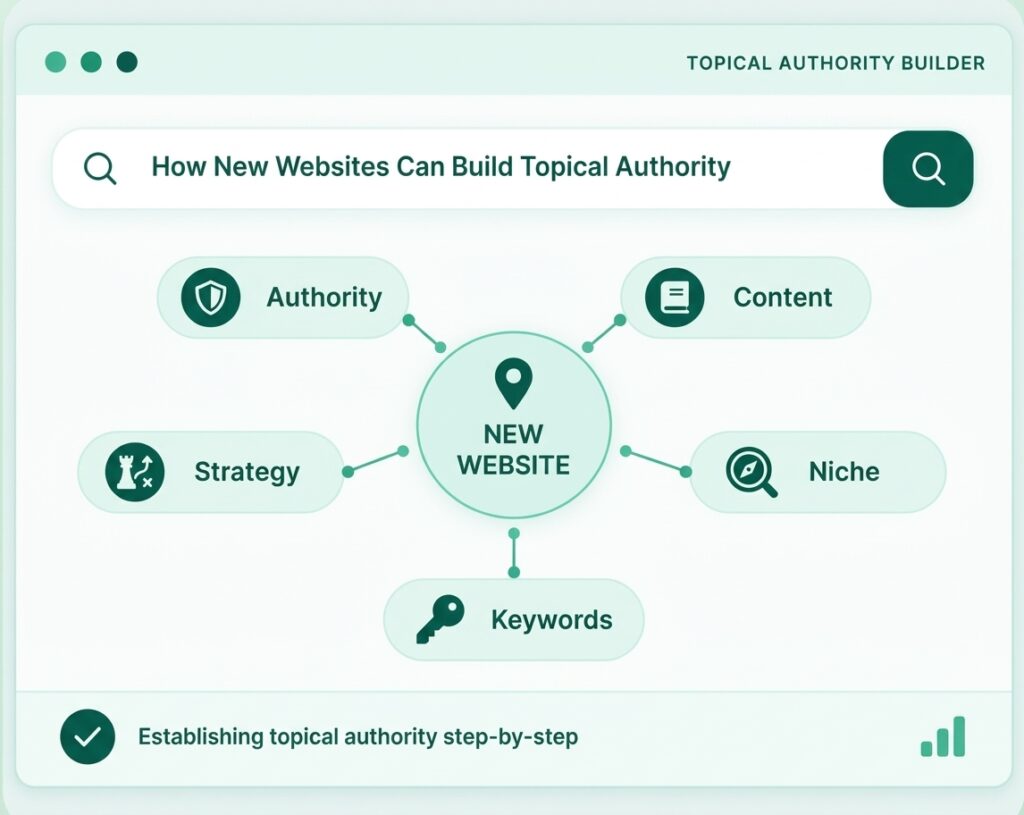
Topical authority for new websites is the trust a young site earns by covering one subject fully, accurately and in a connected way, before it tries to cover anything else. A new domain has no history, so a clear plan matters more than a large word count. This guide shows what to publish, in what order, and how to tell whether the plan is working.
A new site can build topical authority by choosing one narrow subject, mapping the questions people ask, publishing a pillar and supporting articles in a sensible order, and linking them with purpose. No one can promise a timeline or a number of articles, so measure progress in Google Search Console and adjust.
What Is Topical Authority for New Websites?
Topical authority for new websites means a site is seen as a reliable, focused source on one subject, even though it has no long track record. It is an SEO concept, not a score that Google publishes. I could not find an official Google topical authority score, so treat the idea as a planning habit: cover a subject fully, keep the pages connected and keep the quality high.
What topical authority means, and what it does not
Topical authority describes depth and coverage on a subject; it does not describe brand size, domain age or a number you can read in a tool. Tool scores are estimates made by the tool provider. They can help you compare ideas, but they are not Google’s view of your site.
Google’s guidance asks for helpful, reliable, people-first content. That is the standard each article in your plan must meet, whatever the size of the site.
Can a New Website Build Topical Authority?
Yes, a new website can build topical authority, but the time it takes depends on competition, content quality and how steadily you publish. A new site has less history and fewer links than established competitors, so it needs a narrower target and stronger pages.
Sources online disagree on speed. Some say a focused new site can make progress quickly, and others say it takes years. I found no reliable evidence for any fixed timeline, so I avoid promising one. What you can control is focus: one subject, useful articles, clear links and regular updates.
A small site often does better when it competes on a narrow topic where larger publishers give only brief coverage. Depth in a small area is easier to build than breadth across a large one. The same advice holds for topical authority for new site projects of any size: narrow focus first, breadth later.
Topical Authority vs Domain Authority for New Sites
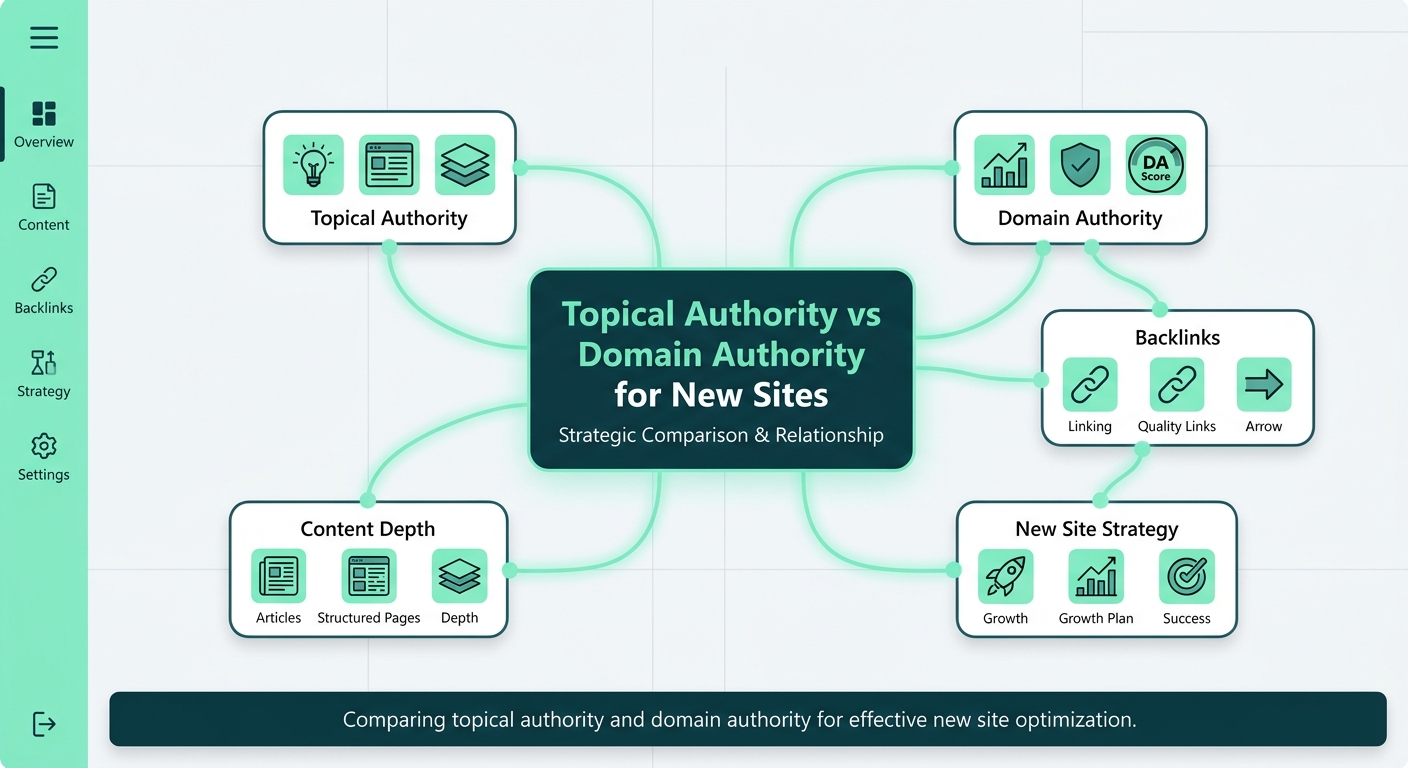
Topical authority is about how well you cover a subject, while domain authority is a third-party tool metric that estimates the overall strength of a site’s links. Google does not use a metric called domain authority. The two ideas overlap in practice, because strong, relevant content tends to attract links over time.
For a new website, this means you cannot rely on site-wide strength at the start. You can only control how clearly your content covers one subject. Links and mentions still matter for trust, so plan to earn them with content worth referencing, but do not wait for them before you publish.
Start With Core Topics: How to Choose One Narrow Niche
Start with core topics by choosing one narrow subject that you understand well, that readers search for and that you can cover with more care than existing pages. A broad subject such as marketing or health needs years of work. A narrow subject, such as beginner guides for one tool or one type of local service, can be covered fully by a small team.
Use four checks before you commit to a niche:
- You can explain the subject accurately and add first-hand detail.
- People ask questions about it, which you can confirm in search suggestions, forums and Google Search Console once the site has data.
- Current results leave questions unanswered or answer them thinly.
- Room to grow. The subject has enough related questions to support at least 20 articles. If you struggle to list 20, narrow the niche further or widen it slightly.
If your new site is a software product, a local business or an online shop, the same method applies with different page types. See the guides on a topical map for SaaS websites, a topical map for a local business and a topical map for an e-commerce store.
If you serve readers in more than one country or language, treat each language as its own research task. Questions, wording and competition can differ between regions, so a direct translation is not a plan.
How to Build Topical Authority for New Websites Step by Step
To build topical authority for new websites, pick one core topic, map the questions around it, group them into clusters, publish a pillar and supporting articles, link them, then review and fill gaps. This is a practical new website SEO content plan, and it lets you build authority from scratch without paid tools.
Step 1: Pick one core topic you can cover fully
Write one sentence that names the subject and the reader. For example: home coffee brewing for beginners. Anything that does not fit that sentence stays out of the plan for now.
Step 2: Map the questions your audience asks
List every question a reader might ask, from beginner to advanced. Use search suggestions, People Also Ask boxes, forums, customer emails and your own experience. Do not worry about order yet.
Step 3: Group questions into clusters
A cluster is a set of related questions that belong to one theme. Place each question in one group, and give each group one pillar topic. Questions that mean the same thing become one article, not two.
Step 4: Publish a pillar and supporting articles
Publish the pillar article first, then the supporting articles that answer narrower questions. The pillar gives an overview and links to each supporting article. Each supporting article goes deep on one question and links back.
Step 5: Link everything with purpose
Add internal links wherever a reader would naturally want the next answer. Use descriptive anchor text, and link new articles from older ones on the day you publish.
Step 6: Review and fill gaps
Every month, check which questions you have not answered and which pages get no impressions. Add the missing articles, improve weak ones and merge pages that compete for the same question.
Low Competition Topics for a New Site
Low competition topics are questions where current results are thin, outdated or only loosely match what the searcher asks. They suit a new site because a well-made page has a fair chance of being useful. Competition is relative, so judge it by looking at the results, not only at a tool score.
To find them without paid tools:
- Search suggestions. Type your topic into Google and note the suggested endings and related searches.
- Forums and communities. Look for questions people ask repeatedly and answers that feel incomplete.
- Result checks. Search each question and read the top pages. If they are generic, old or only partly relevant, you have a gap.
- Google Search Console. After a few weeks of data, check the queries where you already appear and write fuller answers for them.
- Specific questions. Narrow a broad topic by audience, place, tool or situation, because specific questions usually face less competition.
Low competition does not mean low value. A narrow question that matches a real need can bring the right readers. For a wider view of planning content around goals and intent, read the SEO content strategy guide.
Publish Order for a New Site
The best publish order for a new site starts with the pillar, then the questions closest to a decision, then the wider informational topics. This order builds a clear centre first and gives early visitors useful next steps.
- The pillar article. It defines the subject and links to the supporting pages as they appear.
- Core question articles. These answer the most direct questions, such as what it is, how it works and how to start.
- Decision articles. Comparisons, costs and mistakes help readers choose or act.
- Supporting detail. Narrow questions, troubleshooting and examples add depth.
- Wider topics. Add related themes only after the core cluster is complete.
Publish at a pace you can keep. A steady rhythm of one or two good articles a week is more useful than a burst followed by silence. Publishing speed alone does not create authority, because each article still has to be useful.
Topical Authority for New Websites: The First 20 Articles to Publish
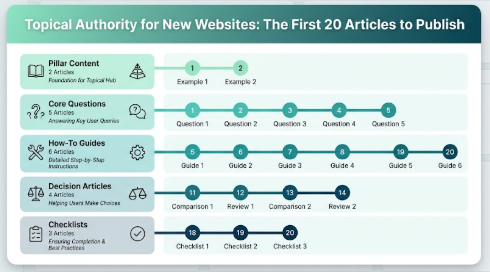
The first 20 articles for a new site should cover one pillar, the core questions, the decision questions and a few examples, all in one narrow niche. The table below is an illustration for a fictional beginner coffee brewing website. It is not client data and not a fixed formula.
| # | Article | Role |
| 1 | Home coffee brewing for beginners: the complete starter guide | Pillar |
| 2 | What equipment do you need to brew coffee at home? | Core question |
| 3 | How to choose coffee beans for home brewing | Core question |
| 4 | How to grind coffee for each brewing method | Core question |
| 5 | How to brew coffee with a French press | How-to |
| 6 | How to make pour-over coffee at home | How-to |
| 7 | How to use a moka pot | How-to |
| 8 | How to make cold brew at home | How-to |
| 9 | French press vs pour-over: which suits you? | Decision |
| 10 | Burr vs blade grinders: what is the difference? | Decision |
| 11 | How much does a home brewing setup cost? | Decision |
| 12 | Why does my coffee taste bitter? | Problem |
| 13 | Why does my coffee taste sour? | Problem |
| 14 | How to clean your brewing equipment | Maintenance |
| 15 | How should you store coffee beans? | Maintenance |
| 16 | What water is best for brewing coffee? | Supporting |
| 17 | Coffee to water ratios explained | Supporting |
| 18 | Common coffee brewing mistakes | Mistakes |
| 19 | A one-week brewing practice plan for beginners | Example |
| 20 | Home brewing checklist for beginners | Checklist |
The pattern matters more than the subject: one pillar, several how-to articles, a few comparisons, problem-solving pages and a closing checklist, all linked. If you want a specialist to check that structure before you publish, my website SEO services include site structure planning.
How Many Articles Build Topical Authority?
No fixed number of articles builds topical authority, so treat any number you read as a planning guide and not as a rule. Guides online give ranges from 10 to 50 or more, and I found no reliable source for a threshold.
A practical way to plan is to count the distinct questions your readers ask in your niche. Twenty is a sensible first target for a narrow niche, because it covers a pillar and its main questions. After that, add articles only when they answer a new question. A small set of strong, linked pages usually does more than a large set of weak ones.
How Long Does a New Website Need to Build Authority?
There is no official timeline, and sources that give exact months or years do not show reliable evidence. Your own results depend on competition, content quality, publishing pace, links and the technical health of the site.
Expect months of steady work before the data tells a clear story, and judge by trends, not by single weeks. New pages can also take time to be crawled and indexed. A better question than how long is what the data shows now: more impressions, more queries and more pages receiving any search traffic are all signs of progress.
Internal Linking for a New Site
Internal links connect your articles into clusters, so readers and search engines can see how the topics relate. On a new site they also help new pages get discovered.
- Supporting articles link to the pillar. Use anchor text that describes the pillar’s subject.
- The pillar links to every supporting article. This gives each page at least one link from a relevant page.
- Related articles link to each other. Link only where it helps the reader, for example from a how-to to the matching troubleshooting article.
- No orphan pages. Every article needs at least one contextual link pointing to it.
- Update older articles. When you publish a new page, add a link to it from older related pages.
Technical and Quality Basics Before You Publish
Before you publish at scale, confirm that search engines can crawl and index your pages and that each article is worth reading. Authority built on pages that cannot be found does not help anyone.
- Crawlable and indexable pages. Check that pages are not blocked and that your sitemap is submitted. The technical SEO audit guides explain how crawling and indexing work.
- Clean structure. Use clear URLs, sensible categories and a navigation that shows your core topics.
- Original value. Add your own process, examples or data. Google advises focusing on unique, valuable content for people, including as search evolves with AI features.
- Check names, dates and claims before publishing. Do not invent results or quotes.
- Plain language. Write simply so a beginner can follow each step.
A 12-Week New Website SEO Content Plan
A 12-week plan gives a new site a clear rhythm: set the foundation, publish the core, then fill gaps. The schedule below is an example, not a promise of results.
- Weeks 1 and 2. Choose the niche, list questions, group them into clusters and check technical basics.
- Weeks 3 and 4. Publish the pillar and the first two or three core question articles.
- Weeks 5 to 8. Publish how-to and decision articles, and link each one as it goes live.
- Weeks 9 and 10. Publish problem-solving, mistakes and example articles.
- Weeks 11 and 12. Review Google Search Console, update weak pages and plan the next batch.
[Image Placeholder – Paste Your image here]
How to Measure Progress
Measure progress with Google Search Console by watching impressions, queries and the number of pages that receive search traffic. Google’s Performance report help page explains clicks, impressions and average position.
Check these signals each month:
- Impressions and clicks. Are they rising across the cluster?
- Query variety. Are you appearing for more questions than last month?
- Page coverage. Are more of your pages getting any search traffic?
- Do two of your pages compete for one query?
Do not react to one week of data. Look at trends across several months before you change the plan.
Common Mistakes New Websites Make
The most common mistakes are choosing a niche that is too broad, publishing without a plan, ignoring search intent and leaving pages unlinked. For a longer list with fixes, read the guide to common topical authority mistakes.
- Starting too wide. A broad subject spreads a young site too thinly.
- Publishing random topics. Unrelated posts weaken the focus of the site.
- Copying competitors. Repeating what already ranks adds nothing new.
- Skipping links. Isolated pages do not form clusters.
- Expecting quick results. Judging the plan after a few weeks leads to wrong decisions.
Topical Authority Checklist for a New Website
Use this checklist to confirm that your plan is ready before you publish and again each month.
- Core topic written. One sentence names the subject and the reader.
- Questions listed. You have a list of at least 20 distinct reader questions.
- Clusters defined. Each question belongs to one group with one pillar.
- One keyword per page. No two pages target the same question.
- Publish order set. The pillar comes first, followed by core and decision articles.
- Links planned. Every supporting article links to the pillar and to related pages.
- Technical basics checked. Pages can be crawled, indexed and found in the sitemap.
- Original value added. Each article has something a reader cannot find on every other page.
- Search Console connected. You can see impressions and queries.
- Review scheduled. A monthly check is in the calendar.
Next Step for Your New Website Content Plan
If you want a specialist to build the plan, a topical map shows which articles to write first and how they connect. I build topical maps, content briefs and website structure plans as part of my SEO work, and you can see the approach on my topical map service for SEO. If writing capacity is the limit, my SEO content writing service can turn the plan into articles. Bring a list of your site’s current URLs and ask for a free topical map audit, so the review starts with your real pages.
Conclusion
A new site builds authority by being focused, useful and connected, not by publishing the most pages. Choose one narrow niche, map the questions, publish the pillar first and link each new article into the cluster. Treat every number you read about articles or months as a rough guide and let your own Search Console data set the pace. Start with the first 20 articles, review the results, then expand with care.
Frequently Asked Questions
Can a new website build topical authority?
Yes, a new website can build topical authority, but no one can promise how quickly. Focus on one narrow subject, publish useful connected pages and track progress in Google Search Console.
How long does a new website need to build authority?
There is no official timeline. Results depend on competition, content quality, publishing pace and links, so judge progress by trends over several months.
How many articles build topical authority?
No fixed number builds it. Twenty is a sensible first target for a narrow niche, and after that you add articles only when they answer new questions.
What should a new website publish first?
Publish the pillar article first, then the core questions and decision articles closest to your reader’s needs. Wider topics come later.
How do you find low competition topics for a new site?
Check search suggestions, forums and Google Search Console, then read the top results for each question. If they are thin, old or only partly relevant, you may have a gap.
Is topical authority more important than backlinks for a new website?
Neither replaces the other. Strong focused content helps relevance, and links and mentions help trust, so plan to earn both over time.
Should a new website cover many topics or one niche?
A new website usually does better with one narrow niche first. Add related subjects only after the core topic is covered well.
How often should a new website publish?
Publish at a pace you can keep, such as one or two quality articles a week. Consistency matters more than bursts of output.
Does topical authority help in AI search?
Clear, accurate and well-organised content can help people and AI features understand your pages, but nothing guarantees visibility. Focus on original, useful answers.
How do you know topical authority is working?
Look for rising impressions, more queries and more pages receiving search traffic in Google Search Console. Check these trends monthly and adjust the plan.