Topical Authority Mistakes to Avoid
A simplified guide to technical SEO basics for beginners: how crawling and indexing work, building entity connections, and structuring your site architecture while avoiding topical authority mistakes to build lasting search visibility.

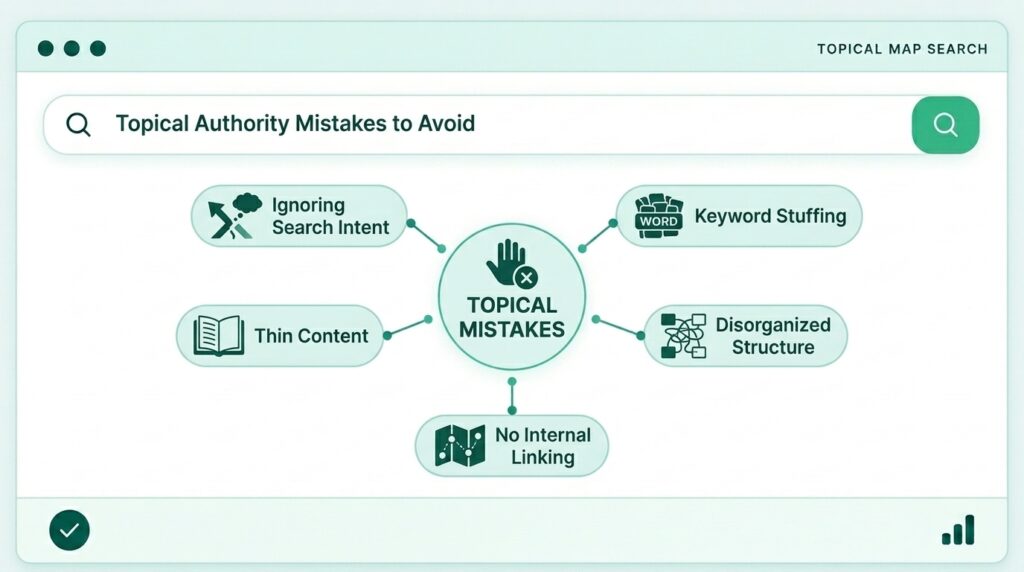
Topical authority mistakes are the content and site-structure errors that stop a website from looking like a reliable source on its subject. Most of them are easy to spot once you know where to look: a niche that is too wide, pages that overlap, thin posts, weak internal links, and content that misses what searchers want. This guide explains each error and shows how to fix it.
Topical authority is not an official Google score, so treat it as a practical way to describe focused, well-connected, useful content. The ten mistakes below are the most common reasons that effort stalls. Fix search intent, page overlap, thin pages, and internal links first.
Topical Authority Mistakes: What They Look Like When Rankings Stall
These mistakes usually show up as a site that publishes often but ranks for very little. The content exists, yet Google cannot see a clear, connected body of work on one subject, and readers cannot find a clear path through it.
What topical authority means, and what it does not
Topical authority is the idea that a site earns trust on a subject by covering it deeply, accurately, and in a connected way. It is an SEO term, not a Google metric. If you want more background before the mistakes, browse these topical authority articles.
The concept is useful as a planning habit. It reminds you to cover a subject fully, link related pages, and stay focused. It becomes harmful when people treat it as a score they can raise with a formula.
Common signs your topical authority is not working
The clearest signs are flat impressions, pages that never rank, several pages competing for one query, and traffic that lands on only a few posts. Watch for these patterns:
- New posts are published but get almost no impressions.
- Two or more URLs swap places for the same search query.
- A few articles bring most of the traffic, while the rest sit unread.
- Rankings stay low even though the content looks well written.
Each sign points to a cause covered in the mistakes below. Do not react to a single week of data. Look for patterns across several months before you change your plan.
Topical Authority Myths That Lead to Wrong Decisions
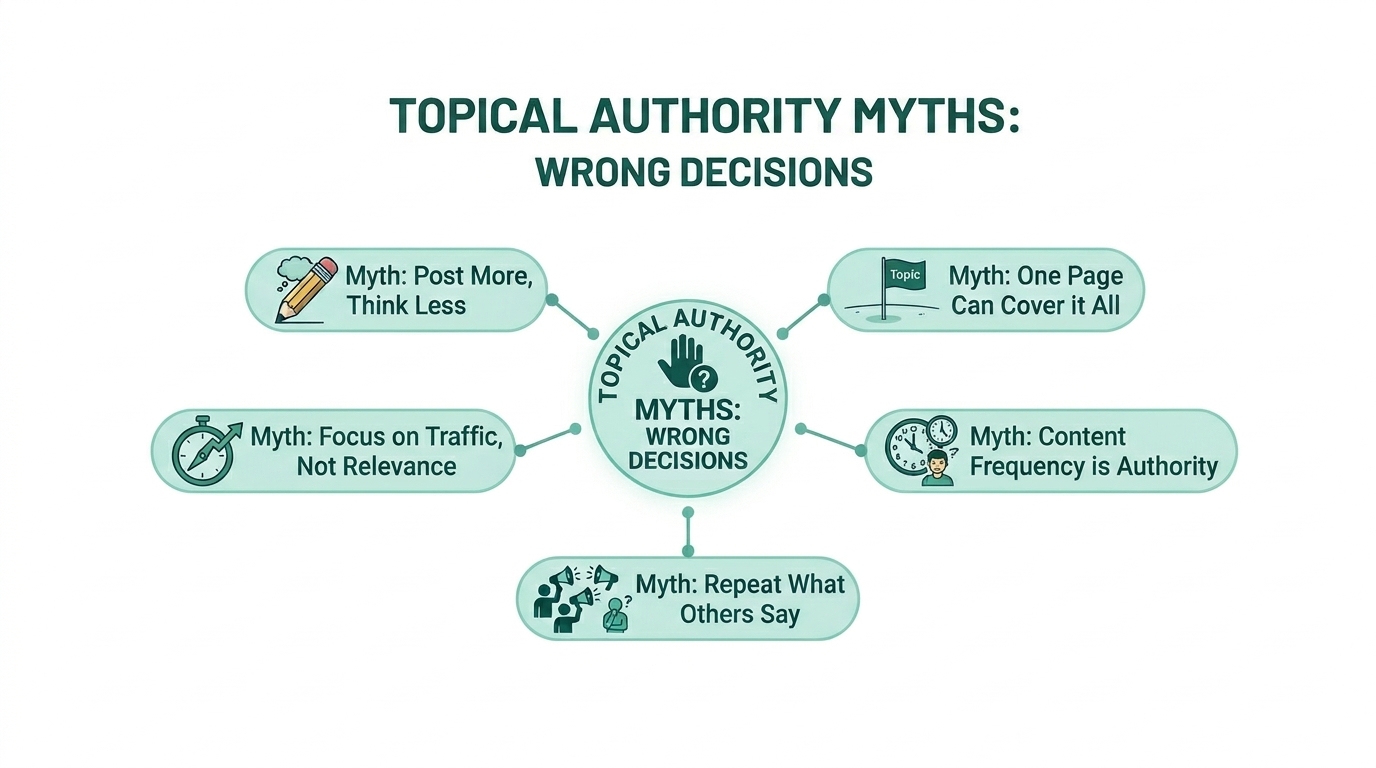
Three myths cause most of the wasted effort: that Google has a topical authority score, that more articles always help, and that topical depth replaces links and trust. Separating fact from interpretation keeps your plan realistic.
Myth: Google has a topical authority score
Fact: Google has not published a general topical authority score. In May 2023, Google described a topic authority system that helps surface expert sources for news-related queries. That is a news ranking system, not a score you can read for any website.
When the idea came up in a Reddit discussion, John Mueller’s advice, as Search Engine Journal reported, was “Don’t worry about it.” My reading is that you should not chase a number. Build useful, relevant, well-structured content and let that work speak for itself.
Myth: More articles always mean more authority
Fact: Volume without usefulness adds noise, not trust. A site with hundreds of shallow posts can look less reliable than a site with a few dozen strong, connected ones. Ask what each new article adds to the subject before you write it, not how many you can publish. Readers judge the quality of each page, and weak pages dilute the rest of the section.
Myth: Topical authority replaces links and site trust
Fact: Topical depth helps relevance, but it does not replace links, brand trust, or technical health. A site can cover a subject thoroughly and still struggle if search engines cannot crawl its pages or if no other site ever references it. Treat topical depth as one part of a wider SEO plan.
10 Topical Authority Mistakes That Hold Back Your Rankings
These ten mistakes are the most common reasons a topical authority plan stalls, and each one has a practical fix.
Mistake 1: Choosing a niche that is too broad
A niche that is too broad spreads your content thin, so no single subject gets enough depth to look reliable. Subjects like “SEO”, “marketing”, or “health” are covered by large publishers with big teams. A smaller site does better with a narrower focus, such as SEO for dental clinics instead of SEO in general.
This applies to local businesses as well. A plumber’s website that tries to cover home improvement, property, and finance will look less focused than one that explains plumbing problems in its own service area. Our local SEO articles show how local relevance shapes that focus.
How to fix it: Choose a core subject you can cover fully and know well. Add closely related subjects only after the core is complete.
Mistake 2: Building a topical map with no hierarchy or priorities
A topical map without hierarchy is only a long keyword list, and it gives writers no clear order or purpose. The usual topical map mistakes are no pillar topic, no grouping of subtopics, mixed search intents, and several entries for the same query.
How to fix it: Group topics by subtopic, mark the intent of each URL, decide which page is the pillar and which pages support it, and rank pages by importance and effort. If you would rather have help with this planning work, my topical map service covers it.
Mistake 3: Publishing without internal links
Publishing without internal links leaves new pages isolated, so neither readers nor search engines can see how they connect. A page that nothing links to is called an orphan page, and it is easy to miss.
How to fix it: Link each supporting page to its pillar and to two or three closely related pages. Link the pillar back to every supporting page. Use descriptive anchor text that tells the reader what the destination covers, and avoid vague phrases such as “click here”. Check for orphan pages every quarter with a site crawler. For example, a guide on keyword research should link to related guides on search intent and content briefs, and those guides should link back.
Mistake 4: Ignoring search intent
Ignoring search intent means writing a page type that does not match what searchers want, so even good content fails to rank. Someone searching “what is topical authority” wants an explanation. Someone searching “SEO audit services” wants to hire a provider. A blog post will not satisfy the second searcher, however well it is written.
How to fix it: Read the current results for your query before writing. Note the page types, the angle, and the questions they answer, then match that intent with one page per intent. Our content strategy and brief guides explain how to turn that research into a clear brief.
Mistake 5: Letting content cannibalization split your pages
Content cannibalization happens when two or more pages target the same intent, so they compete and neither becomes the clear answer. Different titles and slightly different wording do not help if the searcher wants the same thing from both pages.
How to fix it: In Google Search Console, look for queries where more than one of your URLs appears. Then merge them, redirect the weaker one, or rewrite them so each serves a distinct intent. Update internal links so they point to the page you keep.
Mistake 6: Filling the topical map with thin content
Thin content is a page that adds little beyond what readers can already find, such as a short post written only to fill a gap in the map. Length is not the test. A short page that fully answers a narrow question can be strong, while a long page that repeats common advice is still thin.
How to fix it: For every page, ask what a reader gets here that they cannot get elsewhere. Expand the page with steps, examples, or evidence when you have them. Merge it into a stronger page when you do not. Never publish a page only to tick off a topic.
Mistake 7: Chasing trending topics outside your niche
Chasing trends outside your niche dilutes your focus and gives the site a scattered identity. A new tool or update appears, everyone writes about it, and soon the site covers ten unrelated subjects.
How to fix it: Before writing, ask whether the topic supports your core subject and your audience. If the answer is no, skip it. A trend is not a reason to leave your lane.
Mistake 8: Publishing generic content with no original value
Generic content repeats what the top results already say, so it gives readers and search systems no reason to prefer your page. Google’s guidance on people-first content asks creators to make helpful, reliable content primarily for people. Text that restates the same points in new words does not meet that standard.
How to fix it: Add something only you can offer: your own process, verified examples, data you own, screenshots, or expert input. Cover the entities and relationships a subject needs, as explained in our guide to semantic SEO and entity coverage. If you use AI tools to draft, review every claim and add real experience before publishing.
Mistake 9: Relying only on on-site content
Relying only on on-site content ignores the fact that trust is also built by what other sites say about you. Mentions, citations, and links from relevant sources all show that people value your work.
How to fix it: Publish something worth referencing, such as an original study, a useful tool, or a clear guide. Share it where your audience already spends time, and let links come as a result. Avoid buying links or trading them in bulk. Local businesses can add to this trust picture with a well-kept Google Business Profile, consistent business details across directories, and genuine customer reviews. These signals support trust, though none of them guarantees rankings.
Mistake 10: Treating topical authority as a finish line
Topical authority is never finished, because search demand, competitors, and your own content keep changing. There is no point at which Google confirms that you have completed the job.
How to fix it: Review your content every quarter. Update old pages, retire weak ones, and add new subtopics based on the queries Search Console shows. Results take time, so judge progress by trends over months, not by single weeks.
Why Topical Authority Is Not Working: Symptoms, Causes and Fixes
Topical authority usually seems to fail because of a specific, fixable problem such as overlap, weak intent match, thin pages, or poor linking. Check that your content is indexed first. Then use this table to match what you see with a likely cause.
| What you see | Possible cause | First fix |
| Pages are indexed but do not rank | Thin or generic content, or an intent mismatch | Compare with current results and rewrite for intent |
| Several URLs swap places for one query | Content cannibalization | Merge, redirect, or differentiate them |
| New posts get no impressions | Orphan pages or weak internal links | Add contextual links from related pages |
| Only one or two posts bring traffic | No supporting pages, or a niche that is too broad | Build supporting pages around the pillar |
| Rankings slip after off-topic posts | A scattered focus | Merge or remove off-topic posts and refocus |
These causes are likely, not certain. Always confirm with your own data before making large changes.
When new posts get indexed but do not rank
If new posts are indexed but do not rank, the problem is usually content quality or intent, not crawling. Search your target query, open the top results, and compare their format and depth with your page. If they answer a different question than yours, rewrite your page to match the real intent.
When several pages compete for one query
If several pages compete for one query, you likely have cannibalization, and the fix is to choose one page as the main answer. Decide which URL deserves to rank, strengthen it, and merge or redirect the others. This gives readers and search engines a single clear destination.
How long to wait before judging results
There is no official timeline, so judge progress by trends over several months rather than by days or weeks. Many practitioners use a window of a few months as a rule of thumb, but this is an estimate and not a promise. Watch impressions, the number of queries you appear for, and the share of pages that get any search traffic.
How to Fix Topical Authority Mistakes Step by Step
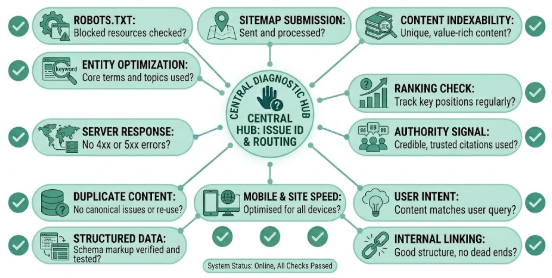
Fix topical authority mistakes in this order: audit your pages, resolve overlap, repair thin content, then improve links and original value. Working in this order stops you from polishing content that should be merged or removed.
Audit your content in Google Search Console
Start with the Performance report in Google Search Console, which shows queries, pages, clicks, and impressions. Google’s Performance report help page explains how to read it. Open the report, review your queries, then select a query and switch to the pages view to see which URLs appear for it.
Note every query that shows several of your pages, and every page with impressions but almost no clicks. These two lists give you your first fixes. For a deeper review of crawling and indexing, see our technical SEO audit guides.
Merge, redirect or differentiate competing pages
If two pages serve the same intent, merge them into the stronger page and redirect the weaker URL to it. Copy over any useful sections, then update internal links to point to the surviving page. If the intents truly differ, rewrite the titles and headings so each page has its own focus.
Strengthen or remove thin pages
Expand a thin page only when you have something real to add, and otherwise merge or remove it. Real additions include a worked example, a clear step-by-step method, or evidence you can verify. If a page has no search traffic, no links, and no purpose, remove it and redirect the URL to the closest relevant page. Keep a short note of what you changed and why, so you can compare results later.
Repair internal links and anchor text
Repair internal links by connecting each page to its pillar, to related pages, and back from the pillar, using descriptive anchors. Read each important page and ask where a reader would naturally want to go next. Add that link, and vary the anchor wording so it reads naturally.
Add first-hand experience and original value
Add value that other pages lack, such as your own process, examples you can verify, screenshots, or expert input. Do not invent numbers, client results, or quotes. A short, honest explanation of how you work is stronger than a large claim you cannot support.
A Pre-Publish Checklist to Prevent Topical Authority Failures
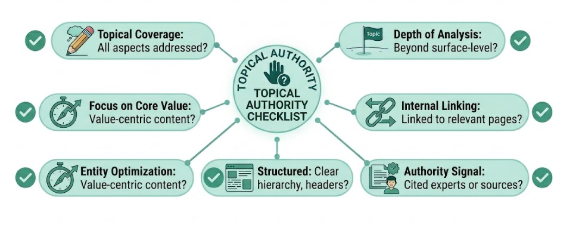
Run this checklist before you publish any new page to avoid the most common topical authority failures.
- Does the page fit my core subject and audience?
- Is the search intent clear, and does the page type match the current results?
- Does another page on my site already answer this query?
- Does this page add something useful that top results do not?
- Is it linked from its pillar and from at least one related page?
- Does it link out to related pages with descriptive anchor text?
- Have I verified every fact, name, date, and source?
- Does the reader have a clear next step at the end?
Next Step for Your Topical Authority Plan
If you want help fixing these mistakes on your own site, a specialist can turn your content and keywords into a clear, structured plan. I build topical maps, content briefs, and website structure plans as part of my SEO work, and you can see the approach on my topical map service page. When you get in touch, ask about a topical map audit and bring a list of your current URLs, so the review starts with your real pages.
Conclusion
Topical authority is a practical shorthand for focused, connected, and useful content, not a score you can chase. Most stalled efforts trace back to the same causes: a niche that is too wide, pages that overlap, thin content, weak internal links, and a poor match with search intent. Start with a Search Console review, fix overlap first, and add original value to every page you keep. If you are unsure where to begin, pick your five weakest posts and decide whether each should be improved, merged, or removed. Steady, honest improvement over several months will do more than any shortcut.
Frequently Asked Questions
What are the most common topical authority mistakes?
The most common topical authority mistakes are a niche that is too broad, a topical map with no structure, missing internal links, ignored search intent, content cannibalization, and thin pages. Chasing off-topic trends and never updating old content also appear often.
Is topical authority a Google ranking factor?
Google has not published a general topical authority score or listed it as a named ranking factor. It does describe a topic authority system for news queries. For most sites, treat topical authority as a way to plan useful, focused content, not as a metric to improve directly.
How long does topical authority take to show results?
No one can give an exact timeline. Many practitioners expect several months before trends become clear, but that is a rule of thumb. Track impressions, queries, and page-level traffic over time instead of waiting for one big jump.
How many articles do I need to build topical authority?
There is no fixed number of articles. Cover the subtopics your audience actually needs, and stop when you have answered them well. A smaller set of strong pages can outperform a large set of weak ones.
Can a small website compete with bigger brands on a topic?
Often yes, especially in a narrow subtopic where the small site is more focused and more useful. There is no guarantee. Bigger brands may have more links and recognition, so choose subjects where you can offer real depth.
How do I know if content cannibalization is hurting my site?
Check Google Search Console for queries where more than one of your URLs appears and their positions keep swapping. If both pages serve the same intent, merge them or redirect the weaker one.
Does thin content hurt the rest of a topical map?
Thin pages can weaken a section because they dilute the usefulness of the whole group. Google does not publish an exact effect, so judge by results. Improve, merge, or remove posts that add nothing new.
How many internal links should a cluster page have?
There is no fixed number. Link to the pillar page and to the closest related pages wherever the link helps the reader. Add more only when they are relevant, and use descriptive anchor text.
Can AI-written content build topical authority?
It can support it only if the final content is accurate, original, and useful to people. Raw AI drafts often repeat what already exists. Review every claim, add real experience and sources, and edit until the page offers something new.
Should I delete old posts that do not fit my niche?
Not automatically. Check each post for traffic, links, and relevance first. Keep and update useful ones, merge overlapping ones, and remove those with no value, redirecting them to a relevant page when one exists.