Semantic Content Writing: A Practical Step-by-Step Guide
Semantic content writing helps you create content around a subject’s meaning, context, entities, and user needs instead of treating a target keyword as a phrase to repeat. It…

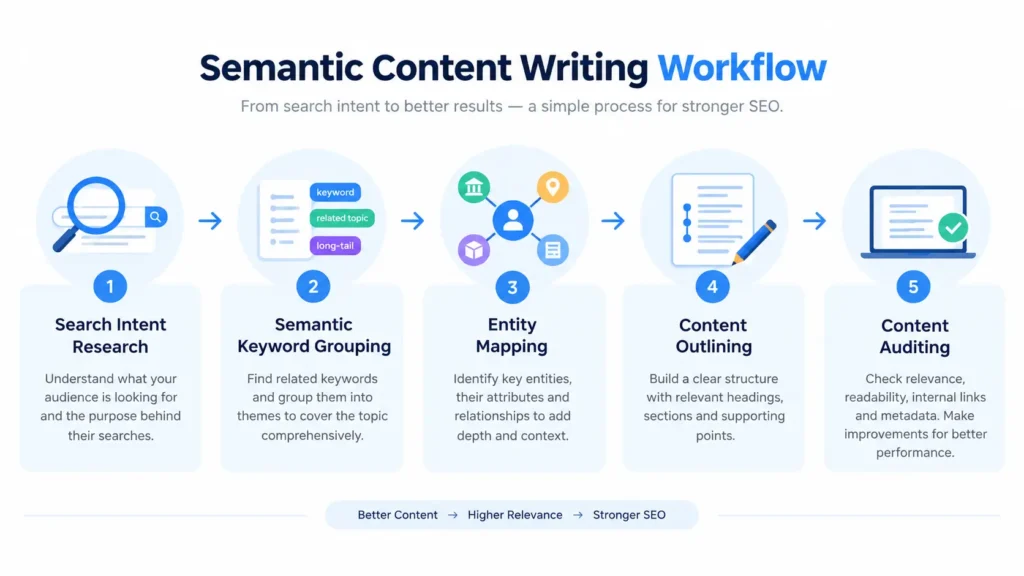
Semantic content writing helps you create content around a subject’s meaning, context, entities, and user needs instead of treating a target keyword as a phrase to repeat. It connects the questions people ask with the concepts they need to understand, the information that helps them act, and the related pages that support their next step.
For SEO practitioners, content writers, and website owners, this approach offers a practical way to plan useful pages. Rather than asking only how often a keyword appears, ask whether the content explains the topic clearly, answers the right questions, and connects related ideas in a logical order.
This guide explains how to apply semantic content writing from initial search intent research to publication and ongoing improvement. You will learn how to research related queries, map entities, analyze competing pages, build a content outline, use internal links, and audit the finished article without adding unnecessary text.
What Is Semantic Content Writing?
Semantic content writing is the practice of developing content around the meaning of a topic, the intent behind a search, and the relationships between relevant concepts. It uses keywords as research evidence while making clarity, accuracy, context, and reader needs the basis of the writing process.
For example, an article about internal linking may need to explain anchor text, destination pages, site architecture, crawlability, contextual relevance, and user navigation. These concepts belong because they help explain the subject, not simply because they are related keywords.
How Semantic Content Writing Works
A semantic approach starts with the central subject and expands into the questions, entities, attributes, and tasks that make the subject understandable.
The process usually involves five connected activities:
- Identify what the searcher wants to learn or accomplish.
- Define the central topic and its boundaries.
- Research related queries and concepts.
- Organize the information into a logical structure.
- Explain the relationships with clear writing, examples, and useful links.
The result should read naturally to a person. It should not look like a list of phrases assembled for a search engine.
Semantic Content Writing vs. Traditional Keyword-Focused Writing
Keyword research remains useful. The difference is how the writer uses it.
| Keyword-focused approach | Semantic approach |
|---|---|
| Starts with a target phrase | Starts with the subject and the searcher’s task |
| May prioritize keyword frequency | Prioritizes useful explanations and context |
| Can treat related phrases as a checklist | Includes concepts that help answer the topic |
| May create separate pages for close variations without a clear reason | Assigns pages distinct purposes |
| Often treats each article in isolation | Connects relevant pages through internal links |
A page can use keywords naturally and still follow a semantic approach. The goal is not to abandon keyword research. It is to use keyword data to understand the questions and language associated with the subject.
How Semantic SEO Relates to Semantic Content Writing
Semantic SEO is the broader practice of helping search systems and people understand a page’s topic, context, and relationship to other information. Semantic content writing applies those ideas during research, planning, drafting, and editing.
They overlap, but they are not identical. Technical accessibility, site architecture, internal linking, structured data, and indexation can also affect how a website’s content is discovered and interpreted.
For a broader explanation, see the semantic SEO principles covered in the related section of the website.
Why Semantic Content Writing Matters for SEO
Semantic content writing gives a page a clear purpose and helps readers find the information they need without piecing together disconnected explanations. It can also help a website cover a subject in a more organized way.
Its value comes from the quality of the content and its fit with the searcher’s needs, not from the presence of a particular number of related terms.
It Helps Match Search Intent
Search intent describes the reason behind a query. A person searching for “what is topical authority” wants an explanation. Someone searching for “topical map template” may want a practical resource. Someone searching for a particular SEO service may be ready to compare providers.
A page should match the task implied by its main query. If the searcher wants a step-by-step guide, a short sales page may not be suitable. If the searcher wants pricing, a long theoretical article may delay the answer.
It Creates Clearer Topic Coverage
A useful article covers the concepts needed to answer its main question. For a guide to semantic content writing, that may include search intent, keyword research, entities, heading structure, contextual internal links, and content auditing.
It does not need to explain every subject in SEO. Related ideas that require substantial independent treatment can be assigned to separate pages.
It Supports Better Content Architecture
A website often contains multiple pages about connected subjects. Descriptive internal links help readers move between those pages and help crawlers discover their relationships.
A page about content planning might link to a relevant guide on topical authority. A page about a topical map might link to an explanation of entity research. Each link should help the reader, rather than exist merely to increase the internal link count.
What Semantic Content Writing Cannot Guarantee
No writing method guarantees a particular ranking, featured snippet, or amount of organic traffic. Search performance also depends on competition, relevance, site accessibility, reputation, content quality, and other factors.
Treat semantic content writing as a planning and editorial method. Measure whether it improves the usefulness and performance of your content instead of assuming that a checklist alone will produce rankings.
Step 1: Understand Search Intent Before Writing
The first step is to understand what the reader expects to accomplish. A keyword by itself may not reveal the full task, so review the query wording, result types, related questions, and the likely stage of the user’s journey.
Identify the Main Intent
Four common intent categories provide a useful starting point.
- Informational: The searcher wants to learn or understand something.
- Navigational: The searcher wants to reach a particular website, page, or brand.
- Commercial investigation: The searcher is comparing options before deciding.
- Transactional: The searcher wants to take an action, such as purchasing or signing up.
These categories can overlap. A query such as “best semantic SEO tools” may have informational and commercial investigation intent.
Review Search Results
Inspect the results for your target query. Look at the types of pages that appear, their main angles, the questions they answer, and the level of detail they provide.
Record observations rather than assuming that every result uses the same strategy. Search results can vary by location, language, device, and time.
Ask:
- Are the leading pages tutorials, service pages, product pages, or definitions?
- Do readers need beginner guidance or specialist detail?
- Which questions appear repeatedly?
- What useful information is missing from the pages you reviewed?
- Can your page serve the dominant intent without changing its purpose?
Create an Intent Brief
Write one sentence that describes the reader’s main goal.
For this article, the intent brief could be:
“Help SEO practitioners and content writers plan, write, and evaluate content using topic meaning, search intent, entities, and contextual relationships.”
Use this statement to decide which sections belong in the article and which topics should be covered elsewhere.
Step 2: Conduct Semantic Keyword Research
Keyword research provides evidence about how people describe a subject and what they want to know. The aim is to find meaningful query groups, not to collect every phrase that contains a similar word.
Find Primary, Secondary, and Supporting Queries
Start with the main query, then collect related phrases from keyword research tools, search suggestions, Search Console data, and relevant search results.
For semantic content writing, a research list might include:
| Query group | Example |
|---|---|
| Primary topic | semantic content writing |
| Definitions | what is semantic content writing |
| Process | how to write semantic content |
| Related concept | semantic SEO |
| Research method | entity and keyword research |
| Structure | semantic content outline |
| Evaluation | semantic content audit |
These are example groups, not verified search-volume findings. Use your own market and tool data to confirm which queries matter to the intended audience.
Group Keywords by Meaning and Intent
Do not create a separate heading for every phrase. Group queries that express the same underlying question.
For example, “how to write semantic content,” “semantic writing process,” and “steps for semantic content writing” may belong to the same section if the search results and intent are similar.
By contrast, “semantic SEO tools” may require a separate page if searchers want a comparison of products rather than a writing tutorial.
Use Modifiers to Understand the Task
Modifiers such as “examples,” “template,” “benefits,” “vs,” and “how to” often indicate the kind of answer a searcher expects.
Use these modifiers to plan the format. A request for examples may benefit from a worked example. A request for a template may call for a downloadable worksheet or a clearly formatted table.
Avoid Keyword Stuffing
A related term should appear when it improves the explanation. If a phrase sounds unnatural, rewrite the sentence instead of forcing the phrase into it.
There is no universal keyword density that guarantees a ranking. Exact-match frequency can be useful as an editorial check, but readability, accuracy, and intent alignment matter more than reaching an arbitrary percentage.
Step 3: Identify Entities, Attributes, and Relationships
Entities are identifiable people, places, organizations, products, concepts, or other things being discussed. Attributes describe their properties, while relationships explain how they connect.
These concepts help writers move from a flat keyword list to a useful explanation of a subject.
Build an Entity Map
Consider an article about semantic content writing.
| Entity or concept | Relevant attributes or questions |
|---|---|
| Semantic content writing | Definition, workflow, purpose |
| Search intent | User goal, query type, expected format |
| Keyword research | Query variations, modifiers, topic groups |
| Content outline | Heading hierarchy, section purpose |
| Internal linking | Anchor text, destination, context |
| Content audit | Accuracy, coverage, usability, performance |
The map is a planning aid, not a mandatory checklist. Include an item only if it contributes to the article’s purpose.
Explain Relationships Clearly
A reader should understand how the concepts relate. For example:
- Search intent influences the type of content a page should provide.
- Keyword research reveals the language and questions associated with that intent.
- Entity research identifies concepts that need definition or explanation.
- The outline organizes those concepts into a readable sequence.
- Internal links connect the article to relevant supporting resources.
- The audit checks whether the finished page fulfils its purpose.
This relationship-based structure is more useful than inserting isolated terms without explaining them.
Use a Topical Map When Planning Multiple Pages
If a website covers a subject across several URLs, map the main topic, supporting topics, and the purpose of each page. Decide which questions belong on the main guide and which deserve dedicated articles.
A topical map can help identify overlapping pages, missing resources, and opportunities for meaningful internal links. It should reflect actual user needs rather than a target number of pages.

Step 4: Analyze Competitor Content and Identify Gaps
Competitor analysis helps you understand the content currently available for a query. It does not mean copying headings or reproducing every topic mentioned by competing pages.
Compare Pages Against the Intent Brief
Review several relevant results and note:
- The main question each page answers.
- Its content format and heading structure.
- Important concepts and examples.
- Evidence, references, and practical instructions.
- Areas that appear unclear, outdated, or incomplete.
Separate direct observations from your interpretation. A heading appearing on several pages may indicate a common reader question, but it does not prove that the heading causes higher rankings.
Find Gaps That Matter to Readers
Useful content gaps include missing steps, unclear definitions, unsupported claims, absent examples, or advice that does not explain how to act.
For example, an article may describe semantic content writing but never show how to turn a keyword list into a usable outline. A worked example can address that gap.
Do not add a section simply because a competitor has one. If it does not help the intended reader, leave it out or cover it in a separate resource.
Define Your Page’s Unique Contribution
Before drafting, write down what your article will add. That contribution might be a practical workflow, a clear template, an original example, or a more transparent explanation of trade-offs.
Do not invent personal results, client case studies, or performance statistics to make the page appear distinctive. Use genuine evidence when it is available, and label illustrative examples clearly.
Step 5: Build a Semantic Content Outline
A strong outline gives every section a clear purpose. It should lead the reader from basic understanding to practical application without jumping between unrelated ideas.
Use Headings to Organize Meaning
The H1 should identify the main subject. H2 headings divide the major sections, and H3 headings break those sections into smaller questions or tasks. H4 to H6 headings are appropriate when additional levels genuinely improve clarity.
Do not use deeper heading levels just to make a page appear more sophisticated. A heading should describe the content that follows it.
Create a Heading-to-Intent Map
Before writing, connect each major heading to a reader need.
| Heading topic | Reader need |
|---|---|
| Definition | Understand the method |
| Search intent | Learn how to select the right page angle |
| Keyword research | Find and group related queries |
| Entities | Identify concepts and relationships |
| Competitor analysis | Find useful gaps |
| Content outline | Organize the article |
| Writing process | Explain ideas clearly |
| Internal links | Connect related resources |
| Audit | Check quality and performance |
This map makes it easier to spot repeated sections or missing steps.
Prepare a Content Brief
A useful brief can include:
- Target audience and primary query.
- Search intent and desired reader outcome.
- Supporting queries and entities.
- Proposed headings and section goals.
- Required examples or evidence.
- Internal link destinations and proposed anchor text.
- Content exclusions and quality checks.
For more planning context, the site’s guide to creating a structured content brief can sit alongside this step.
Example: A Simple Section Brief
Heading: How to Identify Search Intent
Reader question: How can I tell what a searcher wants?
Required explanation: Define intent, describe common categories, and explain how to inspect results.
Example: Compare an informational query with a transactional query.
Quality check: Does the section give the reader a method they can apply to another keyword?
A brief like this helps the writer stay focused while leaving room for natural explanations.
Step 6: Write Content That Answers Questions Clearly
The writing stage turns research into a useful reading experience. Each section should answer its main question, explain unfamiliar concepts, and provide enough context for the reader to understand the next step.
Give a Direct Answer First
Begin each section with the central point. Follow it with explanation, examples, qualifications, or steps.
For example:
“Search intent is the reason behind a query. To identify it, examine the wording of the query, the pages shown in search results, and the task a reader is likely trying to complete.”
This opening defines the concept and gives the reader a starting method. The rest of the section can explain the method in detail.
Use Examples to Make Abstract Ideas Concrete
Instead of saying only that related terms should be grouped by intent, show how the grouping works.
A writer researching “content brief template” might find queries about required fields, heading structure, keyword groups, and internal links. If those queries express one planning task, they can fit into a single practical guide. If users are searching for a downloadable file, a separate template page may better satisfy that need.
Keep Paragraphs Focused
A paragraph should usually develop one main idea. Define technical terms when they first appear, and use transitions that explain the relationship between ideas.
Vary sentence length for readability. Short sentences can state a rule. Longer sentences can explain the reasoning or conditions behind it.
Avoid padding a section with repeated definitions, generic statements about SEO, or claims that do not help the reader make a decision.
Support Important Claims
Use reliable sources for claims that depend on facts, policies, research, or technical documentation. Distinguish published guidance from professional interpretation and your own proposed workflow.
For example, Google Search Central’s guidance on helpful, reliable, people-first content is a useful reference when reviewing whether an article is written to serve people rather than manipulate search visibility.
Do not imply that a practical writing framework is an official search-engine requirement unless the source explicitly says so.
Step 7: Improve Topical Depth Without Adding Filler
Topical depth means explaining the relevant aspects of a subject well enough for readers to complete their task. It does not mean writing about every related concept or making every article longer.
Cover the Questions That Belong on the Page
Review the intent brief, query groups, and entity map. Check whether the article answers the core question and the supporting questions needed to understand it.
For a semantic content writing guide, readers may need to understand search intent, topic grouping, entities, outline planning, internal linking, and auditing. A detailed history of search engines would not normally be necessary.
Know When to Create a Separate Page
A topic may deserve its own URL when it has a distinct intent, requires substantial detail, or serves a different stage of the reader’s journey.
For example, a guide to semantic content writing can explain the role of topical maps without becoming a full topical map tutorial. A separate resource can cover map creation in greater depth.
Related pages can be connected through building topical authority through relevant content, where that resource matches the reader’s next question.
Remove Repetition
During editing, look for repeated definitions, duplicated advice, and sections that reach the same conclusion without adding information.
Ask of each paragraph: does it explain a concept, answer a question, support a claim, demonstrate a method, or guide the reader to a relevant next step? If not, revise it or remove it.
Step 8: Strengthen Internal Links and Contextual Relationships
Internal links connect pages on the same website. They help readers discover related information and provide crawlers with paths to other URLs.
A semantic approach treats internal links as part of the content plan rather than a task left entirely until publication.
Choose Relevant Destination Pages
Link when the destination expands on a concept, explains a related task, or offers a useful next step. A page about semantic content writing might link to a guide on semantic SEO, topical authority, or content briefs.
The destination should genuinely match the promise made by the anchor text. Avoid linking to a page merely because it contains a similar keyword.
Write Descriptive Anchor Text
Anchor text should tell readers what they can expect after following a link.
For example, “semantic SEO principles” describes the subject of the destination more clearly than “read more.” Natural variations are fine, provided the wording remains accurate.
Avoid forcing the exact target keyword into every anchor. The anchor should fit the sentence and describe the destination.
Plan Links in the Brief
For each planned internal link, record the source section, target URL, anchor text, and reason for the link. This makes the links easier to review before publication.
For content-related writing workflows, a relevant SEO content writing resource may be appropriate when readers need to explore the service itself. Because that page is service-focused, use it only where the context genuinely calls for it.
Likewise, a topical map service may be relevant to readers seeking help with topic architecture. Do not insert a commercial link into a purely educational passage if it interrupts the reader’s task.
Check Links Before Publishing
Confirm that each URL loads, points to the intended page, and fits the surrounding sentence. Review redirects and broken links when possible. Check that important pages are discoverable through useful internal paths.
The right number of internal links depends on the article and the website. Relevance is more important than meeting an arbitrary count.
Step 9: Optimize Semantic Signals and On-Page SEO
A clear article still needs sound on-page implementation. Review the title, headings, URL, images, links, and technical presentation so the page is accessible and its subject is easy to understand.
Review the Title and Main Heading
Write a descriptive SEO title that reflects the page’s purpose. Keep the H1 aligned with the subject, and avoid making the title promise a result the article cannot deliver.
Use the focus keyword where it fits naturally, especially in prominent locations such as the title and opening paragraph. Do not repeat it in every heading.
Write a Useful Meta Description
A meta description should summarize the page accurately and give the reader a reason to consider it. Search engines may choose a different snippet, so treat the description as useful page metadata rather than a guaranteed display text.
Optimize Images and Alt Text
Use images when they clarify a process, illustrate a relationship, or make an example easier to understand. Write descriptive alternative text for informative images. Decorative images may require empty alt text, depending on the implementation.
Do not fill alt text with keyword variations. Describe what the image communicates.
Use Structured Data Only When Appropriate
Structured data can describe eligible content in a format supported by search engines. The markup must reflect the visible page and follow the relevant documentation.
Adding schema does not guarantee rich results or higher rankings. Validate the implementation and avoid marking up content that users cannot see or that does not meet the feature’s requirements.
Keep the Page Technically Accessible
Check that the intended URL is crawlable and indexable, internal links work, the page displays well on mobile devices, and important content is available in the rendered page. Technical issues can prevent otherwise useful content from being discovered or used as intended.
Step 10: Audit and Improve Semantic Content
A semantic content audit checks whether the page serves its intended audience and communicates its subject accurately. It should combine editorial review with performance data when available.
Use a Practical Quality Checklist
Before publishing, review the following:
- Does the opening explain the topic and reader benefit?
- Does the article match the main search intent?
- Are definitions clear and accurate?
- Are the necessary entities and relationships explained?
- Does each heading have a distinct purpose?
- Are examples useful and clearly identified?
- Are claims supported where evidence is needed?
- Do internal links lead to relevant pages?
- Are title, meta description, images, and headings appropriate?
- Is any section repetitive, vague, or outside the page’s purpose?
Review Search Performance
After publication, use available analytics and Search Console data to understand how the page performs. Look at impressions, clicks, relevant queries, engagement indicators, and conversions where applicable.
A page may receive impressions for queries that reveal a missing explanation or a mismatch between the page and the searcher’s goal. Review the actual queries before changing the article.
Do not assume that every unexpected query deserves a new paragraph. Some may indicate that a separate page is needed, while others may be unrelated to the page’s purpose.
Update With Evidence
Revise the content when facts change, examples become outdated, links break, or performance data reveals a meaningful problem. Keep a record of significant changes so the team can assess whether the update helped.
Do not make superficial edits simply to change the publication date. Each revision should improve accuracy, usefulness, structure, or access to the information.
A Practical Example of Semantic Content Writing From Start to Finish
Imagine that you need to create an article targeting “semantic content writing.”
Step 1: Define the reader’s goal. The intended reader wants a process for writing content that covers a subject meaningfully rather than repeating a keyword.
Step 2: Review the search results. Inspect the current results to understand whether users expect definitions, tutorials, examples, or tools. Record the patterns you observe and distinguish them from assumptions.
Step 3: Collect related queries. Group phrases about definitions, intent, entity research, content outlines, internal links, and audits. Use keyword data to prioritize the questions that matter.
Step 4: Build an entity map. Identify concepts such as search intent, entities, attributes, content briefs, topical maps, and internal links. Decide which need a definition and which need only a brief explanation.
Step 5: Identify the gaps. Compare relevant pages and look for unanswered questions. Perhaps readers need a clearer process for converting research into headings or a worked example that connects each step.
Step 6: Create the outline. Arrange sections from the definition to research, planning, writing, linking, and auditing. Give each section a clear purpose.
Step 7: Draft and edit. Answer each section’s main question, include practical examples, support factual claims, and remove repetition. Add internal links where they help readers reach related information.
Step 8: Check the page. Review its intent, heading structure, readability, metadata, image descriptions, link destinations, and technical accessibility.
Step 9: Publish and measure. Monitor performance using available data. Revise the article when the evidence identifies a clear opportunity to improve it.
This workflow turns semantic content writing into a repeatable editorial process. It gives the writer a method for making decisions while leaving room for the specific needs of each topic.

Common Semantic Content Writing Mistakes
Treating Related Keywords as a Mandatory Checklist
Not every related phrase belongs in an article. Include concepts because they help answer the question, not because a tool lists them.
Confusing Length With Depth
A long article can still be incomplete if it avoids the reader’s main question. A shorter page may serve the task better when the topic is narrow.
Copying Competitor Headings
Competitor research should inform your decisions, not replace them. Build the outline around your audience, the query’s intent, and the information your page can genuinely provide.
Overusing Exact-Match Keywords
Repeated phrases can make the text awkward. Use the focus keyword in relevant places, then explain the topic with natural language and precise terminology.
Adding Internal Links Without Context
A link is useful when the destination fits the surrounding discussion. Generic or unrelated links can distract readers and weaken the content experience.
Treating Structured Data as a Shortcut
Schema markup describes content in a machine-readable format. It cannot compensate for inaccurate, unhelpful, or inaccessible page content.
Making Unsupported SEO Claims
Avoid promising rankings, traffic gains, or a specific algorithmic result without evidence. Describe the purpose of a method and measure its effects on your own site.
How to Measure the Quality of Semantic Content
Quality should be evaluated using a combination of editorial checks and relevant performance data. No single metric can show whether a page fully serves its audience.
Editorial Measures
Assess whether the page answers the main question, explains important concepts, follows a logical sequence, uses reliable evidence, and gives the reader practical next steps.
A review scorecard can make this process repeatable across multiple writers and articles.
Search Measures
When enough data is available, review impressions, clicks, query relevance, and changes in organic performance. Compare similar periods and account for changes in seasonality, competition, and site conditions where possible.
A wider range of relevant queries can be a useful observation, but it should not be treated as proof of quality by itself. Check whether those queries match the page’s purpose.
Business and Reader Outcomes
Depending on the website, useful outcomes may include qualified enquiries, sign-ups, downloads, assisted conversions, or successful completion of a reader’s task.
Use measures that fit the page’s role. An educational guide and a service landing page may have different goals, so their performance should not be judged by the same conversion target.
Conclusion
Semantic content writing is a practical way to plan content around meaning, search intent, relevant entities, and the relationships between ideas. It begins with understanding the reader’s task and continues through research, outlining, writing, internal linking, on-page optimization, and review.
The method works best when each decision serves a clear purpose. Use keyword research to discover questions, entity maps to organize concepts, competitor analysis to find useful gaps, and descriptive links to connect related resources. Then review the finished page for clarity, accuracy, usefulness, and technical accessibility.
Do not judge the result by keyword repetition or word count alone. Publish content that helps readers complete their task, measure how it performs, and improve it when evidence points to a meaningful change.
Frequently A sked Questions
1. What is semantic content writing?
Semantic content writing focuses on a topic’s meaning, context, and user intent instead of repeating keywords.
2. Is semantic content writing the same as semantic SEO?
No. Semantic SEO is broader, while semantic content writing focuses on creating useful, relevant content.
3. How do I start writing semantic content?
Understand search intent, research related keywords, identify key concepts, create an outline, and write clear answers.
4. Are semantic keywords important?
Yes. They help you understand related topics and answer users’ questions naturally.
5. What are entities in semantic content writing?
Entities are identifiable things or concepts, such as people, places, businesses, products, and ideas.
6. Does semantic content writing improve Google rankings?
It can help create relevant, useful content, but it does not guarantee higher rankings.
7. How many keywords should I use in one article?
Use one main keyword and relevant supporting keywords naturally. There is no fixed number.
8. How does internal linking support semantic content?
Internal links connect related pages and help readers find more useful information.
9. Does semantic content need to be long?
No. It should be long enough to answer the user’s questions clearly without unnecessary details.
10. How often should I update semantic content?
Update it when information changes, links break, or the content needs improvement.