What Is Semantic SEO? A Complete Beginner’s Guide
Semantic SEO is the practice of optimizing for meaning instead of keywords. Learn how entities, topical maps, and search intent work in Google and AI search.

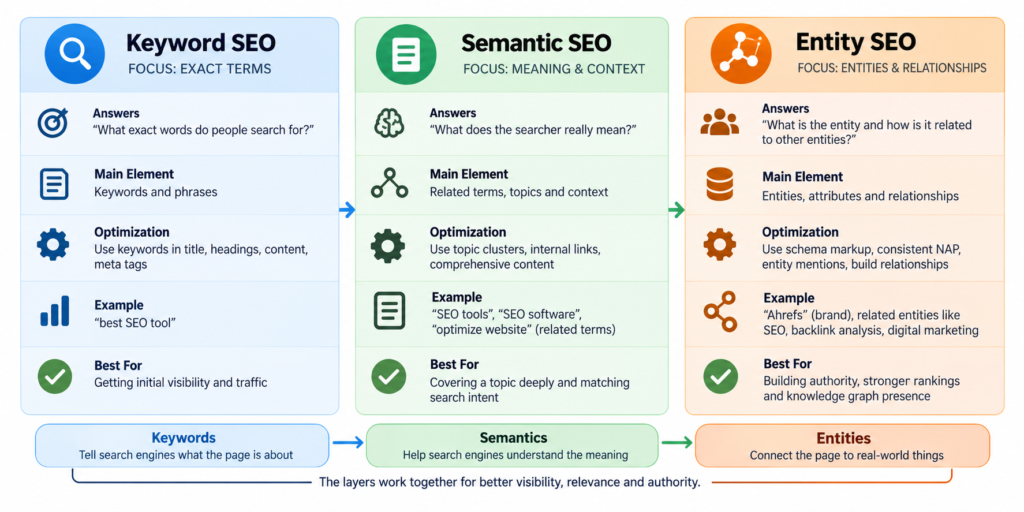
What is semantic SEO? Semantic SEO is an approach to search engine optimization that focuses on the meaning, context, entities, and relationships within content. Instead of optimizing a page only for individual keywords, it considers the broader subject, the questions readers want answered, and how related concepts connect.
For example, an article about coffee makers might need to explain brewing methods, machine types, capacity, maintenance, and the differences between popular models. These topics help readers understand the subject more fully than a page that repeats the phrase “coffee maker” throughout its text.
Semantic SEO is the practice of optimizing content around meaning, context, search intent, and relationships between related concepts.
These concepts are connected to the original question because they help explain how website speed can be improved.
Semantic SEO therefore involves more than adding related keywords. It requires understanding the subject, identifying relevant subtopics, and organizing information so readers can follow the explanation.
What makes content semantic?
Several elements contribute to a semantic approach.
- Meaning: The information communicates a clear idea.
- Context: The surrounding information helps clarify what a term refers to.
- Entities: The content identifies relevant people, places, organizations, products, or concepts.
- Relationships: The content explains how different concepts connect.
- Search intent: The page addresses the reason behind the user’s query.
- Topic coverage: The content answers the relevant questions without adding unrelated material.
These elements work together to create useful content.
Semantic SEO does not mean abandoning keywords, technical SEO, or established optimization practices. It means using them as part of a broader strategy focused on relevance and understanding.
2. How Does Semantic SEO Work?
Semantic SEO starts with understanding a search query and determining what information would satisfy the person who entered it.
Search engines use multiple systems and signals to retrieve, interpret, and rank information. The exact mechanisms differ across systems and queries, so there is no single semantic SEO formula that explains every search result.
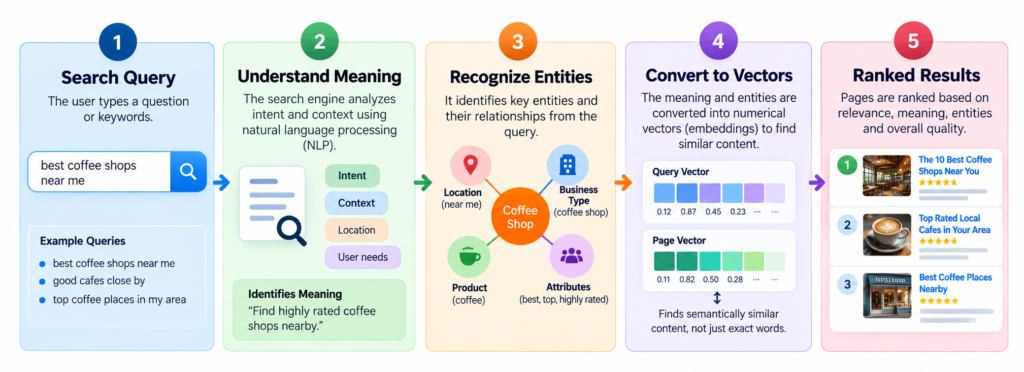
A practical semantic SEO workflow can be understood through five stages.
Stage 1: Understand the search query
A search query provides clues about the user’s goal.
For example, these searches have different purposes:
- What is semantic SEO?
- How does semantic SEO work?
- Semantic SEO vs. traditional SEO.
- Best semantic SEO tools.
- Semantic SEO services.
The first search asks for a definition. The second asks for an explanation. The third requests a comparison. The fourth suggests that the user is evaluating tools, while the fifth may indicate commercial intent.
Although the searches concern the same general subject, each may require a different answer.
Stage 2: Identify the meaning and context
Some words have several meanings.
Consider the word “jaguar.” Depending on the context, it might refer to an animal or a vehicle brand.
A page about the animal would discuss its habitat, physical characteristics, diet, and behavior. A page about the vehicle brand might cover models, specifications, features, and maintenance.
The surrounding information helps clarify the intended meaning.
This is why context matters when planning content. A keyword alone may not communicate the full subject or the information a reader expects.
Stage 3: Connect related entities
Entities are identifiable subjects, such as a person, product, organization, place, or concept.
A page about semantic SEO might discuss:
- Search intent.
- Keyword research.
- Entities and attributes.
- Topical maps.
- Internal linking.
- Structured data.
- Content relevance.
These concepts are not interchangeable. Each contributes a different part of the explanation.
The purpose is to identify the concepts that genuinely help answer the reader’s question and explain their relationships.
Stage 4: Match the content to the user’s intent
Once the topic and intent are understood, the page can be structured around the information the reader needs.
A beginner guide should define unfamiliar terms and explain concepts in a logical order. A comparison page should identify meaningful differences. A service page should explain the service, its scope, and the next step.
The format should follow the reader’s needs rather than a fixed SEO template.
Stage 5: Present useful, organized information
Clear headings, descriptive links, relevant examples, and well-structured paragraphs make information easier to navigate.
Google’s documentation recommends creating helpful, reliable, people-first content. Its guidance also emphasizes clear, descriptive titles and useful page content.
Source: Google Search Central: Creating Helpful, Reliable, People-First Content.
3. What Is the Difference Between Semantic SEO and Traditional SEO?
Traditional SEO includes keyword research, content optimization, technical SEO, internal linking, and other practices that help search engines discover and evaluate web pages.
Semantic SEO builds on these foundations by giving greater attention to meaning, context, entities, and relationships between topics.
The two approaches are not mutually exclusive.
A website can use traditional keyword research while also organizing its content around search intent and connected concepts.
Semantic SEO vs. keyword-focused SEO
| Factor | Keyword-Focused SEO | Semantic SEO |
|---|---|---|
| Main focus | Target keywords and queries | Meaning, context, and topic relationships |
| Keyword research | Identifies relevant search terms | Identifies terms and the intent behind them |
| Content planning | Assigns keywords to pages | Connects keywords, entities, questions, and page purposes |
| Topic coverage | Addresses the target query and related needs | Examines the broader context needed to satisfy the query |
| Internal linking | Connects relevant pages | Connects pages within a meaningful content structure |
| Content evaluation | Considers relevance, quality, and technical factors | Also examines contextual completeness and relationships |
| Technical SEO | Supports crawling, indexing, and accessibility | Remains an important foundation |
This table describes two ways of approaching SEO. It does not represent an official Google classification.
Does semantic SEO replace keyword research?
No. Keyword research remains important because it helps identify the language people use and the questions they ask.
Semantic SEO adds another layer to that process.
Suppose you are creating a guide about email marketing. Keyword research may identify searches about email campaigns, newsletters, automation, segmentation, and open rates.
Semantic planning helps determine how those concepts relate, which questions belong on the main page, and which deserve separate articles.
The result is a content plan that considers both search demand and the structure of the subject.
Why keyword stuffing is different
Keyword stuffing means repeating keywords unnaturally in an attempt to manipulate search rankings.
For example:
“Semantic SEO helps with semantic SEO because semantic SEO is important for semantic SEO.”
This sentence repeats the phrase without adding useful information.
Google explicitly identifies unnatural keyword repetition as a form of keyword stuffing in its spam policies.
Source: Google Search Central: Spam Policies for Google Web Search.
A better approach is to explain the subject naturally, using specific terminology where it helps readers understand the content.
4. Why Is Semantic SEO Important?
Semantic SEO helps content creators plan information around the needs of readers rather than treating every keyword as an isolated target.
Its practical value comes from the decisions it encourages during research, writing, and content organization.
It helps align content with search intent
A page can mention a relevant keyword and still fail to answer the user’s question.
For example, someone searching for “how to create a topical map” probably wants a process, examples, and an explanation of how topics connect.
A page that only defines topical maps would provide an incomplete answer.
Understanding search intent helps determine the information, format, and level of detail the page should contain.
It improves content planning
A broad topic often contains several related questions.
A guide about website security might need to address HTTPS, authentication, software updates, backups, and access controls.
Semantic planning helps identify which subjects belong together and which need separate pages.
This can reduce unnecessary duplication and make the website’s content structure easier to manage.
It supports clearer explanations
Related concepts can help readers understand a subject when they are introduced in the right context.
For example, explaining internal linking alongside page architecture makes it easier to understand why relevant pages should connect to one another.
However, related concepts should only be included when they help answer the reader’s question.
It supports useful content organization
A website with many related articles needs a clear structure.
Pillar pages, supporting articles, descriptive navigation, and contextual internal links can help readers discover additional information.
They also provide links that search engines can crawl when implemented correctly.
It encourages meaningful content updates
Content updates should address genuine weaknesses, not simply add more keywords.
A page may need a clearer definition, a missing explanation, an updated technical detail, or a better example.
A semantic review asks whether the content explains the relevant concepts and relationships clearly.
Important limitation: Semantic SEO does not guarantee higher rankings, increased traffic, or inclusion in AI-generated answers. Results depend on many factors, including content quality, competition, technical accessibility, and the search system involved.
5. What Are Entities, Attributes, and Relationships in Semantic SEO?
Entities, attributes, and relationships are useful concepts for organizing information and explaining how different subjects connect.
Understanding them can help content creators produce clearer explanations and build more coherent content structures.
What is an entity?
An entity is a distinct, identifiable subject.
Examples include:
- A person.
- A company.
- A product.
- A country.
- A software application.
- A scientific concept.
In a guide about semantic SEO, relevant entities might include search engines, Google Search Console, structured data, and topical maps.
The important question is not simply whether an entity appears on the page. It is whether that entity is relevant to the topic and helps answer the reader’s question.
What is an attribute?
An attribute describes a characteristic or property of an entity.
For example, a laptop may have attributes such as processor type, memory capacity, screen size, and battery capacity.
A software application may have attributes such as its supported platforms, pricing model, and available features.
Attributes help explain what an entity is and which characteristics matter in a particular context.
What is a relationship?
A relationship explains how one entity connects to another.
For example:
- Google Search Console is a service provided by Google.
- A topical map organizes related topics.
- Internal links connect pages on a website.
- Structured data describes page information in a standardized format.
Relationships are useful because they explain the connections between concepts rather than merely listing them.
Example: An entity map for semantic SEO
Consider the topic “SEO content strategy.”
| Entity | Attribute or Relationship | Example |
|---|---|---|
| SEO content strategy | Purpose | Plan content around audience needs and search opportunities |
| Keyword research | Supports | Identifies relevant search queries |
| Search intent | Guides | Determines the information a page should provide |
| Topical map | Organizes | Connects main topics and supporting subtopics |
| Internal linking | Connects | Links related pages |
| Google Search Console | Measures | Reports search performance data |
This table is an illustrative planning model, not a representation of Google’s internal systems.
It demonstrates how a content creator can connect the central topic with relevant processes and tools.
6. How Do You Build a Semantic SEO Strategy?
A semantic SEO strategy starts with a clear topic and a defined audience. It then connects search intent, keyword research, entities, content planning, and internal linking.
The following eight steps provide a practical workflow.
Step 1: Define the main topic
Start by identifying the main subject your content should address.
For example, a digital marketing website might focus on semantic SEO, topical maps, keyword research, and content strategy.
Define the audience and the purpose of the content before creating the outline.
Ask:
- Who is the intended reader?
- What problem does the reader want to solve?
- What should the reader understand after reading?
- Does the topic support an existing content strategy?
A clear scope helps prevent the article from expanding into unrelated subjects.
Step 2: Research search intent
Investigate the questions people ask and the information they expect.
For a topic such as semantic SEO, relevant questions may include:
- What is semantic SEO?
- How does it work?
- What are entities?
- How do topical maps work?
- How is semantic SEO different from keyword-focused SEO?
Group questions according to their purpose.
Questions asking for definitions may fit together. A detailed implementation tutorial may deserve a separate page if it requires substantial explanation.
Step 3: Identify related entities
List the entities and concepts that directly support the main topic.
For a beginner guide to semantic SEO, these might include:
- Keywords.
- Search intent.
- Entities.
- Attributes.
- Relationships.
- Topical maps.
- Topic clusters.
- Internal links.
- Structured data.
- Search performance metrics.
Do not include every related term you discover.
Choose concepts according to their relevance and usefulness to the intended reader.
Step 4: Group keywords by intent
Organize related queries into groups that represent similar needs.
For example:
| Keyword Group | Example Queries | Possible Content Format |
|---|---|---|
| Definitions | What is semantic SEO? | Beginner guide |
| Implementation | How to use semantic SEO | Step-by-step tutorial |
| Comparisons | Semantic SEO vs. traditional SEO | Comparison article |
| Planning | How to create a topical map | Practical tutorial |
| Measurement | How to measure SEO performance | Measurement guide |
The final page assignments should be based on the actual intent and scope of each topic, not just the wording of the keywords.
Step 5: Build a topical map
A topical map organizes the subjects a website plans to cover and shows how those subjects relate.
For a semantic SEO content strategy, the main topic might connect to supporting topics such as:
- Search intent.
- Entity SEO.
- Topical authority.
- Keyword research.
- Content clusters.
- Internal linking.
- Structured data.
- Content optimization.
Each supporting topic can then be evaluated to determine whether it deserves its own page.
A topical map is a planning framework. It does not guarantee rankings or establish a fixed number of pages that a website must publish.
Step 6: Create helpful content
Assign each page a clear purpose.
A beginner guide should explain concepts in accessible language. A tutorial should provide actionable steps. A comparison should explain the meaningful differences between alternatives.
Use examples where they make an abstract concept easier to understand.
Avoid copying competing articles or adding sections simply to increase word count.
Google’s people-first content guidance encourages creators to provide useful, accurate information and meaningful value beyond what is already available.
Source: Google Search Central: Creating Helpful, Reliable, People-First Content.
Step 7: Connect related pages
Add internal links where they help readers discover relevant information.
A semantic SEO guide might link to a topical map tutorial when explaining content planning. A topical map article might link back to a broader semantic SEO guide.
Use descriptive anchor text that accurately reflects the destination.
Do not create links merely to insert exact-match keywords.
Step 8: Review and improve
After publishing, evaluate the content’s performance and usefulness.
Review search queries, impressions, clicks, page relevance, and conversions where appropriate.
Look for questions that the page does not answer well. Update the content when you identify meaningful gaps or outdated information.
7. How Do Topical Maps and Topic Clusters Support Semantic SEO?
Topical maps and topic clusters help organize related content, but they serve different purposes.
A topical map provides a broader view of the subject area. A topic cluster groups related pages around a defined topic or pillar page.
The terminology can vary between SEO practitioners, so it is useful to define these terms clearly within a content strategy.
What is a topical map?
A topical map is a structured plan of the topics a website intends to cover and the relationships between them.
Imagine a website focused on SEO education.
Its main subject might connect to:
- Semantic SEO.
- Technical SEO.
- Keyword research.
- Content strategy.
- Local SEO.
- Topical authority.
Each area may contain additional subtopics.
For example, the semantic SEO section might include entities, search intent, semantic keywords, topical maps, and content relationships.
This structure helps content planners identify important topics, evaluate existing pages, and find opportunities for useful supporting content.
You can explore the related Topical Map Service on ForkanMahmud.com.
What is a topic cluster?
A topic cluster is a group of related content pieces organized around a central subject.
A typical cluster includes a pillar page and supporting articles.
For example:
Pillar page: Semantic SEO.
Supporting articles might cover:
- What entities mean in SEO.
- How to build a topical map.
- How search intent affects content planning.
- How contextual internal linking works.
- How to evaluate content relevance.
The pillar page can link to supporting articles where readers need more detail. Supporting articles can link back to the pillar page when the broader explanation is relevant.
Topical map vs. topic cluster
| Factor | Topical Map | Topic Cluster |
|---|---|---|
| Main purpose | Plan broader subject coverage | Organize related published content |
| Scope | May cover a complete subject area | Usually focuses on a defined topic |
| Structure | Topics, subtopics, and relationships | Pillar page and supporting pages |
| Primary use | Content planning | Content organization and navigation |
| Example | A map of an SEO education website | A cluster of semantic SEO articles |
The two approaches can work together.
A topical map helps determine what the website needs to cover. Topic clusters provide one way to organize and connect the resulting content.
However, a website does not need to publish a page for every possible subtopic. Each page should justify its existence by serving a distinct reader need.
For more information, see the Topical Authority guide.
8. How Do Keywords, Search Intent, and Content Relevance Work Together?
Keywords, search intent, and content relevance serve different roles in SEO.
Keywords reveal how people express their questions. Search intent helps explain what they want to accomplish. Content relevance determines how well a page addresses that need.
Consider the keyword “email marketing.”
Someone searching for this term might want a definition, a tutorial, a comparison of email platforms, or a service provider.
The phrase alone does not always reveal the full intent.
Common types of search intent
| Intent | User Goal | Example Query |
|---|---|---|
| Informational | Learn something | What is semantic SEO? |
| Navigational | Find a particular destination | Google Search Console login |
| Commercial investigation | Compare options before deciding | Best SEO content tools |
| Transactional | Take an action or complete a purchase | Buy SEO software |
These categories are useful planning tools, but real searches can have mixed intent.
How to group keywords effectively
Begin by collecting relevant queries from keyword research, search results, and available performance data.
Next, examine whether the queries require the same answer.
For example, “what is semantic SEO” and “semantic SEO definition” may fit the same page because their intent is similar.
However, “how to build a semantic SEO strategy” may need a more detailed tutorial.
Assigning every related keyword to one page can create an unfocused article. Creating separate pages for every minor wording variation can also produce unnecessary duplication.
The goal is to choose a page structure that serves distinct user needs.
Should you target a fixed keyword density?
No. A fixed keyword-density percentage is not a reliable substitute for useful content.
Use the primary keyword naturally in prominent locations, including the title, main heading, introduction, and relevant body text.
Use related terminology where it improves clarity.
Do not force the exact phrase into every heading or paragraph. Google identifies unnatural keyword repetition as a spam practice.
The best test is whether the content reads naturally and answers the intended question.
9. How Does Internal Linking Support Semantic SEO?
Internal linking connects pages within the same website.
These links help readers move between related resources and provide crawlable paths through which search engines can discover pages.
A well-planned internal linking structure also helps communicate how content fits into the wider website.
Link pages where the relationship is useful
Imagine a website publishes three articles:
- What Is Semantic SEO?
- How to Build a Topical Map.
- What Is Topical Authority?
These articles cover related but distinct subjects.
The semantic SEO guide might link to the topical map article when explaining content planning. The topical map article might link to the topical authority guide when discussing broader topic coverage.
The links should help readers understand the next concept or complete a task.
Use descriptive anchor text
Anchor text is the clickable text in a hyperlink.
For example, “learn how to build a topical map” describes the destination more clearly than “click here.”
Descriptive anchors should be natural and accurate. They should not be repeated mechanically just to target an exact-match keyword.
Avoid unnecessary internal links
More links do not automatically create a better content structure.
Avoid links that interrupt the explanation, lead to unrelated pages, or repeat the same destination without a clear reason.
Review important pages periodically to identify broken links, orphan pages, and opportunities to connect useful content.
How many internal links should an article contain?
There is no universal number that guarantees better results.
The appropriate number depends on the article’s length, subject, website structure, and the availability of genuinely relevant pages.
For this article, the priority is to link to related resources on ForkanMahmud.com only where they help readers explore a topic in greater depth.
10. What Role Does Structured Data Play in Semantic SEO?
Structured data is a standardized format for describing information about a web page and its content.
It can help search engines interpret specific details about a page, such as whether the content is an article or a product.
Google supports several structured data formats and recommends JSON-LD when practical.
Source: Google Search Central: Introduction to Structured Data Markup.
Structured data and semantic SEO are related, but different
Semantic SEO is a broader content optimization approach.
Structured data is one technical method for expressing information in a machine-readable format.
For example, a blog post may use Article structured data to describe its headline, author, and publication information.
Person and Organization markup may also help describe an author or publisher when implemented appropriately.
However, structured data should accurately reflect the visible content and follow the relevant guidelines.
Does schema markup guarantee better rankings?
No. Correct structured data does not guarantee higher rankings or rich results.
Google explains that structured data can make a page eligible for supported search features, but the appearance of those features is not guaranteed.
Source: Google Search Central: General Structured Data Guidelines.
Schema markup should therefore support accurate content representation rather than serve as a shortcut to ranking improvements.
What about Knowledge Graphs?
A Knowledge Graph organizes information about entities and their relationships.
A Knowledge Graph is not the same thing as structured data, and adding schema markup does not guarantee that an entity will receive a Knowledge Graph entry.
For semantic SEO, the practical lesson is to describe people, products, organizations, and concepts accurately and consistently.
Use structured data where it is appropriate, but prioritize useful content, correct implementation, and clear information architecture.
11. How Can You Measure Semantic SEO Performance?
Semantic SEO performance should be evaluated using observable data and meaningful business goals.
There is no single universal metric that proves a page is semantically optimized.
Instead, review several indicators to understand how the content performs and where improvements may be needed.
Use Google Search Console
Google Search Console provides reports about how a website performs in Google Search.
Its Performance report includes metrics such as clicks, impressions, click-through rate, and average position. It can also show queries and pages associated with search performance.
Source: Google Search Console: Performance Report.
Use these reports to answer questions such as:
- Which queries generate impressions for the page?
- Are the queries relevant to the page’s intended topic?
- Which pages receive organic clicks?
- Are important pages gaining or losing visibility?
- Which pages may need clearer titles or more useful content?
Metrics worth monitoring
| Metric | What It Tells You | How to Use It |
|---|---|---|
| Impressions | How often the site appeared in search results | Identify queries and pages with visibility |
| Clicks | How often users clicked through from search results | Evaluate organic traffic |
| Click-through rate | The relationship between clicks and impressions | Investigate whether titles and snippets meet user expectations |
| Search queries | Terms associated with search visibility | Identify relevant questions and content gaps |
| Average position | An aggregated position metric in Search Console | Monitor trends while accounting for its limitations |
| Conversions | Actions completed by visitors | Assess business outcomes where tracking is available |
These metrics should be interpreted together.
For example, an increase in impressions may indicate greater visibility, but it does not necessarily mean that the page answers user questions more effectively.
Similarly, a ranking change does not prove that a semantic SEO change caused the result.
Conduct a semantic content audit
Alongside performance data, review the content itself.
Ask:
- Does the page answer its primary question?
- Is the main topic clearly defined?
- Are important related concepts explained?
- Are the relationships between concepts accurate?
- Does each heading introduce a useful answer?
- Are internal links relevant and descriptive?
- Are technical claims supported by reliable sources?
- Does the article offer value beyond repeating other pages?
Use the findings to prioritize meaningful improvements.
A content audit is most useful when it leads to specific actions rather than an arbitrary score.
12. What Are the Common Semantic SEO Mistakes to Avoid?
Semantic SEO can become ineffective when content creators focus on the appearance of optimization instead of the reader’s needs.
Avoid the following mistakes.
1. Repeating related keywords unnecessarily
Adding every related keyword can make content difficult to read.
Use terminology that helps explain the topic. Remove repetitions that add no information.
2. Treating every related topic as part of one page
A broad article can become confusing when it tries to answer too many unrelated questions.
Keep the main page focused and link to supporting resources when a subject needs a deeper explanation.
3. Ignoring search intent
A page that provides a definition will not necessarily satisfy someone looking for a practical tutorial.
Identify the reader’s goal before choosing the content format.
4. Treating entities as a checklist
Mentioning many entities does not automatically improve content quality.
Each entity should serve a purpose. Explain its relevance and relationship to the main topic.
5. Using internal links without context
Links should help readers navigate between related resources.
Avoid adding links simply to increase link counts or repeat target keywords.
6. Treating schema markup as a ranking shortcut
Structured data should accurately describe the page.
It does not guarantee rankings, rich results, or inclusion in AI-generated answers.
7. Copying competitor content
Competitor research can reveal common questions and potential gaps.
It should not become a reason to reproduce the same headings and explanations. Develop examples, analysis, and explanations that provide additional value.
8. Making unsupported claims about AI visibility
No single semantic SEO tactic guarantees that an AI system will cite a page.
Focus on clear, accurate, useful content and evaluate observable performance without promising specific outcomes.
9. Publishing content without reviewing its usefulness
A page may contain the right keywords and headings but still fail to answer the reader’s question.
Review the content for clarity, accuracy, relevance, and completeness before publishing.
13. Conclusion: How Should Beginners Start With Semantic SEO?
Semantic SEO helps content creators organize information around meaning, search intent, entities, and relationships between related concepts.
It does not replace keyword research or technical SEO. Instead, it builds on these foundations to create clearer, more useful content.
Beginners can start by choosing one topic, identifying the reader’s main questions, mapping relevant entities, and grouping related keywords by intent. They can then organize the content, connect related pages with internal links, and measure performance using available data.
The goal is not to mention every related term. It is to explain the subject accurately and help readers find the information they need.
For a practical next step, explore the Topical Map Service and consider how a structured topic plan could support your website’s content strategy.
Frequently Asked Questions
1. What Is Semantic SEO in Simple Words?
Semantic SEO means optimizing content around what a topic means and what readers want to know about it. Instead of focusing only on individual keywords, it considers context, related concepts, and the relationships between subjects. The goal is to create useful content that answers the intended question clearly without relying on unnatural keyword repetition.
2. How Does Semantic SEO Work?
Semantic SEO begins with identifying a topic and understanding its search intent. Content creators then research relevant keywords, entities, questions, and subtopics. They organize the information into useful pages, connect related resources with internal links, and review performance after publication. These practices support clear content organization, but they do not guarantee specific ranking results.
3. What Is the Difference Between Semantic SEO and Traditional SEO?
Traditional SEO includes keyword research, technical optimization, content creation, and link-related practices. Semantic SEO builds on these foundations by considering meaning, context, entities, and topic relationships. The approaches are complementary rather than mutually exclusive. Keywords remain useful, but they should support a clear content strategy instead of being repeated mechanically.
4. Are Semantic Keywords Different From LSI Keywords?
Semantic keywords are terms and phrases related to a subject through meaning or context. The term LSI keywords is often used in SEO discussions, but Latent Semantic Indexing is a specific information retrieval technique, not a universal Google keyword optimization formula. Focus on relevant terminology, user questions, and accurate explanations rather than chasing lists of supposedly required LSI keywords.
5. What Are Entities in Semantic SEO?
Entities are identifiable subjects such as people, organizations, products, places, and concepts. In semantic SEO, they help content creators identify the main subject and explain its relevant attributes and relationships. For example, an article about a software product might describe its purpose, supported features, intended audience, and relationship to other tools. These details should be accurate and relevant.
6. How Do I Create a Semantic SEO Strategy?
Start by defining the topic and intended audience. Research search intent and related queries, identify relevant entities, and group keywords according to the questions they represent. Create a topical map, assign clear purposes to individual pages, and add contextual internal links. After publishing, use search performance data and content reviews to identify meaningful improvements.
7. What Is the Difference Between a Topical Map and a Topic Cluster?
A topical map is a broader plan that organizes a subject, its subtopics, and their relationships. A topic cluster groups related pages around a central topic or pillar page. A topical map can guide the development of several topic clusters. Both approaches can support content planning, but neither guarantees rankings or requires a fixed number of pages.
8. Does Semantic SEO Improve Google Rankings?
Semantic SEO can support clear, relevant content that addresses user needs, but it does not guarantee higher Google rankings. Search results depend on multiple systems and signals, including relevance, content quality, competition, and technical accessibility. Evaluate your content through reliable data, such as Google Search Console reports, rather than assuming that using more entities or related keywords will improve rankings.
9. Is Structured Data Necessary for Semantic SEO?
Structured data is not required for every semantic SEO task. It is a way to describe page information in a standardized, machine-readable format. When appropriate, markup can help Google understand specific details and make a page eligible for supported search features. However, correct implementation does not guarantee rich results, higher rankings, or inclusion in a Knowledge Graph.
10. How Can Beginners Measure Semantic SEO Results?
Beginners can use Google Search Console to monitor impressions, clicks, click-through rate, average position, queries, and page performance. They should also review whether the content answers its intended questions and connects related resources effectively. Business websites may track conversions as well. These measurements provide useful evidence, but no single metric proves that semantic SEO caused a performance change.
References
- Google Search Central. “Creating Helpful, Reliable, People-First Content.”
https://developers.google.com/search/docs/fundamentals/creating-helpful-content - Google Search Central. “Introduction to Structured Data Markup in Google Search.”
https://developers.google.com/search/docs/appearance/structured-data/intro-structured-data
Author
By Forkan Mahmud, Semantic SEO Specialist and Topical Map Strategist at SERP Panda
Forkan Mahmud focuses on semantic SEO, topical map strategy, entity relationships, search intent, content strategy, keyword research, and local SEO. His work centers on organizing content around meaningful topics and helping businesses develop clear, structured SEO content strategies.
Author page: https://forkanmahmud.com/about-forkan-mahmud/
Website: https://forkanmahmud.com/
Agency: SERP Panda
Credentials: Semantic SEO Specialist and Topical Map Strategist at SERP Panda.
Published: To be confirmed.
Last updated: October 20, 2026.