Semantic SEO for AI Overviews: 6 Easy Steps: Simple Guide!
Learn how Semantic SEO for AI Overviews can help you organize content around entities, search intent, topical coverage, and clear relationships. Discover practical content optimization methods, technical SEO checks, internal linking strategies, and ways to measure search performance without relying on unverified AI optimization tactics.

Semantic SEO for AI Overviews focuses on creating helpful content that explains topics clearly, connects related concepts, and answers users’ questions accurately. As Google Search introduces more AI-generated summaries, website owners need to understand how search visibility is changing and which SEO practices still matter.
AI Overviews can help users understand complex topics directly on the search results page. They can also provide links to websites that offer further information. This creates new opportunities for content publishers, but appearing in an AI Overview is not guaranteed.
The practical response is not to abandon traditional SEO or chase unverified AI optimization tricks. Website owners should focus on search intent, relevant entities, useful content, clear website architecture, technical accessibility, and meaningful performance measurement.
AI Overviews change how some search results present information, but established SEO fundamentals remain important. Semantic SEO helps content creators organize information around meaning, entities, relationships, and user needs. The best approach is to improve content quality and technical accessibility while measuring actual results rather than assuming that any particular tactic guarantees AI visibility.
What Are AI Overviews and How Do They Work?
Google AI Overviews are AI-generated summaries that appear for selected searches when Google determines that a synthesized response can help users understand a topic. These summaries can include links to supporting websites.
What Are Google AI Overviews?
Google AI Overviews provide an AI-generated response to certain search queries. They can summarize information from different sources and give users links to explore the subject further.
For example, someone searching for ways to improve website architecture might see a summary that explains internal linking, content organization, and technical considerations. Links within the summary can help that person explore supporting information.
AI Overviews do not appear for every query. Their appearance depends on Google’s systems and the nature of the search.
Website owners should therefore avoid assuming that every informational keyword will trigger an AI Overview. They should also avoid treating AI Overview inclusion as a guaranteed outcome of a content optimization process.
How Do AI Overviews Present Information From Websites?
AI Overviews can present information alongside links to pages that help users explore a subject. Google’s systems determine which information and supporting links are relevant to a particular search.
A useful page needs to offer information that matches the user’s needs. Clear explanations, accurate claims, and relevant supporting details help readers understand the topic without unnecessary effort.
However, website owners cannot control exactly how an AI Overview is generated or which sources appear. A page may be indexed and technically accessible without being selected as a supporting source.
Google explains its approach in the official AI Features and Your Website documentation.
How Are AI Overviews Different From Featured Snippets?
AI Overviews and featured snippets both help users find information, but they are different search features.
A featured snippet typically highlights an extract from one page to answer a query. An AI Overview can synthesize information and provide links to multiple supporting pages.
This distinction matters because optimizing a page for a featured snippet does not guarantee inclusion in an AI Overview. Both features benefit from clear, relevant content, but their selection and presentation are not identical.
What Is Semantic SEO for AI Overviews?
Semantic SEO for AI Overviews means applying meaning-focused content planning and established SEO practices to create useful pages that search systems can interpret in context. It does not describe a separate Google ranking system or a guaranteed method for earning AI citations.
What Is Semantic SEO?
Semantic SEO focuses on the meaning of a topic, the entities connected to it, and the relationships between concepts.
Traditional keyword research remains useful because it reveals how people search. Semantic SEO expands that research by examining what users want to understand and which related concepts belong in a complete explanation.
Consider a page about website architecture. Relevant concepts may include internal links, navigation, URL structure, crawlability, content hierarchy, and user experience.
These concepts are not simply extra keywords. Each one contributes information that helps readers understand how website architecture works.
A good semantic content strategy includes relevant information without adding unrelated topics merely to make a page longer.
How Does Semantic SEO Relate to AI Overviews?
Semantic SEO can help content creators produce clear, relevant explanations that address a subject in context. Those qualities are useful for readers and align with Google’s broader guidance on helpful, accessible content.
A page about Semantic SEO, for example, should explain entities, attributes, relationships, search intent, and content organization where those concepts help answer the reader’s question.
However, semantic optimization does not guarantee that Google will select a page for an AI Overview. Google’s systems use multiple signals and processes, and the complete selection process is not publicly disclosed.
The practical goal is to make the page genuinely useful and technically accessible, not to reverse-engineer an unknown AI selection formula.
What Is the Difference Between Semantic SEO and AI Search Optimization?
Semantic SEO is an approach to understanding topics and organizing content around meaning. AI search optimization is a broader industry term for efforts to improve the visibility of content in AI-powered search experiences.
Answer Engine Optimization (AEO) and Generative Engine Optimization (GEO) are also used in industry discussions. Their definitions vary, and neither label represents a separate mandatory Google optimization framework.
Many practices associated with these terms overlap with established SEO: creating useful content, answering relevant questions, maintaining accessible pages, and explaining information clearly.
For Google Search, Google’s official guidance states that established SEO best practices remain relevant to AI Overviews and AI Mode. There is no special schema or separate technical optimization that guarantees inclusion.
What Changes in SEO When AI Overviews Appear?
AI Overviews change how information may be presented on a search results page, but they do not remove the need for useful content, relevant pages, or sound technical SEO.
How Does AI Search Change the Search Results Page?
Traditional search results often present a list of links that users can open to find information. AI Overviews can place an AI-generated summary within the results page and provide supporting links alongside the response.
This changes the experience for some searches. A user may obtain an initial explanation without immediately opening a website, while another user may follow a source link to learn more.
The effect depends on the query, the search results page, and the user’s needs.
Website owners should examine their own performance rather than assume that every search will behave the same way.
How Can AI Overviews Affect Organic Clicks and Website Traffic?
AI Overviews may change how often users click traditional organic results, but the effect varies across queries, topics, and websites.
A searcher who needs a short definition may find the summary sufficient. A searcher comparing services, evaluating a technical problem, or looking for original research may still need to visit a website.
For this reason, a change in organic clicks should not automatically be attributed to AI Overviews. Seasonality, ranking changes, demand, competitors, and other search features can also affect performance.
Website owners should compare relevant pages over time and examine both search visibility and business outcomes.
Why Does Search Visibility Matter Beyond Traditional Rankings?
Search visibility includes more than a page’s position for one keyword.
Impressions show how often a page appears in eligible search results. Clicks show how often users select a result. Click-through rate compares clicks with impressions, while conversions measure meaningful actions completed after a visit.
These metrics describe different parts of the search journey.
A page can receive impressions without generating many clicks. Another page may attract fewer visitors but produce more relevant enquiries. Neither outcome should be judged using a single metric alone.
Semantic SEO should support a clear business and content goal, not merely increase the number of terms associated with a page.
Which Traditional SEO Practices Still Matter?
Crawling, indexing, internal linking, useful content, accessible text, and appropriate technical implementation remain important.
Google’s guidance for AI features recommends following established SEO best practices. A page must meet Google’s technical requirements and be eligible to appear in Search with a snippet before it can qualify as a supporting link in AI features.
Eligibility does not guarantee that Google will crawl, index, or display the page.
Website owners should continue to maintain their technical SEO, improve the usefulness of their content, and monitor results in Google Search Console.
How Do Entities, Attributes, and Relationships Support Semantic SEO for AI Overviews?
Entities, attributes, and relationships help content creators organize a topic into meaningful concepts instead of treating every search term as an isolated phrase.
What Are Entities in Semantic SEO?
An entity is a distinct, identifiable thing or concept, such as a person, organization, product, place, or established subject.
For a page about AI Overviews, relevant entities may include Google Search, Google Search Console, Semantic SEO, and AI Mode.
Entities provide context, but mentioning more entities does not automatically make a page better. Each entity should contribute to the explanation.
For example, Google Search Console belongs in a discussion about measuring search performance. It may not need extensive coverage in an introductory section defining Semantic SEO.
The correct choice depends on the user’s question and the purpose of the page.
What Are Attributes and Entity Relationships?
Attributes describe characteristics of an entity, while relationships explain how entities or concepts connect.
For example:
- Entity: Google Search Console.
- Attribute: Search performance reporting.
- Related concept: Organic clicks and impressions.
- Relationship: Search Console provides data that website owners can use to evaluate search performance.
Another example involves a website’s topical map. The map organizes related topics and pages, while internal links connect those pages for readers and search discovery.
These relationships create a coherent explanation. They also help writers identify information that belongs in the article and information that should be covered elsewhere.
How Can Entity Coverage Improve Content Clarity?
Relevant entity coverage helps explain a topic without leaving important relationships unclear.
Suppose an article recommends improving internal links. The explanation becomes more useful when it identifies the pages that should be connected, explains why those pages are related, and shows how descriptive anchor text helps readers understand the destination.
The article should not list technical terms without explaining them. A long list of entities can create the appearance of topical depth without answering the reader’s question.
A better approach is to explain each important concept, connect it to the central topic, and provide an example when necessary.
How Should You Build an Entity-Based Content Plan?
Start by identifying the central entity or topic. Then identify the attributes, questions, and related concepts that a reader needs to understand.
Next, group those concepts according to search intent and assign each group to the most suitable page.
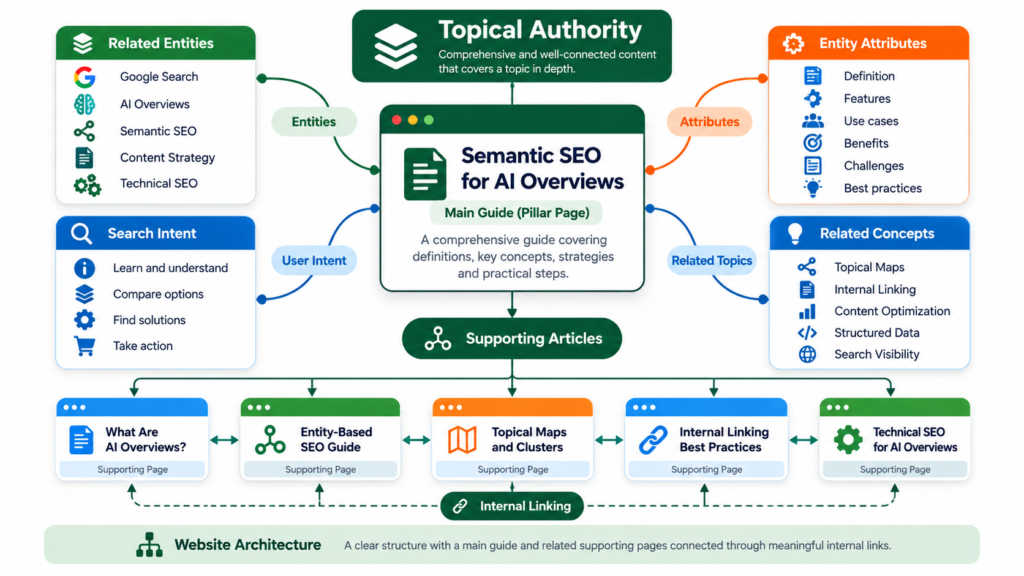
For example, a central guide about Semantic SEO may cover the main principles, while supporting pages explain topical maps, internal linking, and technical SEO audits in greater detail.
Finally, review the relationships between those pages. Add internal links where they help readers move naturally from one topic to another.
The goal is a useful content system, not a large collection of pages created solely to cover every possible keyword variation.
How to Optimize Content for AI Overviews With Semantic SEO
A practical optimization process starts with user intent, builds relevant topical coverage, improves the clarity of the page, and checks whether the website can be accessed and understood by search systems.
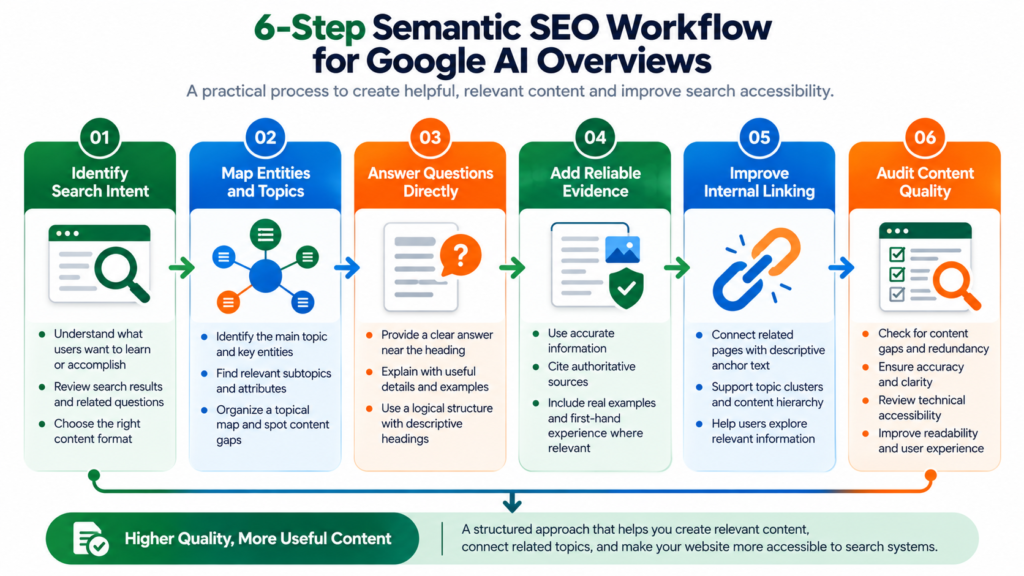
Step 1: Identify the Main Search Intent
Determine what the reader wants to learn or accomplish before drafting the page.
A person searching for a definition needs a direct explanation. Someone comparing tools needs relevant differences and limitations. A person trying to solve a technical issue needs actionable steps.
Review the search results and related questions to understand the likely task. Use this evidence to decide whether the page should be a guide, comparison, tutorial, or another format.
Do not create a page for every minor wording variation. Several queries may express the same underlying need and belong on one useful page.
Step 2: Build a Topic and Entity Map
Create a list of the main topic, supporting concepts, relevant entities, attributes, and questions.
Organize the list by importance. Start with the information needed to answer the main question, then add supporting details that improve understanding.
For a guide about AI Overviews and Semantic SEO, the map could include:
- AI Overviews and their role in Google Search.
- Semantic SEO and entity relationships.
- Search intent and topical coverage.
- Internal linking and website architecture.
- Technical accessibility and indexing.
- Performance measurement and limitations.
Use the map to identify gaps and avoid unnecessary repetition. A topic map should guide the content, not dictate an arbitrary article length.
Step 3: Answer Important Questions Directly
Give readers a clear answer near the beginning of each section.
If a heading asks whether structured data guarantees AI Overview inclusion, answer the question first: structured data does not guarantee inclusion. Then explain its role in other search features and the importance of accurate implementation.
Direct answers make pages easier to scan and help readers find information quickly.
Use supporting paragraphs to explain conditions, examples, exceptions, and limitations. Avoid repeating the same answer in several sections unless the context requires a different explanation.
Step 4: Add Accurate Examples and Supporting Evidence
Examples help readers apply abstract ideas to real tasks.
For instance, an article about entity relationships can show how a central page connects to supporting pages about content architecture and technical SEO.
Support factual claims with reliable sources, especially when discussing Google’s policies or technical requirements. Prefer official documentation when explaining what Google requires.
If you include original research, case studies, or performance figures, make sure the evidence exists and the methodology is clear. Do not invent results to make the article appear more authoritative.
Useful content can include original analysis and experience, but those elements must be genuine.
Step 5: Improve Context and Internal Linking
Internal links connect related pages and help readers discover further information.
Use descriptive anchor text that explains the destination. A page discussing topical maps may naturally link to a relevant guide about topical authority. A technical section may link to a detailed technical SEO resource.
The link should help readers continue their research. Avoid inserting links simply because a page exists or because an exact-match keyword is available.
For this article, relevant supporting resources include the Semantic SEO blog category, the Topical Authority blog category, and the Technical SEO and Audit blog category.
Step 6: Review Content for Gaps and Redundancy
Before publishing, compare the draft with the original search intent and topic map.
Ask whether the article answers the main question, explains the important concepts, supports its claims, and provides useful next steps.
Check for missing information, vague statements, unsupported claims, and repeated paragraphs. Remove sections that do not help readers achieve the intended goal.
Do not remove necessary explanations merely to make the article shorter. The objective is a focused, complete answer at an appropriate length.
How Do Topical Maps and Website Architecture Support AI Search Visibility?
Topical maps and website architecture help organize related content into a structure that readers and search systems can navigate.
What Is a Topical Map in Semantic SEO?
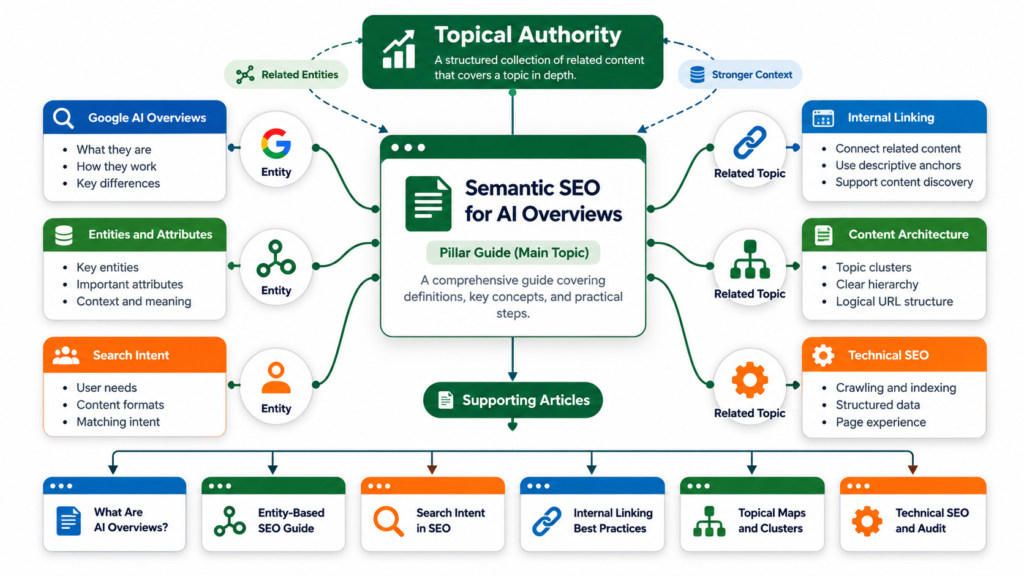
A topical map is a content-planning structure that organizes a subject into related topics and supporting pages.
For example, a website covering Semantic SEO may include a central guide and supporting pages about entities, topical authority, internal linking, and technical SEO.
The map helps define each page’s purpose and identify connections between related subjects.
However, a topical map does not guarantee rankings or AI Overview inclusion. Its value depends on whether the resulting pages provide useful information and serve distinct reader needs.
How Should You Organize Related Content?
Group content according to subject and search intent. Give each page a clear purpose, and avoid creating multiple pages that compete to answer the same question without offering a meaningful difference.
A central guide can introduce the main concepts. Supporting pages can provide detailed explanations, examples, and procedures.
This structure allows readers to move from a general explanation to a specific task without forcing every detail into one page.
A relevant content strategy and briefs resource can support planning and organizing related content.
How Does Internal Linking Connect Related Topics?
Internal links connect pages through meaningful relationships.
A link from a topical map guide to a page about technical SEO makes sense when the reader needs to understand how content planning and technical accessibility work together.
Use anchor text that describes the destination accurately. Review important pages to identify useful links that are missing, unnecessary links that distract readers, and pages that are difficult to discover.
Internal linking supports navigation and content discovery. It should not be presented as a guarantee that Google will select a page for an AI Overview.
Which Technical SEO Factors Matter for AI Overviews?
Technical SEO helps make content accessible to search systems, but technical compliance alone does not guarantee inclusion in AI Overviews.
Why Do Crawling and Indexing Matter?
Google needs access to a page to discover and evaluate its content.
Check that important pages are not accidentally blocked by robots.txt rules, server restrictions, or other technical problems. Review canonical tags, status codes, internal links, and indexing reports where appropriate.
Use Google Search Console’s URL Inspection tool to investigate whether Google can access and process a page.
Remember that a technically accessible page is not guaranteed to be indexed or displayed. Technical checks establish eligibility; they do not guarantee search visibility.
Does Structured Data Guarantee AI Overview Inclusion?
No. Structured data can help search engines interpret supported information and may make a page eligible for certain search features, but it does not guarantee AI Overview inclusion.
Use structured data when it accurately represents the visible content and follows Google’s documentation for the relevant feature.
Do not add markup solely because someone claims that a particular schema type unlocks AI search visibility. Review the actual requirements and use markup for its intended purpose.
Does Google Require Special AI Files or Content Formatting?
Google’s published guidance does not require a special schema or an llms.txt file for inclusion in AI Overviews.
Google also states that website owners do not need to divide content into tiny sections specifically for generative AI systems. Content should be organized for readers, with a clear hierarchy and useful explanations.
This does not mean formatting is irrelevant. Descriptive headings, readable paragraphs, lists, and tables can improve usability when used appropriately.
The distinction is that useful formatting supports readers, while an unsupported claim about mandatory AI formatting can lead to wasted effort.
How Do Page Experience and Mobile Accessibility Fit In?
A page should be easy to read, navigate, and use across devices.
Check that the main content is available as text, links work correctly, headings describe their sections, and important information is not hidden behind inaccessible interactions.
Relevant images and videos can support the written explanation. They should add value rather than repeat decorative information.
Use semantic HTML where practical, follow accessibility principles, and maintain a clear page structure. These practices support usability even when they do not directly determine AI Overview selection.
What Common Mistakes Should You Avoid When Optimizing for AI Overviews?
The most common mistakes involve chasing unverified tactics, repeating keywords unnaturally, and treating AI Overview inclusion as a guaranteed result.
Does Repeating Keywords Improve AI Search Visibility?
Repeating a keyword excessively does not guarantee that a page will appear in AI Overviews.
Use the main phrase where it fits naturally, then explain the topic using accurate terminology and relevant examples. Do not insert the same phrase into every heading or paragraph.
A page should read naturally and answer the reader’s question. Keyword repetition should not replace meaningful explanations.
Should You Create Content Only to Get AI Citations?
No. Content created only to attract AI citations may fail to provide lasting value to readers.
Start with a clear audience and a useful purpose. Add original insights, relevant examples, and evidence where available. Avoid publishing pages that repeat existing information without a meaningful contribution.
AI Overview inclusion is not guaranteed, so it should not be the sole reason for creating a page.
Can Schema Markup or llms.txt Guarantee Visibility?
Neither schema markup nor llms.txt guarantees AI Overview inclusion.
Structured data can serve valid purposes within Google’s supported search features. An llms.txt file may be used by some other systems, but Google states that Google Search ignores it for search visibility and rankings.
Evaluate recommendations against official documentation before investing time in them.
Why Is Publishing More Content Not Always the Answer?
More pages do not automatically create a stronger website.
Creating separate pages for every small keyword variation can lead to duplication, overlapping intent, and a poor user experience. Review whether existing content can answer the question more effectively before creating another page.
A focused content strategy should prioritize usefulness, accuracy, distinct page purposes, and relevant internal links.
How Do You Measure the Performance of Semantic SEO for AI Overviews?
Measure performance using available search data, website analytics, and business outcomes. Do not assume that an increase or decrease in traffic proves a particular AI Overview effect.
How Can Google Search Console Help?
Google Search Console provides information about search impressions, clicks, click-through rate, and average position.
Google’s guidance explains that traffic from AI features has historically been included within the overall Web search reporting. Google has also introduced a Generative AI performance report for eligible properties, providing additional visibility into generative AI search features.
Report availability and metrics can change, so check the current Search Console interface and official documentation before building a reporting process around specific fields.
Use the Google Search Console documentation to review available reports and measurement options.
How Should You Track Organic Traffic and Conversions?
Connect search performance to the actions that matter to the website.
For a service website, useful outcomes may include qualified enquiries, contact form submissions, and relevant service-page visits. For a publisher, they may include engaged visits, subscriptions, or other defined goals.
Compare performance across suitable periods and page groups. Consider seasonality, changes in demand, rankings, and other search features before assigning a cause to a change.
How Can You Evaluate AI Overview Visibility?
Use available Google reporting and carefully selected third-party tools to understand where your pages appear in AI search experiences.
Check the coverage and limitations of each tool. A tool that observes selected queries or search results does not necessarily represent every location, device, query, or user experience.
Do not treat an incomplete sample as a complete measure of AI visibility.
Which Metrics Should You Review Regularly?
A useful review can include:
- Organic clicks and impressions.
- Click-through rate and average position.
- Performance of important landing pages.
- Qualified enquiries or other conversions.
- Technical issues affecting crawling and indexing.
- Available data about generative AI search features.
Use the findings to identify pages that need improvement. The goal is to understand performance and make better decisions, not to chase one metric without considering the user’s needs.
Conclusion: How Should You Adapt Your Semantic SEO Strategy?
AI Overviews change how some search results present information, but they do not remove the need for useful content and sound SEO fundamentals.
Semantic SEO provides a practical way to organize information around topics, entities, relationships, and user intent. Website owners should improve content clarity, connect relevant pages, maintain technical accessibility, and measure actual performance.
Start by reviewing one important page. Check its search intent, topic coverage, evidence, internal links, and technical accessibility. Improve the parts that help readers understand the subject.
Treat AI Overview visibility as an opportunity, not a promise. A strong strategy focuses on useful information and measurable outcomes rather than unverified optimization tricks.
Frequently Asked Questions About Semantic SEO for AI Overviews
1. What Is Semantic SEO for AI Overviews?
Semantic SEO for AI Overviews means organizing content around meaning, related entities, contextual relationships, and user intent. It can improve content clarity, but it does not guarantee inclusion in AI-generated search summaries.
2. How Do You Optimize Content for Google AI Overviews?
Create useful content, answer relevant questions clearly, support factual claims, maintain internal links, and ensure that important pages are accessible to Google Search. No specific tactic guarantees inclusion.
3. Does Semantic SEO Help Content Appear in AI Overviews?
Semantic SEO can support clear and relevant content, but Google does not guarantee AI Overview inclusion based on a particular SEO approach. Selection depends on Google’s systems and the query.
4. Is Semantic SEO Different From Traditional SEO?
Semantic SEO places additional emphasis on meaning, entities, context, and relationships. It works alongside traditional SEO practices such as keyword research, technical accessibility, internal linking, and helpful content.
5. Are Topical Maps Useful for AI Search Optimization?
Topical maps help organize related topics and assign clear purposes to supporting pages. They can improve content planning, but they do not guarantee rankings or AI citations.
6. Does Schema Markup Help a Website Appear in AI Overviews?
Structured data can support eligibility for certain search features when correctly implemented. However, Google does not require a special schema for AI Overviews, and markup does not guarantee inclusion.
7. Does Google Require llms.txt for AI Overviews?
No. Google’s published guidance states that Google Search ignores llms.txt for search visibility and rankings. Website owners should focus on established SEO practices and useful content.
8. Can AI Overviews Reduce Organic Website Clicks?
AI Overviews may change click behavior for some queries, but the effect varies. Website owners should analyze their own performance and consider other factors before attributing traffic changes to AI search.
9. How Can You Track AI Overview Performance?
Use available Google Search Console reporting and appropriate analytics tools. Review current report availability and measurement limitations before drawing conclusions about generative AI visibility.
10. What Is the First Step in Optimizing for AI Overviews?
Start by identifying the page’s search intent and checking whether the content answers the reader’s main question accurately. Then review topical coverage, internal links, technical accessibility, and performance data.
dfghnbvcx.com