How Much Does a Website Costs in Oman? A Practical Guide to Budgets, Costs and Questions to Ask
Discover how much a website costs in Oman, from design and development to hosting, domain registration, and ongoing maintenance. Explore pricing factors, website types, and practical tips for comparing web design services and choosing the right provider for your business.

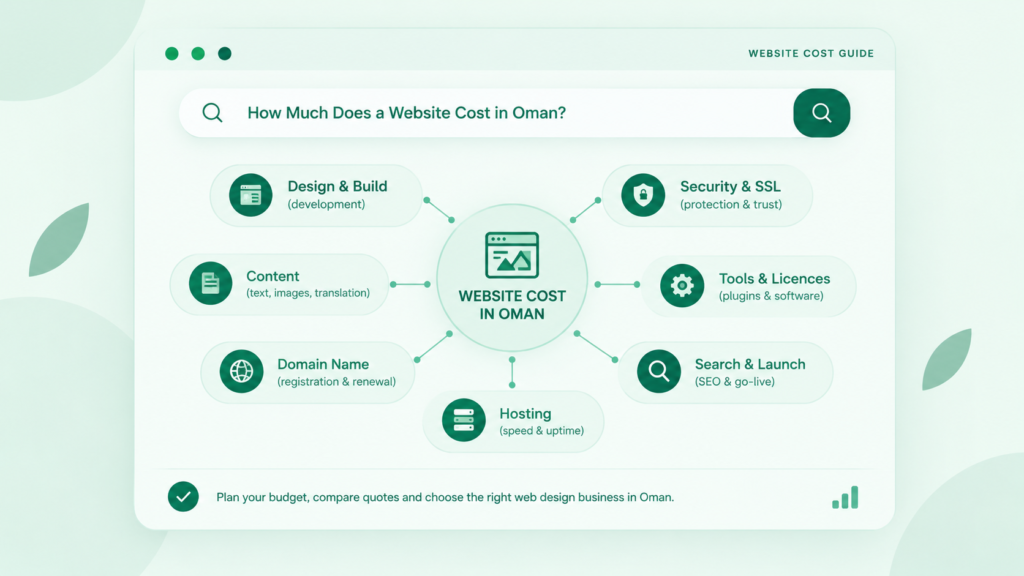
How much does a website cost in Oman? There is no single price, because a website is a bundle of separate costs: design and build, content, domain, hosting, security, and the work of keeping it running. This guide explains what you are paying for, which choices push a price up or down, what ongoing costs to expect, and which questions to ask before you accept a quotation.
The cost of a website depends on its type, number of pages, design approach, functions, languages, and who builds it. Published price ranges are estimates from sellers, so use them only as a rough guide, and compare quotations that cover the same scope. Budget for ongoing costs as well as the build, and check who owns your domain, content, and files. No guide, including this one, can give an exact price without your brief.
How Much Does a Website Cost in Oman, and Why Is There No Single Price?
A website in Oman can cost anything from a small yearly subscription to a large custom project, because the price depends on scope, not on the country alone. Two quotes for “a website” can describe completely different things.
Why do website quotes vary so much?
Quotes vary because providers include different work, use different methods, and charge for their time and risk in different ways. One quote may cover only a template with your logo added. Another may include custom design, Arabic and English content, and search setup. A lower price is not automatically a better deal, and a higher one is not automatically better quality. Always compare what is included.
What do the published price ranges show, and what do they not show?
Published ranges show how sellers price their own services, but they are estimates and I could not verify them independently.
A Middle East agency, Blue, published a regional budget guide in US dollars, with ranges such as $2,000 to $5,000 for a custom brochure website and $5,000 to $15,000 for a custom small business website. It calls them approximate and gives no source. An agency blog focused on Muscat, Kolonell, gave a ballpark of 2,000 to 10,000 OMR with a local agency and 400 to 2,000 OMR with a freelancer for a startup website, but that company sells its own fixed-price service, and I saw only an excerpt. Treat these as examples of seller estimates, not market facts.
A note on who wrote this guide and why it matters
I provide website services in Oman, so I have an interest in your decision, and you should weigh my advice with that in mind. I do not claim that my prices are the cheapest or the best, and I have not included them here. Ask for quotations from several sources.
What this guide will and will not give you
This guide gives you a framework for understanding and comparing costs, not a price list. It explains the cost parts, the factors that change them, and the questions to ask. It does not give you a figure for your project, because that needs your brief. It also does not give legal, tax, or financial advice.
What Are the Main Parts of a Website Cost?
A website cost has seven main parts: design and build, content, domain, hosting, security, tools and licences, and search and launch work. Some are one-off costs, and some repeat every year, so ask which is which.
Design and build
Design and build is usually the largest part, and it covers planning the layout, creating the pages, and building the site. It can be a template with your branding, a customised theme, or a fully custom design. The more custom the work, the more time it takes.
Content: text, images, and translation
Content covers the words, photographs, and graphics on your pages, and it is often underestimated. A provider may build the pages and expect you to supply the content, or may write it for you. Professional SEO content writing and photography add to the price. If you need Arabic and English, translation is an additional cost.
Domain name
A domain name is the address of your site, and you pay for it every year. Common endings such as .com have a standard price. Oman’s country domain .om is managed by the Telecommunications Regulatory Authority (TRA), which says registrations go through its accredited registrars. Prices and requirements differ by registrar, so ask the registrar for current terms.
Hosting
Hosting is the service that keeps your website online, and it is usually a yearly or monthly fee. Shared hosting is the cheapest option and suits small sites with modest traffic. Larger or more demanding sites may need a virtual private server or cloud hosting. Ask what the plan includes, such as storage, email, backups, and support.
Security and SSL
Security includes an SSL certificate, which enables HTTPS, plus protection against hacking and spam. Many hosting plans include a basic certificate, but some charge for it. Ask whether security monitoring, backups, and malware cleanup are part of the price or extra.
Tools, plugins, and licences
Some website features depend on paid tools, such as a premium theme, a booking plugin, or a form or email service. Ask which tools your site will use, who pays for them, and whether the licence is in your name.
Search engine setup and launch work
Launch work includes basic search engine setup, such as titles, a sitemap, and connecting Google Search Console. A provider may include it or sell it separately. Ongoing website SEO to attract visitors is a different, continuing cost, so do not assume a new site will bring customers by itself.

Which Factors Push a Website Price Up or Down?
The main factors are the number of pages, how custom the design is, the functions you need, the content, and the deadline. Each factor adds or removes work.
Number and type of pages
More pages mean more design, content, and testing, so the price rises with the size of the site. A site with five pages is far simpler than one with fifty. Planning the structure first helps, and these web design and architecture articles explain how structure and layout connect.
Custom design vs. a template
A template is faster and cheaper, while a custom design costs more but fits your brand and goals more closely. Templates can look professional and work well for many small businesses. Custom design makes sense when you need a distinctive layout or specific features.
Online store and payment features
An online store adds product pages, a shopping cart, checkout, and payment connections, so it costs more than an information site. For an e-commerce business, the number of products, delivery options, and payment methods all affect the work. Ask which payment methods the store can accept in Oman, and who sets them up.
Booking, login, and other functions
Functions such as online booking, member logins, calculators, and integrations with other systems add development work. List the functions you need early, and mark which are essential and which are optional.
Content and photography
Writing, editing, and photography take time, and professional versions cost more than DIY. Real photographs of your team, products, or premises often build more trust than stock images.
Deadline and revisions
A tight deadline and many rounds of revisions can raise the price, because they change how the provider plans the work. Ask how many revisions the quote covers and what extra rounds cost. A clear brief reduces revisions.
How Much Does a Website Cost in Oman by Website Type?
The cost depends mostly on what the site must do, so the useful question is which type of website you need, not a single average price. I do not give OMR figures here, because I could not verify neutral Omani prices. Instead, this section shows what each type involves.
Simple business or brochure website
A brochure website is a small set of pages that presents your business, with contact details and a few service descriptions. It is usually the lowest-cost custom option. A template with careful setup can meet the needs of many small businesses.
Service business website with several pages
A service business site has separate pages for each service, plus an about page, contact page, and sometimes a blog. It needs more content and more planning than a brochure site.
Online store
An online store costs more, because it needs product management, checkout, payments, and often shipping and tax settings. The number of products and the complexity of the catalogue strongly affect the work. Check ongoing platform fees as well as the build price.
Booking or membership website
A booking or membership site needs user accounts, calendars or access control, and often payments. These functions need careful testing, and the cost depends on how custom they are.
Large company or custom platform
A large or custom platform has many pages, integrations, and users, so it needs project management and more testing.
How to read any price range you find
Read any price range by asking what it includes, who published it, when, and for what kind of site. A range from a seller is an estimate that may favour their own packages. A regional range in dollars may not match Omani conditions. Use it as a rough guide only, and ask for a written quotation.
How Much Extra Does an Arabic and English Website Cost?
An Arabic and English website costs more than a single-language one, because the second language needs its own content, design checks, and testing. Plan for it from the start.
Why a second language is more than translation
A second language means writing for a different audience, not only converting words. Headings, buttons, and forms must fit the text, and the tone may differ. Ask whether the quote includes translation, review by a native speaker, and extra design work.
Right-to-left design and testing
Arabic text reads from right to left, so the layout, menus, and icons must mirror correctly. Developers set the page direction in the HTML and use logical CSS properties so the layout flips properly, as web.dev explains in its guide to internationalisation. Test with real Arabic content on a phone and a desktop.
Planning URLs and language versions
Each language version should have its own URL and link to the other versions. Google publishes guidance on how to tell it about localised versions of a page. Planning this at the start is cheaper than fixing it later. Ask the provider how the language versions will be organised.
Content you may want to write twice
Some content, such as service descriptions and contact pages, is needed in both languages, while other content may suit only one.
Who Should Build Your Website: Freelancer, Agency, or a Website Builder?
Choose by the complexity of your project, the support you need, and how much time you can give, not only by the lowest price. Each option has strengths and limits.
Freelancer
A freelancer is often more flexible and lower in cost, but one person has limited time and a single point of failure. Ask about their experience with similar projects, availability, and what happens if they are unavailable later.
Local agency
An agency offers a team with several skills and more continuity, and it usually charges more. Ask who will actually work on your project and how support is handled.
Website builders and ready platforms
Website builders such as Wix and Squarespace offer templates and hosting for a subscription, and they suit simple sites you can manage yourself. Blue’s regional guide lists them as the cheapest route, with limited customisation. Check the subscription, the cost of extra features, and how easily you can move your site later.
A simple way to compare the three
Compare the three on control, cost over three years, support, and the effort you will personally put in. A builder may cost less to start and more in subscriptions. A custom build may cost more upfront and give more control. Write down what each option includes, and compare the total, not only the first payment.
Should you hire locally or from abroad?
Hiring locally can help with communication, Arabic, and an understanding of the Omani market, while a provider abroad may offer lower or different pricing. If you prefer a local contact, you can find a web designer in Muscat, and you should compare more than one provider either way.

What Ongoing Costs Come After Launch?
After launch you pay for domain renewal, hosting, maintenance, content updates, and any marketing, so budget beyond the build. A cheap build with high running costs can end up costing more.
Domain renewal and hosting
Domains and hosting renew every year or month, and the renewal price can differ from the first-year price. Ask for the renewal price in writing.
Maintenance, updates, and backups
A website needs updates, security checks, and backups, whether you do them or pay someone else. Websites built on common platforms need regular updates to stay secure. Ask whether the quote includes a maintenance plan, and what it covers.
Content updates
Fresh content, such as new services, prices, and news, keeps a site accurate, and someone has to do the work. Decide whether you will update the site yourself, and whether the provider will train you. Ask what each small change costs if you use a provider.
Marketing and search visibility
A website does not bring visitors by itself, so budget for search work, advertising, or other marketing if you need customers. This is separate from the build. Decide whether you want search optimisation, paid advertising, or both, and how much you will spend each month.
How to estimate a three-year total
Add the build cost, three years of domain and hosting, maintenance, content updates, and marketing to compare options fairly. For example, list each cost per year and add them up for each provider. A three-year view shows when a cheap start becomes expensive. This is the comparison method, not a price estimate.
What Should a Good Quotation Include?
A good quotation lists what you get, what you pay, when you pay, and what happens after launch. A vague quotation is a warning sign.
Scope, pages, and deliverables
The quotation should list the pages, functions, languages, and deliverables in writing. It should say whether content, images, and translation are included. If something you expect is not listed, ask whether it is included.
Ownership of the domain, content, and files
You should own your domain, your content, and the files of your site, and the quotation should say so. Make sure the domain is registered in your name, not the provider’s. Ask who holds the hosting login and whether you can move the site to another provider.
Revisions, timeline, and payment stages
The quotation should state the timeline, the number of revisions, and the payment stages. A common structure splits payment between the start and the delivery, but the terms vary. Avoid paying everything upfront before any work is shown.
What happens after launch
Ask what support, fixes, and training follow launch, and for how long. Find out whether bugs found after launch are fixed free of charge, and for how long. A regular technical SEO and audit check after launch can also catch problems early.
Red flags in a quotation
Be careful with unclear scope, no ownership terms, pressure to pay in full immediately, and prices far below every other quote. Ask why a price is much lower. Also ask whether the quotation includes value added tax, and check the Oman Tax Authority’s guidance on how it applies to your purchase.

How Do You Set a Realistic Budget?
Set a realistic budget by working from your goal, listing must-haves, and comparing quotations for the same scope. Start with what the website must achieve for your business.
Start with the goal and the audience
Write down what the site should do and who it is for, because those decide the scope. A site that must generate enquiries needs different work from one that only proves your business exists. Knowing your audience tells you whether you need Arabic, English, or both.
Separate must-haves from nice-to-haves
List the features and pages you cannot launch without, and keep a separate list of extras. This lets you compare quotes and cut cost without losing essentials. It also helps if a quote is above your budget.
Phase the project
Build the essential site first, and add features in later phases as your budget and needs grow. A first phase can cover core pages and contact details. Later phases can add a store, a second language, or extra functions. Plan the structure so later additions fit.
Get several quotes and compare like with like
Ask at least three providers to quote on the same written brief, and compare the scope line by line. Give each the same information. Differences in price then reflect differences in the work, not different assumptions.
Can You Build a Website for Less? Where to Save and Where Not To
You can reduce cost by simplifying scope and using proven tools, but cutting the wrong things costs more later. The aim is to save on extras, not on the foundations.
Where saving is reasonable
Saving is reasonable on page count, custom features, and design extras you do not need at launch. A template, a simpler layout, and fewer pages can reduce the build price. Supplying your own content and photographs can also lower cost, if you have the time.
Where cutting corners costs more later
Cutting corners on structure, security, backups, and domain ownership often costs more later. A poorly planned site is hard to extend. Skipping backups and security can lead to expensive recovery. Keep ownership of your domain and files.
Free and low-cost options: what you trade off
Free and low-cost options save money upfront, but they often limit design, features, and portability. Free plans may show the platform’s branding or limit the domain. Check the terms, and ask what happens if you outgrow the plan.
Which Mistakes Make a Website Cost More Than Expected?
The most common mistakes are a vague brief, choosing on price alone, not owning the domain, skipping content planning, and forgetting ongoing costs. Each can add cost later.
A vague brief
A vague brief leads to extra rounds of work and disputes about what was included. Write down pages, functions, languages, and goals before asking for quotes.
Choosing on price alone
The lowest price may leave out work you assumed was included. Compare scope first, and then price.
Not owning the domain
If the provider registers the domain in their name, you may struggle to move or keep it. Register it yourself, or confirm in writing that it is in your name.
Skipping content planning
Delays in content are a common reason projects run over time and budget. Plan who writes, who approves, and by when.
Forgetting the cost of keeping the site up to date
A site that is not maintained becomes outdated and less secure. Budget for updates, backups, and content changes.
How Much Does a Website Cost in Oman? Checklist Before You Request Quotes
Before you request quotes, write down your goal, your pages, your languages, your functions, your content plan, and your budget range. This checklist turns the guide into a brief you can send to providers.
A pre-quote checklist
Answer yes to every item below before you ask for a quotation.
- Have you written the main goal of the website in one sentence?
- Do you know who the audience is and which languages they need?
- Have you listed the pages the site needs at launch?
- Have you listed the functions you need, marked as essential or optional?
- Do you know who will write and approve the content?
- Have you decided whether you need an online store, booking, or logins?
- Will the domain be registered in your name?
- Have you set a budget range for the build and for yearly running costs?
- Will you ask at least three providers to quote on the same brief?
- Have you decided how the site will be maintained after launch?
How do you review a quotation you have received?
Review a quotation by checking that it lists scope, ownership, timeline, payments, and support, and that the total matches your brief. Compare it with your checklist:
- Check every page, function, and language you listed.
- Confirm what is included for content, images, and translation.
- Look at renewal prices for the domain and hosting.
- Ask who owns the domain, files, and logins.
- Check revisions, payment stages, and what support follows launch.
Ask about anything unclear, and keep the answers in writing.
Next Step for You
I measure local SEO work with real ranking data, not opinion, and the results below come from client projects I worked on. If you are not sure what you need, contact me and share your current website address.
I tested Google Maps rankings on a grid of real search points around each business, so I could see where customers find it and where they do not. I tried Google Business Profile work with Mapping each keyword to its own page and removing technical friction on the website. I saw a roofing contractor in New Boston, Ohio reached an average Maps rank of 1.51 on a 9 x 9 grid, with 100% Top 3 visibility.
Real examples from my case studies
| Project | Location and date | What I did | Measured result |
| Roofing contractor | New Boston, Ohio, USA; scanned 20 Jan 2026 | GBP optimisation, local relevance, citations, reviews | Average Maps rank 1.51; competitors averaged 2.64, 2.67 and 5.88 |
Conclusion
The cost of a website in Oman depends on what you need, so the best budget starts with a clear brief, not a guess. Understand the parts: design, content, domain, hosting, security, and launch work. Allow for the factors that raise a price, especially a second language and an online store. Check who owns the domain, content, and files. Treat published price ranges as seller estimates, and use the checklist to write your brief before you ask for quotes.
FAQs
How much does a website cost in Oman?
It depends on the type, pages, functions, languages, and who builds it, and I could not verify a neutral Omani price list. Published ranges are seller estimates. Write a clear brief and ask several providers to quote on it.
How much does a simple business website cost?
A simple business website is usually the lowest-cost custom option, but the price depends on the pages, content, and provider. Ask what the quote includes, such as mobile design, content, and search setup.
How much does an online store cost?
An online store costs more than an information site, because it needs products, checkout, payments, and often shipping settings. The number of products and payment methods strongly affect the price.
How much extra is an Arabic and English website?
It costs more, because the second language needs translation, right-to-left design, and extra testing. Ask whether the quote covers each of these.
Is a freelancer cheaper than an agency?
A freelancer is often cheaper, but price is only one factor, and support and reliability also matter. Compare scope, experience, and what happens after launch.
What ongoing costs should I expect after launch?
Expect domain renewal, hosting, maintenance, backups, content updates, and any marketing. Ask for renewal prices in writing.
How much does a domain name cost?
It depends on the ending and the registrar, and .om domains go through TRA-accredited registrars with their own terms. Ask the registrar for the current price and requirements.
Do I need to pay for hosting separately?
Usually yes, unless it is bundled into a website builder subscription or a package. Ask what hosting is included, and the renewal price.
Why are website quotes so different?
Quotes differ because providers include different work, tools, and levels of support. Compare scope line by line before you compare prices.
How long does it take to build a website?
A simple site can take a few weeks, and complex sites take longer, and delays in content are a common cause. Ask for a written timeline and agree who supplies content, and by when.