SEO Content Length: How Long Should an SEO Article Be?
SEO content length has no fixed number. Learn what Google says, which benchmarks matter, and how to set article length by search intent.

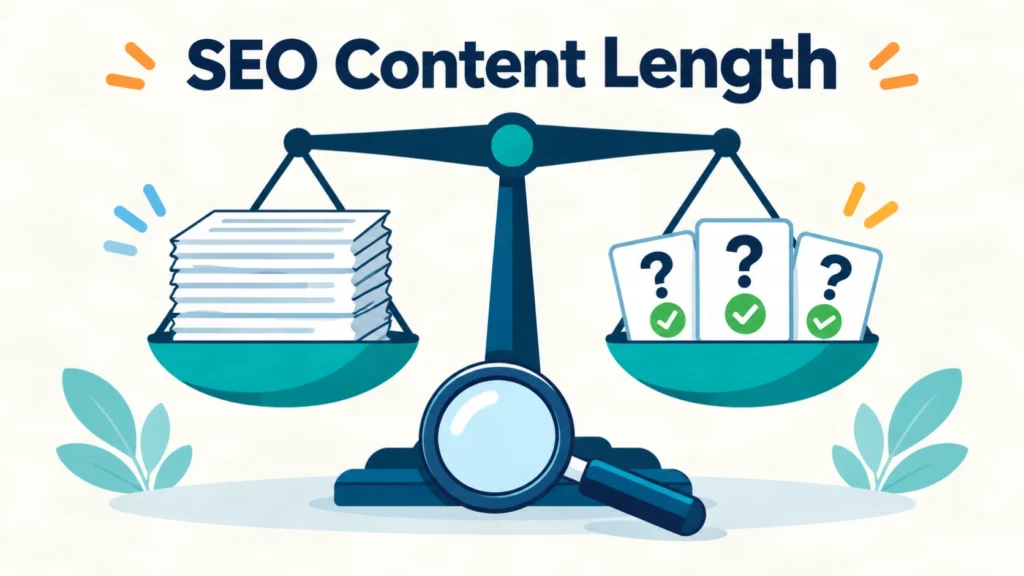
SEO content length is the number of words a page needs to answer a search query completely, and no single number fits every page. Google says it has no preferred word count, so the right length depends on search intent, topic depth, and what already satisfies readers. This guide explains how long an SEO article should be in 2026, which benchmarks are worth using, and how to set a length for your own keyword without padding.
Published averages sit near 1,300 to 1,450 words, but Google does not reward a word count. Compare the pages that already answer your keyword, add the evidence they miss, and stop when the reader’s question is fully answered.
I am Forkan Mahmud. I have around five years of SEO experience with clients across Europe, and I manage much of my work from Oman with a team. Content briefs, topical maps, and content optimization are part of my regular work, so length decisions come up in almost every project. This guide combines Google’s own documentation, published studies, and the planning method I use. Every figure links to its source, and I label my own planning ranges as judgment, not data.
What Is SEO Content Length and Why Does It Matter?
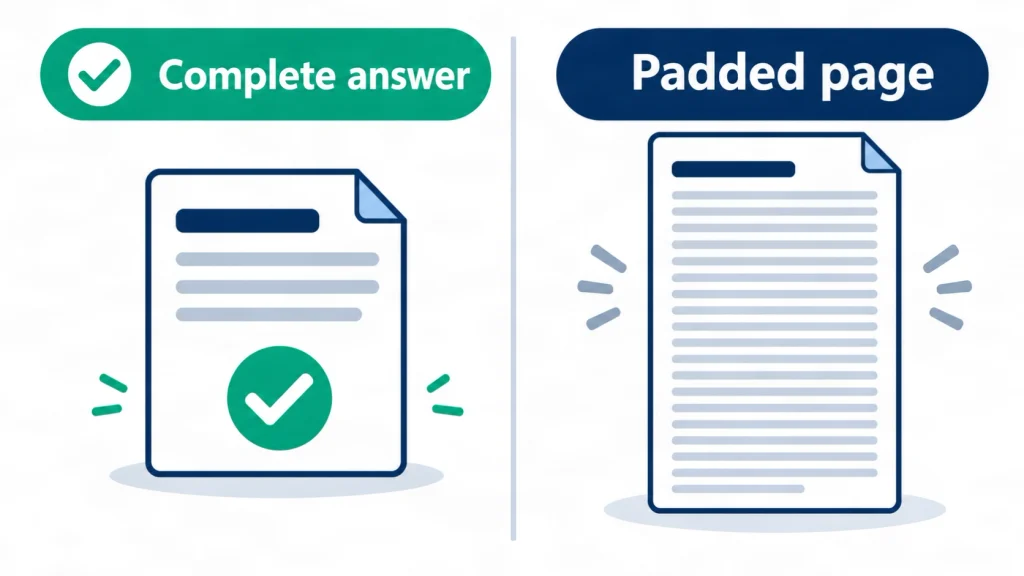
SEO content length is the word count of a page, judged together with how fully the page covers its topic. Word count is only a measurement. Coverage is the goal.
A 150-word answer can fully satisfy a simple query. A 4,000-word page can still feel thin if it repeats common advice. Google’s helpful content guidance asks whether a page gives a substantial, complete description of its topic and real value compared with other results. It does not ask for a minimum number of words.
Google also defines “main content” as any part of a page that directly helps the page reach its purpose. That includes text, images, tables, interactive tools, and headings. So SEO content length is not only a paragraph count. A clear table or an original screenshot can do more for the reader than 300 extra words.
For content teams, SEO content length is a planning question: how much space does this topic need to be answered well? The sections below show how to answer it with evidence, starting with what Google says about content length.
Does Word Count Matter for SEO?
Google does not use a preferred word count, so word count alone does not decide rankings. The depth that adds words can still change how well a page satisfies the reader.
What does Google say about word count?
Google says it has no preferred word count. Its page on creating helpful, reliable, people-first content lists writing to a particular word count as a warning sign of search engine-first content, then answers its own question with a plain no. Google last updated that page on October 5, 2026.
Its guide to generative AI features says the same about page length:
“There’s no ideal page length”
Source: Google Search Central, Optimizing your website for generative AI features on Google Search, last updated July 10, 2026
The same guide adds that you do not need to chunk content into tiny pieces for AI systems. It says shorter or longer pages can work, depending on the audience and the subject.
Why do longer pages often rank higher in studies?
Longer pages often rank higher in studies because they tend to cover more subtopics, not because Google rewards length itself. Backlinko analyzed 11.8 million Google search results and found that the average first-page result contained 1,447 words. The same study found word count was evenly distributed among the top 10 positions, so a longer page did not reliably beat a shorter one inside page one.
Studies of SEO content length like this show correlation, not cause. Ahrefs reports a different figure in its AI Overview research: 1,188 words for content ranking in organic results. Two respected datasets give two different averages. That gap is the first reason to avoid copying any single number.
Does word count affect AI Overviews and AI search citations?
Word count has almost no relationship with citation in Google AI Overviews. Ahrefs analyzed 174,048 pages cited in AI Overviews and found a Spearman correlation of 0.04 between word count and citation position. The average cited page had 1,282 words. Pages under 1,000 words earned 53.4% of citations, pages with 1,000 to 2,000 words earned 30.6%, and pages over 2,000 words earned 16.0%.
My reading is that clear answers and topical fit matter more than length for this feature. That is an interpretation, not a proven rule, and the study covers Google AI Overviews only, not every AI assistant. Google’s own guide says its generative AI features rely on its core ranking and quality systems, so ordinary SEO best practices still apply.
How Long Should an SEO Article Be in 2026?
An SEO article should be as long as it takes to answer the query fully. Published averages sit near 1,300 to 1,450 words, so many informational articles land between 1,200 and 2,000 words. Treat that range as a starting point for SEO content length, not a rule.
| Source | Figure | What it measures | Limit to remember |
| Orbit Media, Blogging Statistics 2026 | 1,312 words | Average published blog post, from a survey of 1,042 content marketers | Self-reported, and it shows what marketers publish, not what ranks |
| Backlinko ranking study | 1,447 words | Average first-page Google result across 11.8 million results | Older correlation study |
| Ahrefs AI Overview study | 1,188 words | Average content ranking in organic results in the same dataset | Reported alongside an AI Overview study |
| Ahrefs AI Overview study | 1,282 words | Average page cited in AI Overviews, from 174,048 pages | Google AI Overviews only |
Orbit Media reports that the average post fell to 1,312 words in 2026 from a peak of 1,427 words in 2023, and that it was about 800 words in 2014. If you searched for seo article length 2023, that year was the peak, and averages have declined since.
Why should you avoid copying an average word count?
An average hides the spread, and your keyword lives somewhere inside that spread. Any single SEO content length benchmark has the same weakness. Ahrefs’ distribution shows both short and long pages earning citations. Orbit’s 12-year data shows publishers wrote longer posts for years, but Orbit says the return on extra effort flattened once effort peaked. Only 13.9% of its 2026 respondents said their blog delivers strong results, the lowest share in the survey’s history. These figures come from marketers describing their own results, so they show a pattern, not proof that length caused anything.
“The most effort produces the best results.”
Source: Mark Schaefer, keynote speaker and author, quoted in Orbit Media’s 2026 Blogging Statistics
Schaefer adds that in the middle range of effort, more work is not necessarily a predictor of business results. That fits the point of this guide: extra words are not the same as extra effort.
SEO Content Length by Search Intent
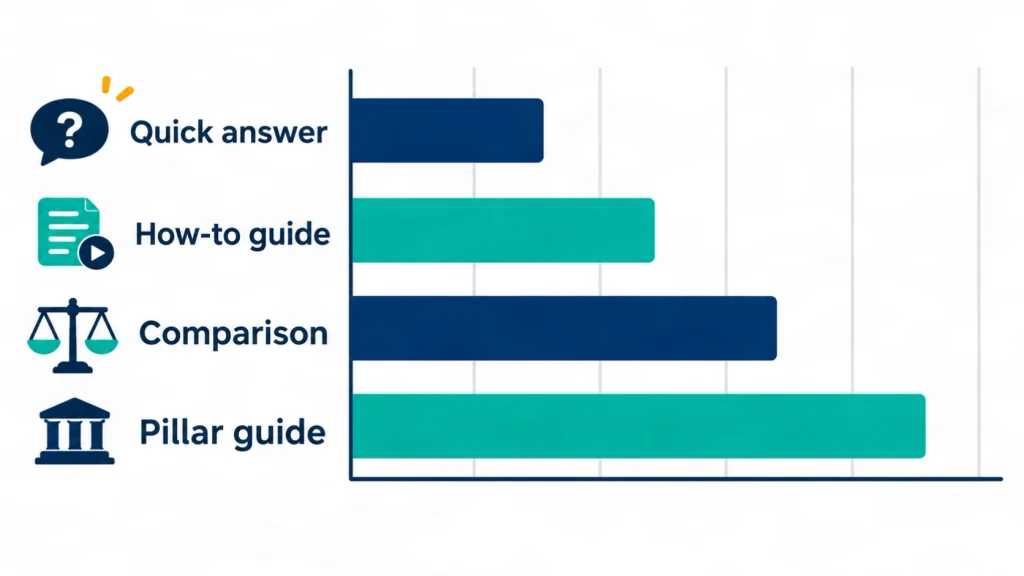
Search intent sets the length: quick answers need a few hundred words, how-to guides need more, and comparisons or pillar guides need the most room. Content length by intent is the most useful way to plan SEO content length, because intent tells you what the reader must be able to do after reading.
The length range of content below are my own working ranges, based on how I plan briefs. They are judgment, not Google rules, and you should test them against live results for your market.
| Search intent | Example query | Working range | Why this range |
| Quick answer or definition | what is a URL slug | 300 to 800 words | One clear answer, a short example, and a next step |
| How-to guide | how to write a meta description | 1,200 to 2,000 words | Steps, common mistakes, examples, and edge cases |
| Comparison or review | SEO plugin comparison | 1,500 to 2,500 words | Criteria, a comparison table, and honest trade-offs |
| Pillar guide | local SEO guide | 2,500 to 4,000 words | Many subtopics, with links to deeper pages |
| Service page | local SEO service in Muscat | 600 to 1,500 words | Scope, process, proof, FAQs, and a contact route |
| News or update | Google core update announcement | 300 to 800 words | Speed and clarity matter more than depth |
How do you read search intent from the results?
Read intent by looking at what the top results already are. If they are short definitions, featured snippets, or tool pages, a 3,000-word essay is the wrong format. If they are long guides with tables and step lists, a 400-word post will feel incomplete. Note the page types, headings, and questions each result answers before you set a word target.
Does a service or local page need to be long?
No, a service page needs enough words to explain the service, the process, and the proof, and no more. In the Ahrefs AI Overview data, core pages such as home, about, and service landing pages had a median of 317 words among cited pages. That does not make 317 words the right SEO content length for every service page. It does show that a focused page can be cited without being long.
When a blog post touches a service, I link to the service page instead of repeating the sales explanation. For example, my local SEO service and website SEO service pages carry the detail, so an article can stay focused on its own question.
Long Form vs Short Form Content: Which Is Better for SEO?
Neither is better by default. Long form content suits topics with many subtopics, and short form content suits queries that one clear answer can satisfy. The long form vs short form debate often hides the real question, which is whether the page matches intent.
When does long form content help SEO?
Long form content helps when the reader must compare options, follow a process, or understand several related entities. In those cases, SEO content length grows because the topic is larger. A guide to planning a content strategy needs definitions, trade-offs, steps, and examples, so the depth uses more words naturally. Orbit’s 2026 chart also places long, keyword-focused articles among the less common strategies that show higher rates of strong results. Again, that is a survey correlation.
When does short form content win?
Short form content wins when the query has one clear answer. A definition, a single fact, or a quick local detail does not need 2,000 words. Ahrefs found that 53.4% of AI Overview citations went to pages under 1,000 words. For short pages,content length should stay tight: lead with the answer, add one example, and link to deeper material.
How to Set the Right SEO Content Length Step by Step
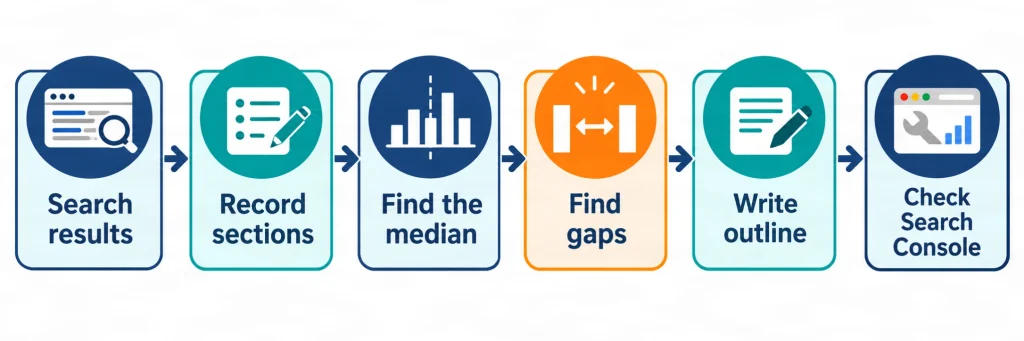
Set SEO content length by studying the pages that already satisfy your keyword, listing what they miss, and writing until every question is answered. This is the method I use when planning length in a content brief:
- Search the keyword and open the first 10 relevant results. Use the market and language of your audience, and count only pages you can actually open.
- Record the main sections and approximate word count of each page. Count main content only, and leave out menus, comments, and footers.
- Use the median as a reference point, not a target. The median is less distorted by one extreme result than the average.
- List what the results miss. Look for unanswered questions, outdated figures, missing tables, and a lack of first-hand evidence.
- Write the outline first and let the outline set the length. Every heading should answer a question the reader has. Remove any heading that only repeats another.
- Publish, then review the page in Search Console. Check queries, impressions, and clicks once the page has been crawled and indexed, then edit based on what you learn.
Here is an example with invented numbers, not a real search result page. Suppose ten results have these main-content word counts: 1,100, 1,250, 1,350, 1,450, 1,500, 1,600, 1,700, 1,900, 1,950, and 2,200. The median is 1,550 words and the average is 1,600 words. I would plan an outline near 1,500 to 1,900 words, then add the two or three sections that none of the ten pages covers. That is how I set SEO content length for a real brief. If those sections need 300 more words, the article grows because it has something new to say.
Group queries by meaning before you write. Google’s generative AI guide warns that creating separate pages for every query variation, mainly to manipulate results, can violate its scaled content abuse policy. So “how long should a blog post be,” “ideal blog post length seo,” and “best seo article length” belong on one page, not three. Long-tail variants with the same intent can share a page.
What does a good SEO article example look like?
A good SEO article opens with a direct answer, follows a clear heading order, uses a table or list only where it helps, and ends with sourced FAQs. This guide follows that pattern. It is also a practical checklist for SEO content length, seo article best practices, and seo content best practices: match intent, answer first, cite dated sources, show who wrote it, and update it when facts change.
How Can You Add Value Without Padding the Article?
Add information a reader cannot get from a short recap: first-hand evidence, sourced figures with context, expert quotes, and clear structure. Google’s helpful content page asks whether content offers original information, insightful analysis, and substantial value compared with other results. It also says that crediting other sources does not replace original effort.
| Padding | Better replacement |
| A long introduction that repeats the title | A direct answer in the first sentence |
| The same tip repeated in new words | One clear explanation with an example |
| A statistic with no source | A dated figure that says who produced it and what it measures |
| Filler FAQs | Questions that real searches ask |
Statistics need context. State what the number measures, who produced it, and when. In this guide, the 1,312-word figure is the 2026 average of posts published by 1,042 surveyed content marketers, according to Orbit Media. It is not a ranking benchmark.
Quotes need real sources. Quote a real expert or a primary source, name the person or organization, and link the original. Never invent a quote or attribute generic wording to someone.
First-hand evidence needs a method. First-hand evidence means something you actually did, tested, or observed, shown with its method and limits. This guide does not claim a controlled length experiment. If you run your own, record the pages, dates, queries, and what changed, and publish the limits with the result. Orbit’s survey links original research with roughly 50% higher odds of strong results, and it also links a formal human editing process with better outcomes than AI-only edits. Both are correlations.
How Should YMYL Topics Change Your Article Length and Sourcing?
YMYL topics need accuracy and qualified review before they need length. YMYL means “Your Money or Your Life”: topics that could significantly affect health, financial stability, safety, or the well-being of society. Google says its systems give even more weight to content that aligns with strong E-E-A-T for these topics, and that trust is the most important of the four qualities.
Google’s guidance also says informational content on these topics should be highly accurate and consistent with established expert consensus. A longer page does not make outdated or unsafe advice safer, so SEO content length is never a substitute for review.
If your site covers healthcare, dental care, or law, plan for a qualified professional to write or review each page, name that person, and cite primary sources such as regulators and official health bodies. My industry pages for healthcare and dental and law firms cover the sectors where this matters most.
This article covers SEO planning. It is not medical, financial, or legal advice. For personal health, money, or legal decisions, consult a qualified professional.
Why Do “How Long Should” Searches About Eggs, Naps, and Blood Tests Show Up in SEO Keyword Lists?
They show up because keyword tools group queries by shared wording, and “how long should” is one of the most common question patterns online. The wording matches, but the meaning does not. “How long should you boil eggs,” “how long should a nap be,” “how long should a resume be,” and “how long should a car battery last” each have a different entity, intent, and set of trusted sources.
Group them by canonical topic instead, and keep SEO content length questions on one page. “How long should an article be,” “how long should a blog post be,” “how long should an seo article be,” and “seo article length” describe one topic, and this page covers it. “How long should an article review be” asks about an academic or editorial review, which is a different intent. “How long does SEO take” asks about a results timeline. That deserves its own page, because no honest source can promise a date, and results depend on the site, the competition, and indexing.
Health-related versions, such as how long to fast before blood work or when to take a pregnancy test, are medical questions. An SEO article is the wrong source. Follow the product instructions, your laboratory’s or doctor’s directions, or an official health agency such as the CDC or the NHS. If you consult a professional, you will get advice that fits your situation.
How Can You Write for AI Overviews and Answer Engines Without Padding?
Answer the question in the first sentence, define each entity clearly, and support claims with dated, linked sources. These habits help readers and AI features alike. For answer engine optimization (AEO), write short passages that make sense without the paragraph before them. For generative engine optimization (GEO), name entities, explain how they relate, and give context for every statistic.
Google’s guide says you do not need llms.txt files, special markup, or rewriting just for AI systems to appear in its generative AI features. It describes generic, common-knowledge content as “commodity content” and says a unique point of view helps a page stand out. No tactic guarantees a citation, and I do not promise one.
Which Length Mistakes Hurt SEO Articles Most?
The most common mistakes are padding to hit a number, copying a competitor’s word count, and changing dates without changing the content. Watch for these:
- Padding a page with filler until it reaches a target length.
- Copying the longest result, which is not always the most helpful one.
- Treating a survey statistic as a rule, such as an average from self-reported data.
- Repeating the exact focus keyword until the text reads badly. Keep it natural.
- Changing the published date without a substantial update. Google lists this as a warning sign.
- Publishing near-duplicate pages for every wording variation.
When Should You Get Help Planning Article Length?
Get help when you manage many pages, work in a sensitive niche, or cannot tell why strong pages are not performing. At scale, SEO content length belongs in the content brief and the topical map, not in one writer’s guess.
My SEO content writing service covers research-led briefs and drafts, and my topical map service shows which pages a site needs and how they connect. The content strategy and briefs and semantic SEO blog categories go deeper on planning. You can read more about me or reach out through the contact page. I do not promise rankings, traffic, or AI citations, because no one controls those.
What Are the Limits of This Guidance?
This guidance has three limits: studies show correlation, my ranges are judgment, and search results change. Orbit’s data comes from marketers describing their own results. Backlinko and Ahrefs measure patterns, not Google’s internal signals. My intent table gives planning ranges that you must test against live results.
The main risk is writing to a number instead of a reader, which is the most common SEO content length mistake. A sensible next step is to pick one page, run the six steps above, and record what you change and what happens in Search Console.
The Practical Answer: Match Length to the Job
The right SEO content length is the shortest length that fully answers the query and shows real expertise. For many informational topics, that means 1,200 to 2,000 words. For quick answers, it means far less. For pillar guides, it can mean much more.
Check the live results, find what they miss, set SEO content length from the outline, cite sources with context, and let the outline decide the word count. Then update the page when the facts change.
Frequently Asked Questions
How long should an SEO article be?
An SEO article has no fixed length; SEO content length should match what the topic needs. Published averages sit near 1,300 to 1,450 words, and many informational articles land between 1,200 and 2,000 words. Compare the pages ranking for your keyword, then add what they miss.
Does word count matter for SEO?
Not directly, because Google says it has no preferred word count for SEO content length. Word count matters indirectly when a topic needs more words to be answered fully. A page that pads to reach a number does not gain from the extra words.
What is the best SEO article length for a blog post?
The best length is the one that matches search intent. For blog length for SEO, start with the median of the top results, then plan sections from the questions readers ask. Orbit’s 2026 average of 1,312 words is a benchmark, not a target.
How long should an article be?
It depends on the purpose and the reader. A news update may need a few hundred words, while a detailed guide may need several thousand. There is no universal answer, so decide from the audience, the goal, and the search results.
How long should an article review be?
An article review for a course or journal follows the instructor’s or publisher’s rules, not SEO rules. Check the assignment brief or submission guidelines. This is a different intent from SEO content length.
How long does SEO take?
No one can promise a fixed time. Results depend on the site, the competition, the content quality, and indexing. Track progress in Search Console, and be careful with anyone who guarantees a date.
Is long form content better than short form content for SEO?
Not by default. For SEO content length, long form content fits topics with many subtopics, and short form content fits queries with one clear answer. Ahrefs found that 53.4% of Google AI Overview citations went to pages under 1,000 words.
What does “SEO article” mean?
An SEO article is a page written to answer a search query helpfully and to be easy for search engines to crawl and understand. Google says SEO is helpful when applied to people-first content. Clear headings, sourced facts, and relevant internal links support that goal.
Does a longer article get cited more by AI search tools?
Not according to Ahrefs’ study of Google AI Overviews, which found a correlation of 0.04 between word count and citation position. Other AI tools may behave differently, and no formatting trick guarantees a citation.
Is “how long should a resume or cover letter be” an SEO article question?
No, it is a career-document question. Follow the employer’s instructions and advice from reputable career services. An SEO article should not answer it unless the site publishes career advice reviewed by qualified people.