AI SEO Content: How to Use AI Safely Without Hurting Your Rankings
AI SEO content is safe when a person checks the facts, adds real experience, and writes for the reader. This guide shows a 7-step workflow, Google’s current rules, and the risks to avoid.


AI SEO content is safe to publish when a real person checks the facts, adds first-hand experience, and writes for the reader. Google does not ban AI-assisted writing. It acts against pages made mainly to manipulate rankings, however they were produced. This guide explains the risks, shows a seven-step workflow, and lists the checks I recommend before any page goes live.
Use AI to research, outline, and draft AI SEO content faster. Do not publish unchecked pages in bulk. Verify every fact against a primary source, add your own experience, edit in your own voice, and show who wrote and reviewed the page.
What Is AI SEO Content?
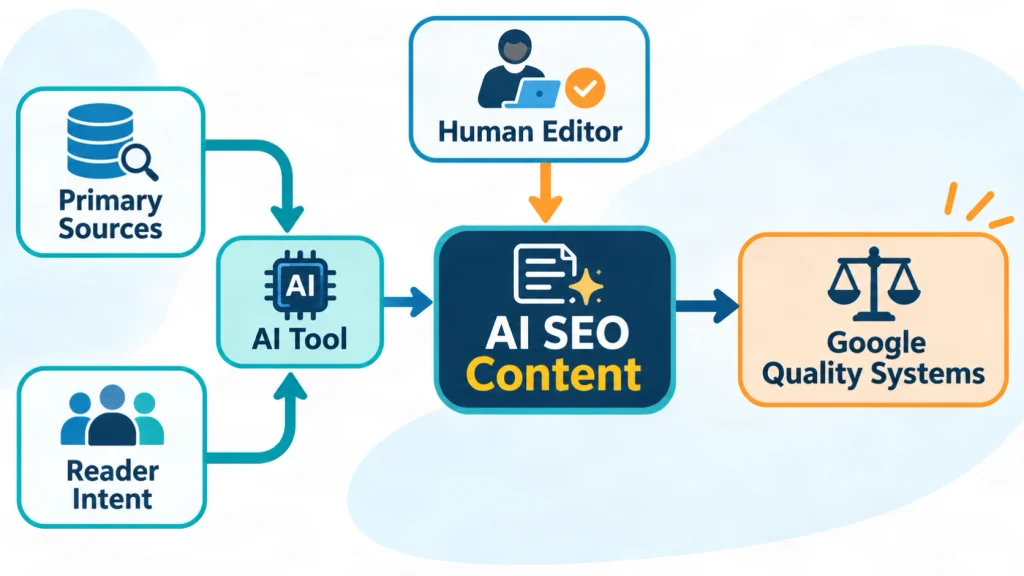
AI SEO content is search-focused content that a generative AI tool helped plan, draft, or improve, and that a person reviews before it is published. It ranges from an AI-made outline to a full AI draft that an editor rewrites and fact-checks. The label describes how the content was made, not whether it is good. Strong AI content still starts with a reader’s question, not a prompt.
The phrase “AI SEO” has two common meanings. The first is using AI tools to do SEO work, such as keyword grouping, outlines, and drafts. The second is optimizing a site so it appears in AI search features like Google’s AI Overviews and AI Mode.
Some people call the second meaning GEO (generative engine optimization) or AEO (answer engine optimization). Google says that, from its perspective, optimizing for generative AI search is still SEO. So SEO still means search engine optimization. AI is one tool and one search channel inside it, not a replacement for the discipline.
Is AI SEO Content Bad for SEO?
No. Google does not penalize content only because AI helped write it, but it does act against many low-value pages made to manipulate rankings. Google’s guidance on generative AI content says the tools can help with research and with adding structure to original content. The same page warns that generating many pages without adding value may violate the scaled content abuse policy.
That policy does not depend on the method. In its March 2024 announcement , Google said it can act on scaled content abuse whether the content comes from automation, human effort, or a mix of both. A human content farm and an AI content farm face the same test: does each page help a reader?
What Did Google Change in Its AI SEO Content Guidance in October 2026?
On October 1, 2026, Google updated its generative AI guidance, and the update puts accuracy first. The page explains that generative models predict likely word sequences instead of retrieving facts, so their output can contain errors, often called hallucinations. Google calls it critical to:
“manually factcheck and review all AI-generated content for accuracy and trustworthiness”
Google Search Central, Guidance on using generative AI content, last updated October 1, 2026
That review also covers metadata. Google lists title elements, meta descriptions, structured data, and image alt text as items to check. An AI-written meta description needs the same fact-check as the article body.
Google also suggests giving readers context about how content was created. A short note near the end of an article is a simple way to do that.
What Does the Data Say About AI Content and Rankings?
Large studies show that AI use alone does not predict ranking position, but pure AI pages rarely reach the top spot. Ahrefs analyzed 600,000 pages from the top 20 results for 100,000 random keywords. Its detector found that 86.5% contained some AI-generated content, and only 13.5% were purely human-written (Ahrefs, July 7, 2025).
The correlation between AI percentage and ranking position was 0.011, which Ahrefs calls effectively zero. Only 4.6% of those pages were classified as pure AI. Pages ranking first tended to have slightly less AI content, though Ahrefs says the link is very weak.
A separate Ahrefs study checked 900,000 newly published English pages from April 2025. It found that 74.2% contained AI-generated content (Ahrefs, May 19, 2025). In the same research, 87% of 879 surveyed marketers said they use AI to help create content.
Read these numbers with care. Both studies rely on Ahrefs’ own detector, which Ahrefs says is not perfect, and correlation does not prove cause. They show that AI use is common and not punished by default. They do not show that AI makes pages rank.
My reading is that the “AI-generated” label is the wrong thing to worry about. A better test is whether any model could produce the same page from the same prompt. Google’s AI search guide calls content built on common knowledge “commodity content,” and it warns against it.
What Are the Real Risks of Using AI for SEO Content?
The main risks are wrong facts, generic pages, scaled publishing, invented authorship, unreviewed metadata, and weak review on high-stakes topics. Weak AI SEO content usually fails in one of these ways, and the table pairs each risk with a safeguard.
| Risk | What goes wrong | Safeguard |
| Hallucinated facts | The model predicts likely words and states a false claim confidently | Check each claim against a primary source |
| Commodity content | The page repeats what top results already say | Add first-hand detail, data, or a clear point of view |
| Scaled publishing | Many similar pages are made quickly with little added value | Publish fewer, reviewed pages with one purpose each |
| Invented authorship | Made-up names, headshots, or credentials mislead readers | Use real authors and real qualifications only |
| Unreviewed metadata | AI-written titles, schema, or alt text contain errors | Review every field before it goes live |
| High-stakes errors | Wrong health, money, or legal information harms readers | Use a qualified reviewer and official sources |
How Do I Use AI in My Own SEO Work?
I use AI as a research and drafting assistant, and I never let it be the final author. I am Forkan Mahmud, an SEO consultant who works with SERP Panda and manages much of my work from Oman. My work covers Local SEO, Google Business Profile optimization, website structure, topical maps, content briefs, and content optimization, and I work with a team. I have about five years of experience working with European clients.
Because briefs and optimization are part of my daily work, my rule for AI content is simple. AI can sort, draft, and suggest. A person owns the facts, the experience, and the final wording.
Method and limits: this guide draws on Google’s documentation and the published studies listed in the sources section. I did not run a new ranking test for this article, and I do not claim one.
A Safe Workflow for AI SEO Content in 7 Steps
A safe workflow has seven steps: define intent, gather primary sources, draft in small parts, add experience, fact-check, edit by hand, and publish with accountability. Each step has a clear owner, either the person, the AI, or both. Use it for any AI SEO content, from a blog post to a service page.
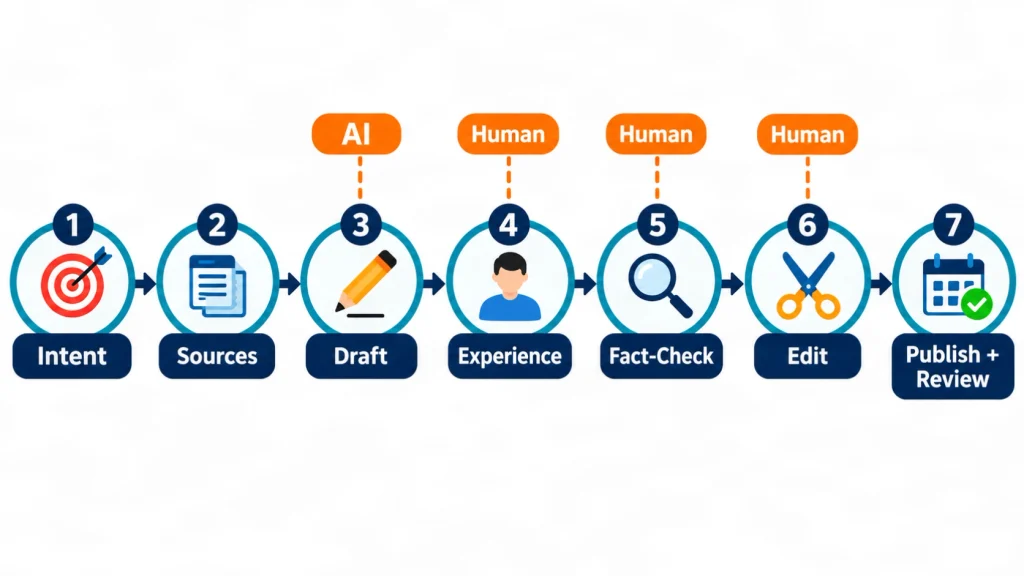
Step 1: Define the Search Intent and the Reader’s Task
Start by writing down who the reader is and what they must be able to do after reading. Look at what Google currently shows for the query and decide which page type fits. AI cannot judge your business context or your reader’s real problem, so this step stays with a person.
Step 2: Collect Primary Sources Before You Prompt
Gather official documents, original data, and your own notes first, then give them to the AI. A model that works from supplied sources makes fewer unsupported claims than one answering from memory. Prefer government pages, regulators, standards bodies, peer-reviewed research, and company documentation. Tell the tool to write “needs source” instead of guessing a missing fact.
Step 3: Draft One Section at a Time
Ask for one section per prompt, with a clear brief, instead of one long article in a single request. The brief should state the audience, the search intent, the sources, and the claims to avoid. A topical map helps here because it shows which pages belong together, so each draft has one job and does not repeat another page.
Step 4: Add First-Hand Experience and Original Insight
Add something the model cannot know: your tests, screenshots, client lessons, numbers, or decisions. Google’s AI search guide makes the same point about unique viewpoints and advises:
“Don’t just recycle what others on the internet have already said”
Google Search Central, Optimizing your website for generative AI features, last updated July 10, 2026
If you have no real experience with a topic, say so, or invite a qualified person to contribute. Never invent a case study, a result, or a quote to fill the gap.
Step 5: Fact-Check Every Claim by Hand
Check every name, number, date, quote, and link against its original source. Open the source page, confirm the exact figure and its date, and confirm that the quote wording matches. Remove any claim you cannot verify. Do the same for titles, meta descriptions, schema, and alt text.
Step 6: Edit for Voice, Clarity, and Usefulness
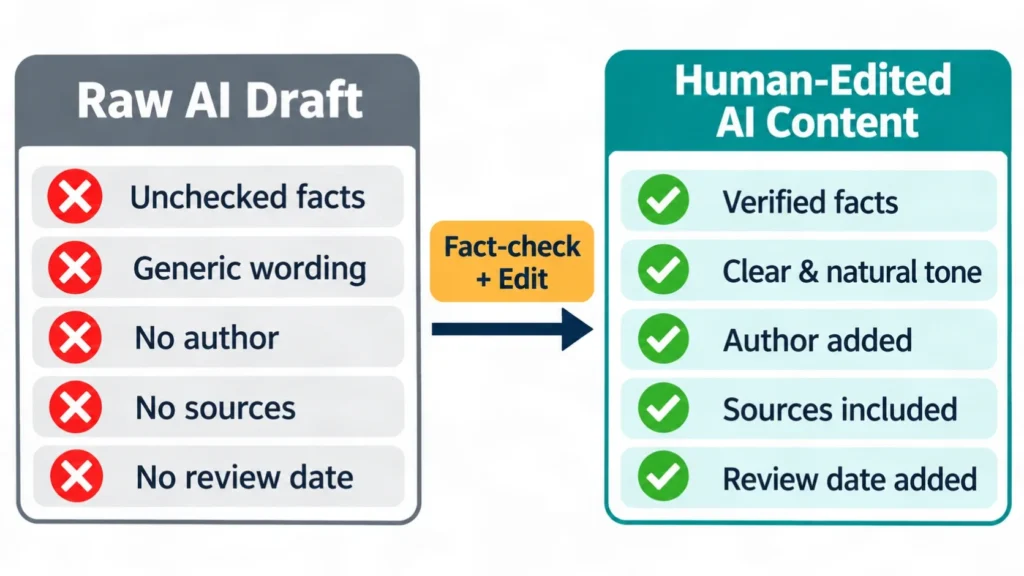
Rewrite until the page reads like a named person who knows the subject. Cut filler and stock phrases. Shorten long sentences. Make sure each heading is answered in its first sentence, and read the page aloud to catch repeated patterns. This editing turns raw AI text into human-edited AI SEO content.
Step 7: Publish With Author, Sources, Dates, and a Review Plan
Publish with a real author, visible sources, a last-updated date, and a date for the next review. Add a short note on how AI was used, which matches Google’s suggestion to give readers context. If you want a team to build this process into your site, my SEO content writing service follows these steps.
How to Use ChatGPT for SEO Content Without Copying the Web
Give ChatGPT a tight brief and your own sources, and ask it to draft only what those sources support. The same method works for AI SEO content made with Claude, Gemini, and other chat tools. The tool matters less than the brief, the sources, and the review.
Here is a prompt template you can adapt:
Act as an SEO editor. Audience: [who will read this].
Search intent: [what they want to do].
Use ONLY the sources below. If a fact is missing, write “NEEDS SOURCE”.
Draft the section “[heading]” in plain English, under 150 words.
Start with a direct answer to the heading.
Do not invent statistics, quotes, or examples.
Sources: [paste notes and links]
Avoid prompts such as “write a 2,000-word article about [topic]” with no sources. Those prompts invite generic text and made-up details. After the draft, run Steps 4 to 6 before anything is published.
Where Else Can You Use AI for SEO Besides Writing?
AI helps most with sorting, drafting, and checking tasks where a person still approves the result. The table lists common use cases.
| Task | How AI helps | Human check |
| Keyword grouping | Clusters queries by likely intent | Compare each group with live search results |
| Outlines | Suggests headings and related questions | Match them to real reader needs and gaps |
| Meta titles and descriptions | Drafts several options | Verify accuracy, length, and brand voice |
| Content refresh | Flags outdated passages | Update facts from current sources |
| Internal link ideas | Suggests related pages | Confirm each URL exists and fits the anchor |
| Schema drafts | Writes structured data code | Validate the markup before publishing |
| Local business copy | Drafts service descriptions | Check services, hours, and location details |
For local businesses, AI can draft service descriptions, but it must not invent services, hours, or reviews. If you work on Local SEO or Google Business Profile optimization, verify every detail against the real business.
Do AI Content Detectors Matter for SEO?
AI content detectors are imperfect, and Google’s published guidance focuses on accuracy, quality, and relevance, not detector scores. Ahrefs, which built its own detector, states that no AI content detector is perfect. A flag is a prompt to review the text, not a verdict on whether AI SEO content is good or bad.
Use AI content detection as a rough signal for generic passages. Do not use “humanizer” tools to hide AI use. Improve the content itself: add evidence, fix errors, and rewrite weak sections.
What Counts as Human-Edited AI Content?
Human-edited AI SEO content has been fact-checked, rewritten with original input, and approved by a named person who takes responsibility for it. Use this checklist:
- Every fact, number, and quote has been checked against its source.
- The page contains experience, data, or a viewpoint that the AI did not supply.
- The wording is simple and written in the author’s own voice.
- A named author and reviewer are visible.
- The next review date is set.
How Should You Handle AI-Assisted Pages on Health, Money, and Legal Topics?
Use AI only for structure and first drafts on these topics, and have a qualified professional review every claim before publishing. These subjects are often called YMYL, short for “Your Money or Your Life,” because errors can harm a reader’s health, finances, legal position, or safety. The higher the stakes, the less room there is for unchecked AI SEO content.
Follow these safeguards:
- Use current primary sources: regulators, government agencies, standards bodies, and peer-reviewed research.
- Show real qualifications for the reviewer. Never invent or imply credentials.
- State limits and uncertainty, and tell readers when to consult a qualified professional or official emergency services.
- Show the review date, and update the page when official guidance changes.
- Do not give personal diagnosis, tax, or legal advice in a general article.
This article covers an SEO workflow. It is not medical, financial, or legal advice.
Does AI Search Change How You Should Publish AI-Assisted Pages?
No. Google says optimizing for generative AI search is still SEO, and it recommends helpful, non-commodity content over special hacks. Its guide explains that AI Overviews and AI Mode are rooted in core ranking and quality systems. From Google’s perspective, “AEO” and “GEO” are not separate disciplines, so AI SEO content needs no special markup.
The same guide lists tactics you can ignore for Google Search: llms.txt files, splitting content into tiny chunks, rewriting content just for AI systems, seeking inauthentic mentions, and over-focusing on structured data. Other AI assistants may behave differently, and this guide covers only what Google documents.
Click behavior adds another reason to publish something distinctive. In a March 2025 sample of 900 U.S. adults, Pew Research Center found that users clicked a traditional result link in 8% of visits when an AI-generated answer appeared, versus 15% without one (Pew, July 22, 2025). In my view, a page therefore needs a clear answer and real experience that a generated answer cannot fully replace.
How Do You Measure Whether AI-Assisted Pages Work?
Track search impressions, clicks, queries, engagement, and error corrections, and compare AI-assisted pages with fully human-written ones. Treat AI SEO content like any other page: it earns trust through results, not labels. Use Google Search Console, including the Generative AI performance report that Google points to in its guide. Google also notes that indexing and serving are never guaranteed, so avoid promising results to anyone.
My suggested rhythm is a recommendation, not a Google rule. Check a new page after 30 days, then review facts and sources every six months.
Keep a log of each correction. If errors keep appearing, tighten Steps 2 and 5. Because content and technical health work together, I treat website SEO and content as one system.
What Does This Guide Not Claim?
This guide does not promise rankings, traffic, rich results, or citations in AI answers for any AI SEO content. Google’s guidance can change, and I checked the Google pages cited here on November 4, 2026. The Ahrefs and Pew figures come from specific samples and dates, so they may not match your niche or country. Studies that use AI detectors carry detector error. The workflow lowers risk but does not remove it, and it is not legal advice.
Last reviewed: November 4, 2026. Next review planned: May 2027.
Sources Used in This Guide
- Google Search Central, “Google Search’s guidance on using generative AI content on your website,” last updated October 1, 2026. https://developers.google.com/search/docs/fundamentals/using-gen-ai-content
- Google Search Central, “Optimizing your website for generative AI features on Google Search,” last updated July 10, 2026. https://developers.google.com/search/docs/fundamentals/ai-optimization-guide
- Google Search Central Blog, “What web creators should know about our March 2024 core update and new spam policies,” March 2024. https://developers.google.com/search/blog/2024/03/core-update-spam-policies
- Ahrefs, Si Quan Ong, “AI-Generated Content Does Not Hurt Your Google Rankings (600,000 Pages Analyzed),” July 7, 2025. https://ahrefs.com/blog/ai-generated-content-does-not-hurt-your-google-rankings/
- Ahrefs, Ryan Law, “74% of New Webpages Include AI Content (Study of 900k Pages),” May 19, 2025. https://ahrefs.com/blog/what-percentage-of-new-content-is-ai-generated/
- Pew Research Center, “Google users are less likely to click on links when an AI summary appears in the results,” July 22, 2025. https://www.pewresearch.org/short-reads/2025/07/22/google-users-are-less-likely-to-click-on-links-when-an-ai-summary-appears-in-the-results/
Conclusion
AI SEO content works when AI speeds up the process and people own the facts, the experience, and the final decision. Google judges accuracy, quality, and purpose, not the tool. The seven steps above keep a person in charge of AI SEO content from intent to review.
Start with one page of AI SEO content on a topic you know well. Apply the steps, then compare the result with your usual process. If you want help, you can reach me through my website.
Frequently Asked Questions
Can you use AI for SEO?
Yes, you can use AI for SEO tasks such as research, outlines, keyword grouping, and first drafts of AI SEO content. Google says generative AI can help with research and structure. A person should verify facts, add original experience, and review titles, meta descriptions, and alt text before publishing.
Does using AI hurt SEO?
Using AI does not hurt SEO by itself, but publishing many unhelpful pages can. Google’s scaled content abuse policy targets pages made mainly to manipulate rankings, however they are produced. Ahrefs found a 0.011 correlation between AI percentage and ranking position across 600,000 pages, so quality matters more than the tool.
Will AI replace SEO or take SEO jobs?
AI is unlikely to replace SEO, because Google says SEO best practices still apply to its generative AI search features. AI automates some tasks, such as clustering and drafting. People still decide strategy, verify facts, supply experience, and take responsibility. Nobody can predict the job market with certainty, so keep learning.
What is the best AI to use for SEO?
No single AI tool is best for every SEO task. Choose by task, accuracy on your own sources, data privacy, and cost. Test two or three tools on the same brief, then compare the fact errors and edits each one needs. This guide does not rank tools, because I have not verified a reliable ranking.
Does Google use AI in search?
Yes, Google uses AI in Search, including features such as AI Overviews and AI Mode. Google’s guide says these features are rooted in its core ranking and quality systems and use techniques like retrieval-augmented generation. Pew found that 18% of Google searches in its March 2025 sample produced an AI-generated answer.
How much of an article can AI write safely?
Google publishes no safe percentage of AI text. What matters is accuracy, originality, and usefulness. Ahrefs found that only 4.6% of top-20 pages were classified as pure AI, and pages ranking first tended to have slightly less AI content. Treat AI as a drafting aid for AI SEO content and keep a person responsible.
Do I need to tell readers I used AI?
Google suggests giving readers context about how content was created, so a short note is good practice. For example: “AI helped with the outline; the author fact-checked and edited this article.” Google Merchant Center also has separate labeling rules for AI-generated product data and images on ecommerce sites.
How do I use AI for on-page SEO?
Use AI to draft options, then check each one. It can suggest title tags, meta descriptions, headings, FAQ ideas, internal link candidates, and schema drafts. A person must confirm accuracy, search intent, length, and that every URL exists. Google says metadata, structured data, and alt text need the same manual review as body text.
Is AI SEO reliable?
AI SEO is reliable only when a person reviews the output. Generative models predict likely words instead of retrieving facts, so errors can appear. Tools that promise guaranteed rankings are a warning sign, because Google says no third-party tool has access to its internal ranking systems. Check tool advice against official guidance.
How often should I update AI-assisted pages?
Google gives no fixed schedule, so set your own. I suggest checking a new page after 30 days and reviewing facts, links, and sources every six months. Update AI SEO content sooner when a source, policy, or law changes, especially on health, money, or legal topics. Record the change and the new last-updated date.