E-E-A-T for Content Writers: What It Means and How to Apply It
E-E-A-T for content writers explained in plain English: how to show experience, cite primary sources, handle YMYL topics, use AI honestly, and check every page before publishing


E-E-A-T for content writers is a practical way to build pages that readers can trust: show real experience, explain topics accurately, cite reliable sources, and be open about who wrote the page and how it was made. This guide explains each part of E-E-A-T, shows how to apply it in seven steps, covers YMYL topics and AI use, and ends with a checklist you can use before every publish.
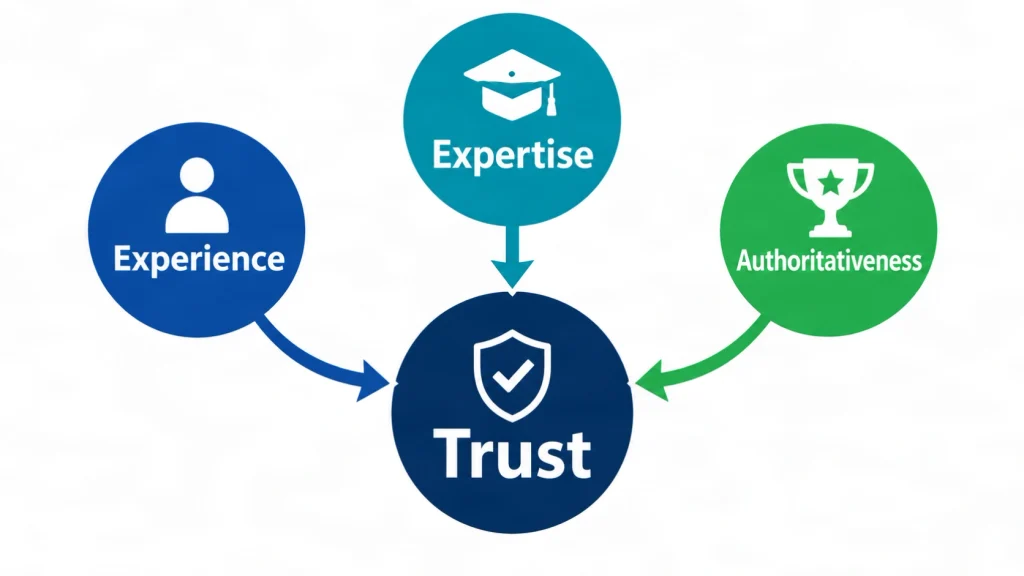
E-E-A-T stands for Experience, Expertise, Authoritativeness, and Trust. Google says E-E-A-T is not a specific ranking factor, but it is a useful quality framework, and trust matters most. Writers support it with first-hand evidence, primary sources, a visible author, honest AI use, and careful handling of health, money, and safety topics.
What Is E-E-A-T for Content Writers?
E-E-A-T for content writers is a set of four quality signals, Experience, Expertise, Authoritativeness, and Trust, that a writer shows through research, sourcing, accuracy, and transparency on every page. Google’s ranking systems aim to prioritize helpful, reliable information created to benefit people. Its documentation says the systems identify a mix of factors that can show which content demonstrates E-E-A-T. You can read the full explanation in Google’s guide to creating helpful, reliable, people-first content.
What do the four letters in E-E-A-T mean?
The four letters stand for Experience, Expertise, Authoritativeness, and Trust, and each one asks a different question about the writer and the page. In plain terms:
- Experience: Has the writer actually used, tested, or done what the page describes?
- Expertise: Does the writer, or a named reviewer, have the knowledge and skill to explain the topic correctly?
- Authoritativeness: Is the writer or the website a recognized source on this topic?
- Trust: Is the page accurate, honest, transparent about its purpose, and safe to rely on?
These definitions are a simplified working version for writers. Google’s search quality rater guidelines contain the formal criteria, and they are published as a PDF.
Is E-E-A-T a Google ranking factor?
No. Google states that E-E-A-T itself is not a specific ranking factor, but its systems use a mix of factors that can identify content with good E-E-A-T. Search quality raters help Google check whether its systems work well, but rater data is not used directly in the ranking algorithms. A writer should treat E-E-A-T as a quality standard, not as a score that can be gamed or measured by one tool.
Why is trust the most important part of E-E-A-T?
Trust matters most because the other three signals exist to support it. Google’s documentation says that of the four aspects, “trust is most important.” It also says content does not need to demonstrate all four. Some pages are helpful because of the experience they show, and others because of the expertise they share. For a writer, this means one weak signal is not a failure, but one dishonest signal can damage everything else.
Why Does E-E-A-T Matter for Content Writer Jobs and Client Work?
E-E-A-T matters because clients hire writers to produce pages that readers believe and act on, and Google’s guidance favors helpful, reliable, people-first content. No framework can promise rankings or traffic. Still, a writer who understands E-E-A-T can explain why a source list, a named reviewer, or a first-hand example belongs in a draft. That skill is useful for content writer jobs, remote and entry level roles, and freelance work alike.
How do clients and editors judge a writer’s E-E-A-T?
Clients and editors judge E-E-A-T by checking proof they can verify: published samples, a clear byline, accurate facts, named sources, and a repeatable research process. A strong content writer portfolio usually shows:
- Samples in the niche the client sells in.
- Links to published work with the writer’s name attached.
- Sources that open and support the claims made.
- Notes on how each piece was researched or reviewed.
Does E-E-A-T change content writer pay or rates?
No source I reviewed links E-E-A-T directly to content writer pay. Rates depend on scope, niche, client budget, and region, so this guide does not quote any salary or cost-per-word figure. A reasonable hypothesis, not a proven fact, is that writers who can research carefully and handle sensitive niches can justify a wider scope of work. Check named, current rate surveys or job listings before you set a price.
How Does E-E-A-T Work for Content Writers, Copywriters, and Content Strategists?
Each role applies E-E-A-T differently: writers prove accuracy and experience, copywriters prove claims behind persuasion, and strategists prove that the content plan fits real audience needs. The table below shows the main difference.
| Role | Main job | Main E-E-A-T focus |
|---|---|---|
| Content writer | Informs or teaches through articles, guides, and pages | Accurate explanations, sources, first-hand evidence |
| Copywriter | Persuades readers to take an action | Claims that are specific, honest, and provable |
| Content strategist | Plans topics, briefs, and page relationships | Topic coverage, audience fit, clear roles for each page |
What is the difference between a content writer and a copywriter?
A content writer mainly informs or educates, while a copywriter mainly persuades readers to act. The two roles overlap on many projects. A service page, for example, needs clear information and a persuasive next step. Both roles need honest claims, because an unsupported promise harms trust in either case.
What does a content strategist add to E-E-A-T?
A content strategist adds structure: which topics to cover, which questions to answer, and how pages connect. This planning supports the other signals. If you want to see how planning works, read the guide on what a topical map is and the article on topical authority. Both topics are also part of my work on content briefs and topical maps.
How to Apply E-E-A-T for Content Writers Step by Step
Apply E-E-A-T in seven steps: define the purpose, show experience, prove expertise, use primary sources, show the author, explain how the page was made, and review it before and after publishing. The steps follow the “Who, How, and Why” questions that Google recommends asking about content.
Step 1: Define why the page exists
Start by writing one sentence that states who the page helps and what that reader should be able to do afterward. Google calls “Why” perhaps the most important question about content. Content made mainly to attract search visits does not match what its systems aim to reward. If the sentence only mentions rankings, rewrite it around the reader’s goal.
Step 2: Show first-hand experience honestly
Show experience by including only what you or your sources actually did, tested, saw, or lived. Useful evidence includes your own screenshots, step-by-step notes from a real test, an interview with a named practitioner, or a clearly labeled client example that you have permission to share. Do not invent stories, results, or client names. If you have no first-hand experience, say so and attribute the experience to a named source.
Step 3: Prove expertise through accurate explanations
Prove expertise by defining terms correctly, explaining how things work, and stating limits. A reader should understand the concept, the method, and the exceptions. Short, self-contained answers under each heading help readers and answer engines. When a topic is outside your knowledge, ask a qualified reviewer to check it and name that reviewer on the page.
Step 4: Use primary and official sources
Use primary and official sources, such as Google Search Central, government agencies, regulators, standards bodies, and original research, for every claim that matters. Place the source next to the claim it supports. Check the date, the definition, and the context of every statistic before you use it. If you cannot open or verify a source, leave the claim out.
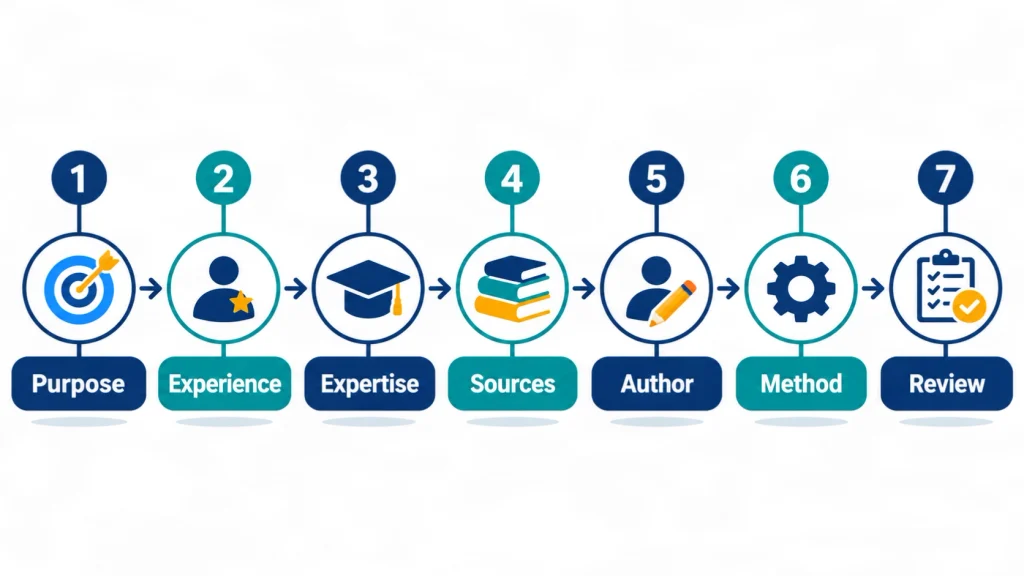
Step 5: Make the author visible
Make the author visible with a byline that links to an author page or an About page with accurate background. Google encourages accurate authorship information where readers would expect it, and warns against deceptive authorship such as made-up names, AI-generated headshots, or false credentials. List only real qualifications. If a team member or reviewer contributed, name their role truthfully.
Step 6: Explain how the content was made
Explain how the content was made when readers could reasonably ask, especially if AI or automation helped. A short note works: what research was done, who reviewed it, and what tools assisted. Google’s documentation says disclosures are useful where someone might think, “How was this created?” Keep the note factual and brief.
Step 7: Review, fact-check, and update
Review every draft against its sources, then update the page when facts change. Check names, numbers, dates, links, and quotes. Change the published date only when the content has changed in a meaningful way. Google lists changing dates to look fresh, without real changes, as a warning sign of search engine-first content.
How Should Content Writers Handle YMYL Topics?
Content writers should handle YMYL topics with current primary sources, careful wording, clear limits, and review by a qualified expert. YMYL stands for “Your Money or Your Life.” Google’s documentation says its systems give even more weight to content that aligns with strong E-E-A-T for these topics.
What counts as a YMYL topic?
A YMYL topic is one that could significantly affect a person’s health, financial stability, or safety, or the welfare of society. Medical content writing topics, investing and tax guidance, legal advice, and safety instructions are common examples. If your client is a clinic or a law firm, the page needs extra care. My industry pages for healthcare and dental and law firms explain how those sites are usually structured.
What rules should writers follow on YMYL pages?
Follow six rules: cite primary sources, use current information, avoid personal advice, add clear limits, use a qualified reviewer, and never promise outcomes. In practice:
- Use official health, financial, or legal bodies as sources, not blogs.
- Check that the guidance is current and applies to the reader’s country.
- Describe general information, and tell readers to consult a qualified professional for personal decisions.
- State what the page does not cover.
- Name the reviewer and their role only when the review actually happened.
- Do not write guarantees about cures, returns, or legal results.
When should a writer decline or escalate a YMYL assignment?
Decline or escalate when the topic needs professional judgment you cannot provide, when no reliable source exists, or when the client asks for claims you cannot support. It is better to tell an editor that a claim cannot be verified than to publish it. This protects readers, the client, and your own reputation.
Can Content Writers Use AI Without Hurting E-E-A-T?
Yes, content writers can use AI as a tool if a human researches, verifies, edits, and takes responsibility for the final page. The risk is not the tool itself. The risk is publishing unreviewed, unoriginal text. Google also publishes separate guidance on using generative AI content.
Does Google penalize AI-assisted content?
Google’s helpful content documentation does not say AI-assisted content is penalized by default, but it warns against using automation mainly to manipulate rankings. It says that using AI to produce content for the primary purpose of manipulating search rankings violates its spam policy on scaled content. It also describes generating large amounts of text with generative AI and no manual oversight as little to no effort.
What is a safe AI workflow for content writers?
A safe workflow keeps people in charge of research, facts, and final wording. Use these steps:
- Collect your own sources and notes first.
- Use AI only for tasks such as outlining, rephrasing, or checking clarity.
- Verify every fact, number, and quote against the original source.
- Add original examples, tests, or interviews that AI cannot supply.
- Edit the draft in your own voice and remove generic text.
- Disclose AI help where readers would reasonably expect it.
Will AI replace content writers?
Nobody can predict this reliably, and I did not find verified evidence that settles the question. What the documentation does show is that unreviewed AI text is treated as low effort, while original analysis, first-hand evidence, and accuracy carry weight. Writers who add research, judgment, and accountability give clients something a raw draft does not.
How Do E-E-A-T Signals Support AEO and GEO for Content Writers?
E-E-A-T signals support AEO and GEO because clear answers, named entities, and cited facts make content easier for people and answer engines to understand and check. No formatting method guarantees that an AI system will cite a page. Google also publishes a page on optimizing for generative AI search, which is worth reading alongside this guide.
How do you write for answer engine optimization (AEO)?
Write for AEO by answering the heading in the first sentence, then adding detail. Keep the first answer short, define terms in plain language, and make each paragraph understandable without the one before it. Name the entity instead of using a vague pronoun, and explain how ideas relate.
How do you write for generative engine optimization (GEO)?
Write for GEO by naming entities clearly, describing relationships between them, and citing sources for factual claims. Add context to any number: who measured it, when, and how. Give your own synthesis, such as a method or comparison, so the page adds something beyond a restatement of other pages.
E-E-A-T for Content Writers Checklist
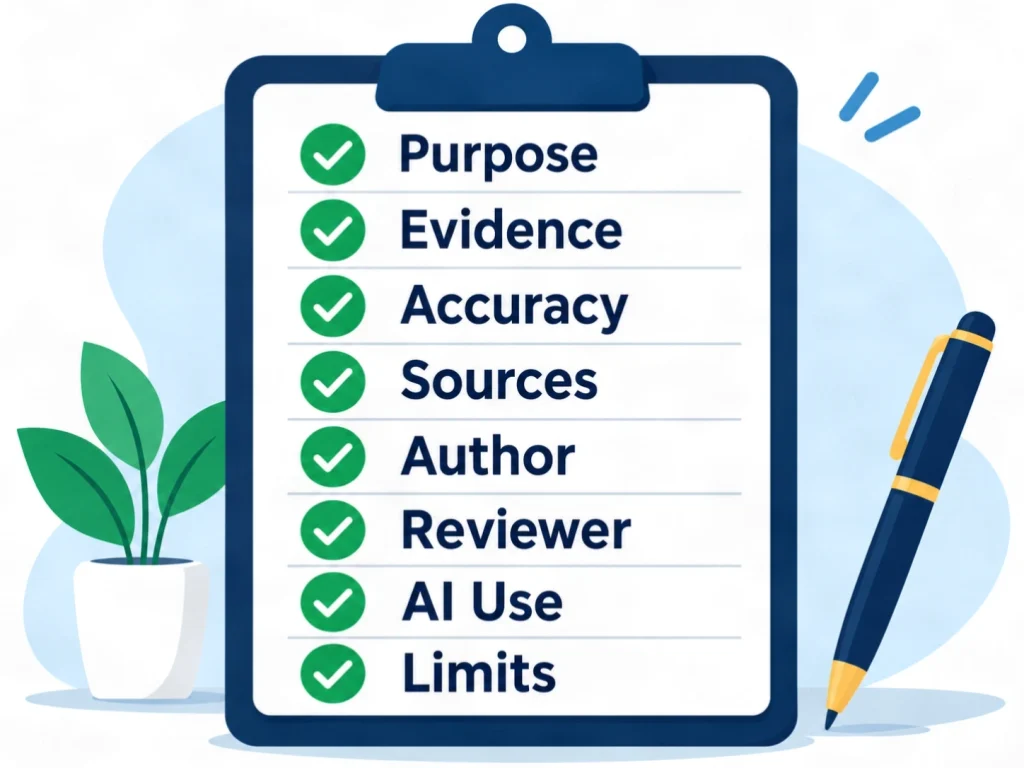
Use this checklist before you publish any page: if you cannot answer “yes” to an item, fix it or remove the claim. It is a diagnostic tool, not a Google score.
| Check | What to do | Signal |
|---|---|---|
| Purpose | State who the page helps and why it exists | Trust |
| First-hand evidence | Add real tests, screenshots, interviews, or labeled examples | Experience |
| Accuracy | Verify every fact, name, date, and number | Trust, Expertise |
| Sources | Link primary or official sources beside each key claim | Authoritativeness, Trust |
| Author | Add a real byline linked to an author or About page | Trust |
| Reviewer | Name a qualified reviewer for YMYL topics, only if real | Expertise |
| AI use | Disclose where readers would expect it | Trust |
| Originality | Add a method, example, or analysis not found elsewhere | Experience, Expertise |
| Limits | State what the page does not cover | Trust |
| Claims | Remove guarantees and unsupported superlatives | Trust |
| Freshness | Update when facts change, not only the date | Trust |
| Links | Check that every link opens and supports the point | Trust |
What E-E-A-T Mistakes Should Content Writers Avoid?
The most common mistakes are invented credentials, unsourced statistics, copied or lightly reworded content, fake quotes, and date changes without real updates. Each has a simple fix:
- Invented credentials: Use only real, verifiable background. Remove anything you cannot prove.
- Unsourced statistics: Find the original source, or write the claim without a number.
- Rewriting other pages: Google asks whether content merely rewrites other sources. Add original analysis or evidence.
- Fake or altered quotes: Quote only wording you have verified, with the person’s name, role, and source.
- Mass production: Publishing many thin pages on unrelated topics is a warning sign in Google’s documentation.
- Hidden commercial intent: Say clearly when a page promotes a service.
What Does Strong E-E-A-T Look Like in a Real Paragraph?
Strong E-E-A-T shows up as specific, sourced, honest wording instead of confident but empty claims. The examples below are illustrative, not taken from a real client page.
Weak: “Content writers earn a lot of money, and anyone can start today.”
Stronger: “Content writing income varies by niche, client, and region. This guide does not quote a figure because no single reliable source was verified. Compare current job listings and named rate surveys before you decide.”
The stronger version states its limit, avoids an unsupported number, and tells the reader how to verify the answer. That is how trust is built in practice.
How Can Beginners and Entry-Level Writers Show E-E-A-T Without Experience?
Beginners can show E-E-A-T by being transparent, researching carefully, and creating original proof such as tests, interviews, and documented projects. You do not need years of experience to be honest. A starter plan:
- Write about topics you can test yourself and document the process.
- Interview a practitioner and quote them only after confirming their words.
- Build a small content writer portfolio with clearly labeled sample work.
- Add a short author page with real facts only.
- Learn the basics from official guidelines such as the SEO Starter Guide.
This approach also supports people asking how to become a content writer with no experience: build proof first, and claim only what the proof supports.
How Can You Check E-E-A-T Quality Before Publishing?
There is no official E-E-A-T score, so check quality by answering Google’s self-assessment questions and the Who, How, and Why questions. Third-party tools sometimes advertise an E-E-A-T content checker, but treat their output as a diagnostic opinion, not a Google metric. A human review is stronger:
- Ask an unaffiliated reader to judge whether they would trust and share the page.
- Open every source and confirm it says what the page claims.
- Search the topic and compare your page’s value against the top results, without copying them.
- Monitor impressions, clicks, and enquiries in Search Console after publishing, and avoid expecting a fixed ranking result.
Conclusion
E-E-A-T for content writers comes down to one habit: make every claim easy to verify and every page honest about who wrote it, why, and how. Show real experience, explain accurately, cite primary sources, handle YMYL topics with care, and use AI as a supervised tool. These practices do not guarantee rankings, but they make content more useful and more credible for readers.
If you need articles, service pages, or content briefs built on this approach, see my SEO content writing service or learn more about Forkan Mahmud.
Frequently Asked Questions
What is E-E-A-T in content writing?
E-E-A-T in content writing means showing Experience, Expertise, Authoritativeness, and Trust through accurate, well-sourced, honest content. Google uses it as a quality framework, and trust is the most important part.
Is E-E-A-T a ranking factor?
No, Google says E-E-A-T is not a specific ranking factor. Its systems use a mix of factors that can identify content with good E-E-A-T, and the idea carries more weight for YMYL topics.
How can a content writer show experience?
A content writer can show experience with original tests, screenshots, interviews, documented projects, and clearly labeled client examples. Never invent experience. If you lack it, attribute it to a named source.
Can content writers use AI or ChatGPT?
Yes, content writers can use AI tools if a human verifies the facts, adds original value, and takes responsibility for the result. Using AI to mass-produce content mainly to manipulate rankings goes against Google’s spam policies.
Will AI replace content writers?
No reliable evidence settles this question. Google’s documentation treats unreviewed AI text as low effort, so writers who add research, original evidence, and accountability remain useful to clients.
Is content writing a good career?
It can be, but the answer depends on your niche, skills, and market, and I could not verify a single demand or pay figure for this guide. Review current job listings and named salary sources, then build a portfolio that proves your skills.
What is the difference between a content writer and a copywriter?
A content writer mainly informs or educates readers, while a copywriter mainly persuades them to take an action. Many projects need both skills.
Is there an E-E-A-T content checker?
No official E-E-A-T checker or score exists from Google. Some third-party tools offer checks, but they are diagnostic aids. A manual review with Google’s self-assessment questions is more reliable.
What are YMYL topics for content writers?
YMYL topics are subjects that could significantly affect health, financial stability, safety, or the welfare of society. Medical, financial, and legal writing are common examples and need current primary sources and expert review.
How much do content writers make?
Content writer pay varies by niche, client, region, and experience, and this guide does not quote a figure because none was verified. Compare several current, named sources and ask clients for their scope and budget before you set a rate.