Arabic SEOs: The Complete Step-by-Step Guide to 9 Best Practices for Bilingual Websites
Arabic SEOs, also called Arabic search optimization, help bilingual Arabic and English websites rank in both languages. This guide covers keyword research, hreflang, right-to-left design and local setup in Oman.


Arabic SEOs are the methods, and the specialists who apply them, that help a website rank for searches typed in Arabic. For a bilingual Arabic and English site, the work follows nine steps. They are market and language choices, Arabic keyword research, URL structure, localized copy, hreflang tags, right-to-left design, metadata and schema, internal links, and measurement. This guide explains each step.
What Are Arabic SEOs and Why Do They Matter for Bilingual Websites?
Arabic SEOs are practices built for Arabic-speaking searchers. They matter because Arabic reaches a large audience but fills a small share of the web. A bilingual site with useful Arabic pages can serve readers that English-only pages do not reach.
What does SEO mean in Arabic?
SEO in Arabic is تحسين محركات البحث, which means “search engine optimization.” Searchers who type SEO بالعربي likely want this term, Arabic tutorials, or an Arabic-speaking specialist. That reading is an inference, not measured data.
The Arabic phrase follows the English idea word for word: tahsin (improvement), muharrikat (engines), and al-bahth (the search). SEO is the work of making pages easy for search engines to crawl, understand and show to the right people.
What does SEO stand for, and how do people say it in other languages?
SEO stands for search engine optimization. Other languages either translate the full phrase or keep the English acronym. A multilingual team should record both forms before writing any page.
| Language | Full term | Common short form |
|---|---|---|
| Arabic | تحسين محركات البحث | SEO or سيو |
| Spanish | optimización para motores de búsqueda | SEO |
| French | optimisation pour les moteurs de recherche | SEO |
| German | Suchmaschinenoptimierung | SEO |
The same rule applies to related terms. A checklist is “lista de verificación” in Spanish and قائمة مراجعة in Arabic, and a reader may search for either the translated word or the English one.
Is Arabic a VSO or SVO language, and does it affect SEO?
Arabic allows both orders. A 2015 University of Ottawa study by AlQahtani and Sabourin reports that Standard Arabic and regional dialects can use either order: verb-subject-object (VSO) or subject-verb-object (SVO). It notes a clear preference for VSO.
For search, this means one idea can appear in more than one word order. Keyword research should check natural order variants instead of copying the pattern of an English phrase.
Why does Arabic content need its own SEO work?
Arabic content needs its own SEO work because the audience is large and the supply of pages is small. The UN Secretary-General describes 22 Arabic-speaking countries. Yet W3Techs reports that Arabic is the content language of only 0.6% of websites whose language it knows (as of August 26, 2026).
That gap suggests room for useful Arabic pages. It does not predict rankings, and competition varies by topic and country.
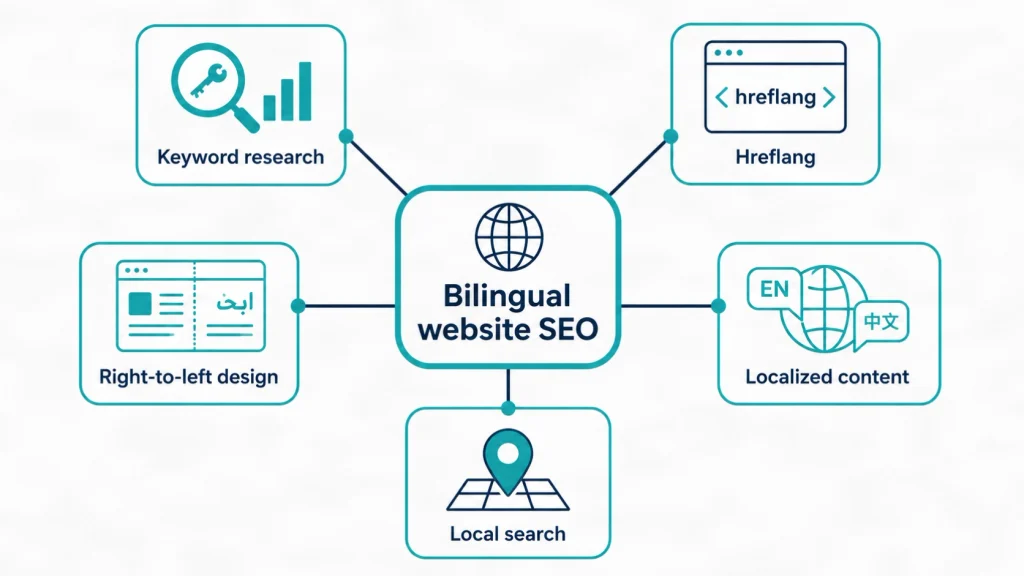
How Does Bilingual Website SEO Work?
Bilingual website SEO gives each language its own crawlable pages, links those pages together, and tunes each page for the people who read that language. Arabic SEOs rely on this setup so Google can show the Arabic page to Arabic searchers and the English page to English searchers.
What is a bilingual website?
A bilingual website offers the same core content in two languages, usually on separate URLs for each language. Arabic and English is a common pair for businesses in the Middle East, and Arabic SEOs usually begin by deciding which pages need both languages.
What is the difference between bilingual and multilingual websites?
A bilingual site uses two languages, while a multilingual site uses two or more. The SEO rules match, but each added language multiplies the hreflang links, sitemaps and pages you must maintain.
Google also separates multilingual from multi-regional. According to its multi-regional site documentation, a multi-regional site targets users in different countries, and a site can be both multilingual and multi-regional.
Are translated pages treated as duplicate content?
Translated pages are not duplicates when the main content is translated. Google’s localized versions guidance says localized versions count as duplicates only when the main content stays untranslated.
This is why a page with a translated menu but English body text is a weak Arabic page.
How Should You Research Arabic Keywords?
Arabic SEOs research keywords by starting from real Arabic queries, not from English phrases. Use your own search data, autocomplete suggestions and a native-level reviewer, then match each page to one primary Arabic query.
Why should you not translate English keywords word for word?
Word-for-word translation can produce phrases that nobody types. Most Arabic SEOs avoid it because searchers phrase the same need differently across languages. Arabic marketing content often uses both the translated term and the transliterated term سيو for SEO.
Check both forms against your own data before you commit a page to one of them.
How do dialects and Modern Standard Arabic change keyword choice?
Searchers may type formal Modern Standard Arabic, local dialect words, or English terms, so one topic can have three query layers. This three-layer check is a working framework from practice, not a measured result.
- Formal layer: Modern Standard Arabic phrases, common in guides and official pages.
- Local layer: words people use in daily speech in a given country.
- Mixed layer: English or transliterated terms placed inside Arabic queries.
Pick the layer that matches the page’s reader. A government service page leans formal, while a local shop page may need the local layer as well.
Which spelling and script variants should you check?
Check spelling and script variants because Arabic has several valid ways to type the same word. Test each variant in your own data instead of assuming that a search engine merges them.
- Hamza forms such as أ, إ and ا.
- The endings ة and ه, and the letters ى and ي.
- Words with and without diacritics, which many searchers skip.
- Western numerals (123) and Eastern Arabic-Indic numerals (١٢٣).
- Arabic written in Latin letters, sometimes called Arabizi, which appears in some markets.
Which tools help with Arabic keyword research?
Arabic SEOs use Google Search Console, Google Trends and Google autocomplete for the most direct view of Arabic queries, and keyword planning tools can add ideas. Set the language and location in each tool, and treat volume figures as estimates.
Search Console shows the real queries that already bring people to your pages. Our SEO tools and resources page is a good place to start, and any Arabic tool should be tested on your own queries before you trust its numbers.
What does an Arabic keyword set for an Oman business look like?
An Arabic keyword set pairs each English service phrase with the Arabic phrases a local searcher is likely to type. The examples below are illustrations only, carry no search volume, and need review by a native Arabic editor.
| English idea | Arabic example | Likely intent |
|---|---|---|
| Web design in Muscat | تصميم مواقع في مسقط | Commercial |
| SEO services in Oman | خدمات تحسين محركات البحث في عمان | Commercial |
| What is SEO | ما هو تحسين محركات البحث | Informational |
| Local SEO in Oman | تحسين محركات البحث المحلي في عمان | Mixed |
Connecting these phrases into one topic map is a core part of semantic SEO, where entities and their attributes decide what a page must cover.
Which URL Structure and Hreflang Setup Works for Arabic and English Pages?
Arabic SEOs give each language its own URL, link every pair of versions with hreflang, and keep each version indexable. This setup lets Google match the right page to the right searcher.
Which URL structure is best for Arabic and English pages?
A subdirectory such as /ar/ is the simplest choice for most small and mid-size sites. Google’s documentation lists country-code domains, subdomains and subdirectories as valid options with different costs and trade-offs.
| Structure | Example | Main strength | Main cost |
|---|---|---|---|
| Subdirectory | example.com/ar/ | One domain, easy setup | Less separation by country |
| Subdomain | ar.example.com | Easier to host separately | Often tracked separately |
| Country domain | example.om | Clear country signal | Higher cost, more upkeep |
Avoid URL parameters for languages, such as ?lang=ar, because they are harder for search engines and people to understand.
How do you write hreflang for Arabic and English pages?
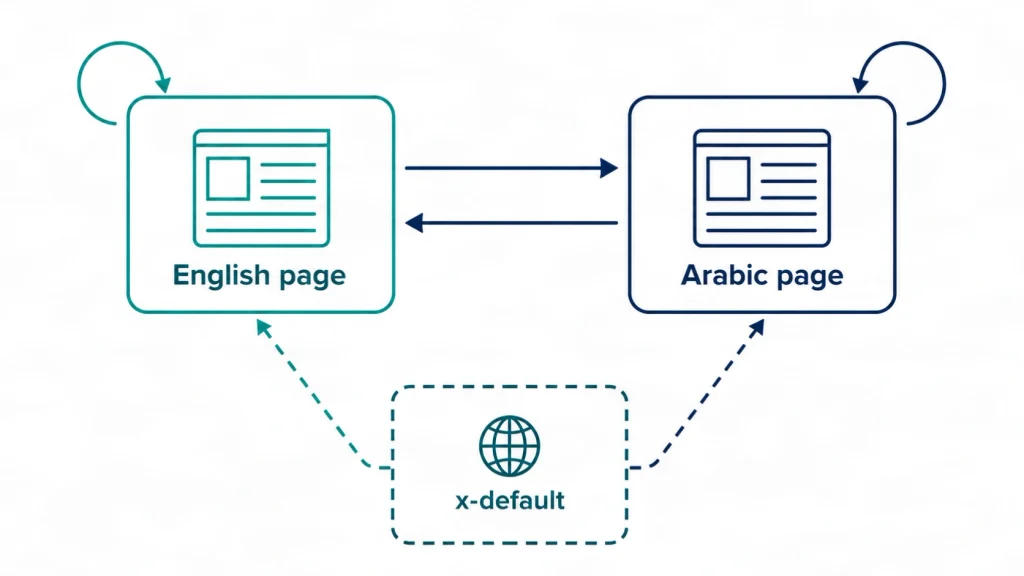
Add one link element for every language version, including the page itself, and add an x-default fallback. Google states that each language version must list itself as well as all other language versions.
html
<link rel="alternate" hreflang="en" href="https://example.com/en/services/" />
<link rel="alternate" hreflang="ar" href="https://example.com/ar/services/" />
<link rel="alternate" hreflang="x-default" href="https://example.com/en/services/" />
The example.com addresses are placeholders. Replace them with your real, fully qualified URLs, and place the same set of lines on both pages.
Which hreflang codes fit Oman and other Arabic-speaking markets?
Use ar for Arabic readers in general, and add a region code such as ar-om only when the page differs by country. Differences that justify a region code include prices, laws, delivery terms or local vocabulary.
A language code comes first and an optional country code follows it. A region code on its own, such as om, is not valid.
What hreflang mistakes break bilingual sites?
The most common mistakes are missing return links, missing self-references, wrong codes, and links to pages that redirect or block indexing. Google notes that when two pages do not point to each other, the tags are ignored.
- Page A names page B, but page B does not name page A.
- A page omits its own hreflang line.
- Codes use a country instead of a language.
- Hreflang points to a noindex page or a redirect.
- HTML tags and sitemap entries disagree.
Should you redirect visitors automatically by language?
Do not redirect visitors automatically by language or location. Google warns that it may not crawl, index or rank all content on locale-adaptive sites. Offer a visible language switcher or banner instead of a forced redirect.
How Do You Write Arabic Content That Ranks and Reads Naturally?
Arabic SEOs write for Arabic readers first and let search signals follow. A native-level editor, a clear page purpose and one primary query per page matter more than any keyword count.
Can machine translation produce Arabic pages for SEO?
Arabic SEOs treat machine translation as a first draft, and a native editor should review the page before it goes live. A Google spokesperson said its policies do not strictly define content that has been translated by AI as spam, as reported by Search Engine Roundtable.
That statement is not a promise of rankings. It also leaves the quality question open: a page that reads badly in Arabic can still fail readers.
AI tools can write Arabic text, and their quality varies by dialect and topic. Treat their output as a draft, never as a final page.
How do you localize Arabic copy instead of translating it?
Localizing means adapting terms, tone, examples and formats for the reader, not only converting words. For an Oman audience, check the currency, phone format, address style, date style and the way local customers describe the service.
Ask the editor to mark sentences that sound translated. Replace them with phrasing a local reader would write.
How do you set up right-to-left layout correctly?
Arabic SEOs add dir=”rtl” and lang=”ar” to the html tag of every Arabic page. The W3C Internationalization team explains that this sets the base direction for the whole document. It adds a firm rule: never use CSS to apply the base direction.
Test the layout on a phone, because buttons, menus, icons and sliders often need to be mirrored.
How should Arabic titles, meta descriptions and headings be written?
Write each Arabic title and description for the Arabic reader, with the primary query near the start and one H1 per page. Search results cut titles by pixel width, not by character count, so preview Arabic titles instead of trusting a fixed limit.
Do not paste the English meta description into the Arabic page. Rewrite it as a short, natural sentence that promises what the page delivers.
How do you handle mixed Arabic and English text, numbers and fonts?
Mark left-to-right terms inside Arabic text with a dir attribute, and choose a font that fully supports Arabic. The W3C notes that numbers and embedded Latin text still run left to right inside right-to-left text. Without markup, URLs, brand names and codes can display out of order.
Arabic fonts can be large files. Load only the weights you use and test page speed on mobile.
What Technical Checks Do Bilingual Sites Need?
Arabic SEOs check four things on a bilingual site: clean canonical tags, complete hreflang sets, matching sitemaps and structured data that mirrors visible text. Each check keeps both language versions indexable on their own.
Should each language page have its own canonical tag?
Yes. Arabic SEOs set each Arabic and English page to point to itself as the canonical version. A canonical tag that sends the Arabic page to the English page tells search engines to prefer the English URL. That can remove the Arabic page from view.
How do XML sitemaps help with hreflang?
Arabic SEOs often place hreflang in a sitemap, which can carry every version when adding tags to each page is hard. Google’s documentation explains that a page with three versions needs an entry for each URL, and each entry lists all three versions.
Pick one method per URL set, either HTML tags or sitemap entries, so the two sources cannot conflict.
How should structured data work in two languages?
Structured data must describe what the visitor can see, and Arabic SEOs keep both languages in step. Write the Arabic page’s business name, description and FAQ text in Arabic markup, and the English page’s in English, and validate both versions.
Does Arabic font loading affect page speed?
Yes, because custom fonts add files that the browser must download before it can show text as intended. Compress the font files, load only the needed weights, and test Arabic pages on a mid-range phone.
What Do Arabic SEOs Check Before Launching a Bilingual Site?
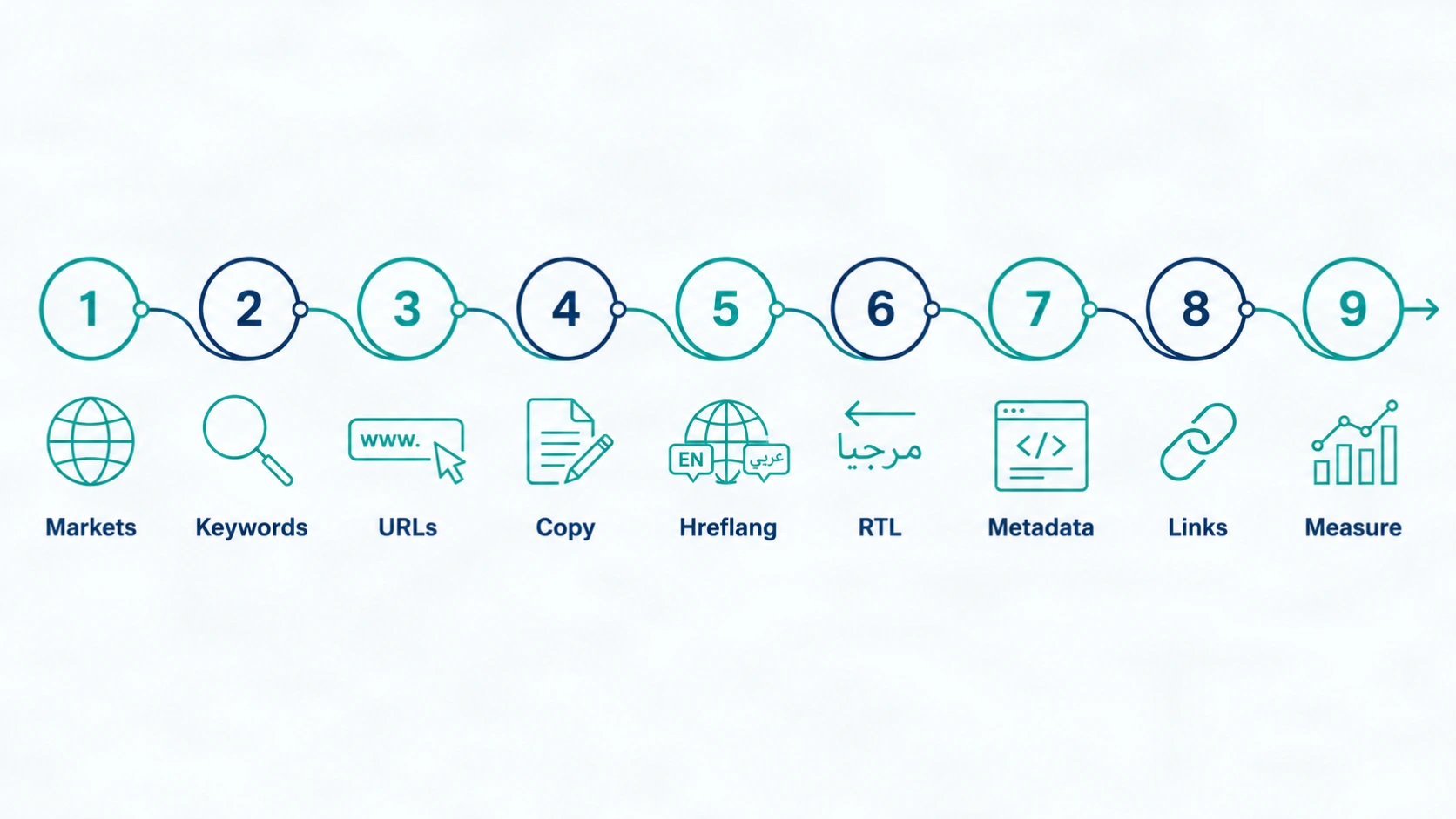
Before launch, Arabic SEOs check nine items in a fixed order, from market choice to measurement. The table below turns the guide into a checklist you can hand to a developer, an editor and a content lead.
What is the 9-step checklist for a bilingual site?
The checklist has nine steps, each with a clear finish line, covering markets, keywords, URLs, copy, hreflang, design, metadata, links and reporting. Work through them in order, because later steps depend on earlier choices.
| Step | What to do | Done when |
|---|---|---|
| 1. Choose markets and languages | List the countries and languages each page serves | Every page has a language and country decision |
| 2. Research Arabic keywords | Build a query list from Search Console, autocomplete and a native review | Each page has one primary Arabic query |
| 3. Pick a URL structure | Use one pattern, such as /ar/ and /en/ | Each language has crawlable URLs |
| 4. Localize the copy | Have a native-level editor review every page | The editor approves each page |
| 5. Add hreflang | Include self-references, return links and x-default | A crawler reports no missing return links |
| 6. Set up right-to-left design | Add dir=”rtl”, lang=”ar” and a tested font | Mobile layout passes review |
| 7. Localize metadata and schema | Write Arabic titles, descriptions and markup | Markup matches visible text |
| 8. Link inside each language | Link Arabic pages to Arabic pages | No page sends readers to the wrong language |
| 9. Measure by language | Filter Search Console by language folder and country | A monthly report exists |
What is an SEO localization strategy for Arabic markets?
An SEO localization strategy decides which pages to adapt, for which country, and in what order. A useful decision rule for Arabic SEOs is to localize pages by business value: service and product pages first, high-intent question pages next, and general articles last.
Not every page needs an Arabic twin. Translate a page only when an Arabic reader would search for it and you can keep the Arabic version current.
How do you build topical authority in both languages?
Arabic SEOs build each language as its own connected set of pages, then link the sets only where an equivalent page exists. The idea comes from topical authority: a site earns trust on a subject by covering it deeply and consistently.
An Arabic cluster does not have to copy the English one. It should cover the questions Arabic readers ask, with internal links that stay inside the Arabic section.
How Do You Run Local SEO in Oman for Arabic and English Searchers?
Arabic SEOs in Oman run local SEO with Arabic pages for local searchers and English pages for international clients. Oman’s Basic Statute names Arabic as the state’s official language, and the country has near-universal internet use.
Why does Oman need both Arabic and English pages?
Oman needs both because the audience is online and mixed. The Basic Statute of the State in Article 3 names Arabic as the official language. DataReportal reports 5.28 million internet users in Oman at the end of 2025, a penetration rate of 95.3%.
Many Omani businesses also serve English-speaking customers. For a regional signal, W3Techs reports that among websites hosted in Qatar, 76.8% use English and 21.5% use Arabic (April 2, 2026). Server location is not audience location, so read this as a hint, not proof.
How should a Google Business Profile handle Arabic and English?
Use the business name exactly as it appears on your signage and documents, and answer reviews in the language the reviewer used. Add Arabic details to the description and posts where they help customers.
For help with the profile itself, see our Google Business Profile optimization service in Oman. For the wider topic, read the guide to local SEO.
Which service pages should get Arabic versions first?
Start with the pages that bring in customers: your main service pages, your contact page and your top local pages. Add Arabic versions of these first, then extend to guides and blog posts.
A page such as our local SEO expert in Oman service is the kind of high-intent page that deserves an Arabic twin early.
How Do You Measure Bilingual SEO Results and Avoid Common Mistakes?
Measure each language on its own, using separate Search Console filters and analytics goals, and review common mistakes before you add more pages. Mixed reports hide problems because a strong English section can cover for a weak Arabic one.
How do you track Arabic and English performance separately?
Filter Search Console by page path (for example, /ar/) and by country. Compare impressions, clicks and click-through rate for each language folder, and track conversions per language in your analytics tool.
Search Console has no single language filter, so a clean folder structure makes this reporting possible.
Which mistakes hurt bilingual sites most?
The most damaging mistakes are publishing unreviewed machine translation and breaking the links between language versions, because both reduce trust for readers and clarity for search engines. Arabic SEOs see six mistakes again and again:
- Translating only the menu and footer.
- Publishing raw machine translation with no review.
- Redirecting visitors by location.
- Pointing the Arabic canonical to the English page.
- Skipping return links in hreflang.
- Letting the Arabic and English versions drift out of date separately.
How long do bilingual SEO changes take to show results?
No fixed timeline applies. Search engines need to crawl and process new pages, and results depend on competition, site quality and market. Review results monthly and judge each change over a few months.
When Should You Hire an Arabic SEO Company or Bilingual SEO Specialist?
Hire help when you lack a native-level Arabic editor, hreflang skills, or time to maintain two versions of a site. A team of Arabic SEOs should reduce risk, not promise rankings.
What should a bilingual SEO specialist show you?
A bilingual SEO specialist should show a clear method, real samples and reporting by language, not guarantees about rankings. Ask for these four items before you agree to any contract:
- Arabic samples that a native editor reviewed.
- An example hreflang audit, with client details removed.
- A report format that splits results by language.
- A plan for updating both languages together.
What do strategic SEO services cover for bilingual sites?
Strategic SEO services for bilingual sites usually cover market research, keyword research, content briefs, technical setup and reporting. Our SEO content brief service and international service pages explain related services.
Forkan Mahmud offers SEO services, so this section carries a commercial interest. Judge any provider, including this one, by the evidence it can show.
What Are the Limits of This Guide?
This guide covers on-site and local SEO for Arabic and English websites. It is not legal advice, a certified translation, or a promise of rankings, traffic or AI citations.
Who wrote this guide, and how was it prepared?
Forkan Mahmud is a Local SEO service provider, SEO consultant and SaaS tool developer based in Oman. He has about five years of experience in Local SEO, Google Business Profile work, topical maps and content briefs, including work for European clients.
The facts here come from the Google, W3C, W3Techs, DataReportal, UN and Oman government pages linked in the text. They were reviewed on November 6, 2026. No client results are cited because no verified case-study figures were supplied. The Arabic phrases are illustrations and should be checked by a native editor.
What should you do next?
Pick one important page, localize it into Arabic with a native editor, add hreflang to both versions, and watch the results for a few months. When you want help with the setup, you can contact Forkan Mahmud.
Conclusion
Arabic SEOs come down to nine steps. Choose markets, research Arabic queries, pick clean URLs, localize the copy, add hreflang, and set right-to-left design. Then localize metadata, link within each language, and measure each language on its own. Start with the pages that bring in customers, and keep both versions updated together.
Frequently Asked Questions
Is hreflang a ranking factor for Arabic pages?
No. Hreflang tells Google which language or regional version to show, but it does not raise a page’s position by itself. Its job is to match the right page to the right searcher, so each version still needs useful content to rank.
Can one URL serve both Arabic and English with a language switcher?
Technically yes, but it is a weak setup for search. A single URL gives search engines one page to index, so one of the languages usually goes unseen. Separate URLs per language let each version rank for its own queries.
Should Arabic page URLs use Arabic letters or Latin letters?
Either can work, as long as you stay consistent. Arabic-letter URLs read well to Arabic users but are often copied as long encoded strings. Many sites use short Latin transliterations for easier sharing. Pick one pattern and apply it to every Arabic page.
Do I need to translate every page into Arabic?
No. Translate pages that an Arabic reader would search for and that you can keep current. Start with service, product and contact pages. A smaller set of well-edited Arabic pages is stronger than a large set of weak ones.
How do I check whether my Arabic pages are indexed?
Use the URL Inspection tool in Google Search Console for individual pages, and the Pages report for a wider view. You can also filter performance data by your /ar/ folder to see whether Arabic pages earn impressions.
Can Arabic be self-taught well enough to review SEO content?
Self-study can build useful reading skills, but it rarely reaches the level needed to judge tone, dialect and natural phrasing. For published pages, use a native-level Arabic editor, and treat your own learning as support for checking the work.
Can WordPress, Wix or Squarespace run a bilingual website?
Most major builders offer multilingual features, but abilities differ by plan, version and plugin. Check three things before choosing: separate crawlable URLs per language, correct hreflang output, and full right-to-left support for Arabic pages.
Is it better to add Arabic to my current site or build a separate Arabic site?
For most businesses, adding Arabic folders to the current domain is simpler to manage and keeps authority in one place. A separate country domain can make sense when legal, brand or hosting needs differ by market, but it costs more to maintain.
How often should I update Arabic and English pages together?
Update both versions whenever a fact, price or service detail changes, and review the full set every three to six months. Show a visible last-updated date on each page so readers and search engines can see that both versions are current.
Can I put Arabic and English text on the same page?
You can, but each page should have one main language. Short English terms inside Arabic text are normal. A page split evenly between two languages is harder to optimize, so give each language its own page and link them with hreflang.