How to Optimize Content for Featured Snippets: A 9-Step Guide
Featured snippets are Google’s answer boxes, and you can improve your chances of earning one with a clear answer under a matching heading. This guide gives nine steps, sourced data, honest limits, and a checklist for mobile, AI, and ChatGPT.


Featured snippets are the answer boxes Google shows above regular results, and you can improve your chances of earning one by placing a short, accurate answer under a clear heading on a page that already ranks on page one. Google does not let you mark a page for this spot, so the work comes down to clarity, format, and real usefulness. This guide gives you nine steps, sourced data, honest limits, and a checklist you can reuse.
Find queries that already show a snippet, match the format Google uses, and answer in about 40 to 60 words under a matching heading. Then add depth below the answer. Nothing guarantees selection, because Google decides, and AI Overviews now compete for the same attention.
What Are Featured Snippets in Google?
A featured snippet is a special box in Google Search that shows an excerpt from a web page first, followed by the page title and link. Google describes these boxes as results where the usual format is reversed, with the descriptive text shown before the link (Google Search Central). They can also appear inside the People Also Ask group.
Google pulls the excerpt automatically. When a reader clicks the box, Google takes them to the matching section of your page, if the browser and Google’s systems can locate the exact position. SEOs often call this spot “position zero,” though the name is an industry habit, not a Google setting.
What Does a Featured Snippet Example Look Like?
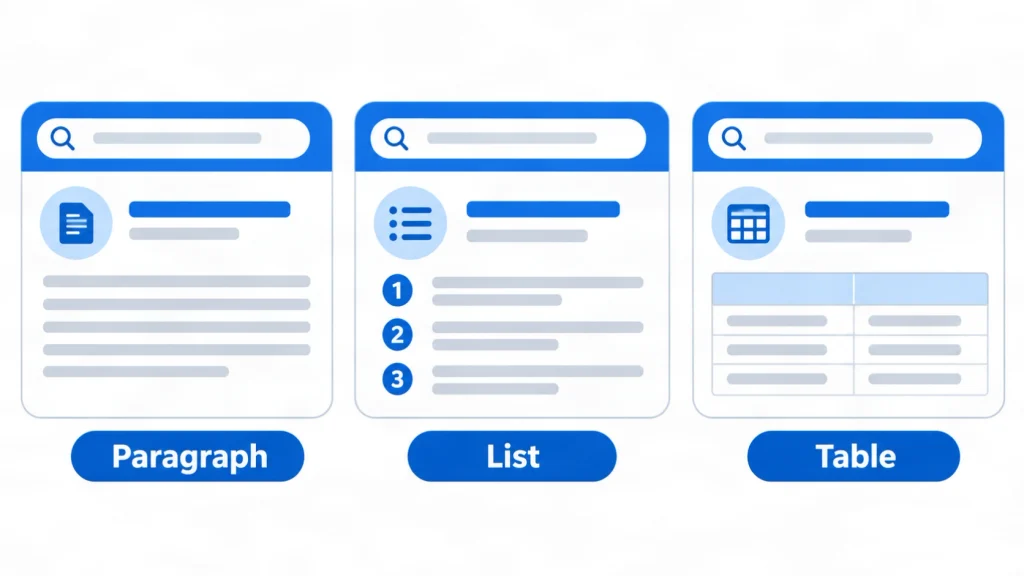
A featured snippet usually appears as a paragraph, a numbered or bulleted list, a table, or a video-based answer, depending on the question. Google’s own documentation shows a query about how to make a hard-boiled egg, where the cooking time appears first and the source link sits below it.
The format follows the question. The table below is a working rule from my own planning process, not a Google rule, so always check the live results before you write.
| Query pattern | Format that often fits | What to write |
|---|---|---|
| What is [term] | Paragraph | A two-sentence definition that names the term |
| How to [task] | Numbered list | Short, parallel steps in order |
| Best or types of [item] | Bulleted list | One line per item, each starting with the item name |
| [A] vs [B] | Table | Clear column headers and short cells |
| Why [problem] | Paragraph | The reason first, then one example |
How Are Featured Snippets Different From AI Overviews and Rich Results?
Featured snippets quote one page, AI Overviews generate an answer from many pages, and rich results add visual details to a normal listing. Each one has a different owner and a different way to influence it.
| Feature | What it shows | Can you request it? | What helps |
|---|---|---|---|
| Featured snippet | One excerpt from one page | No, Google selects it | Clear answer, matching format, page-one ranking |
| AI Overview | A generated answer with source links | No, Google selects sources | Helpful, original, crawlable content |
| Rich result | Extra details such as ratings or images | Eligibility only | Accurate structured data and a valid page |
Why Is Content Optimization Important for SEO?
Content optimization improves a page so searchers and search systems can understand it, trust it, and use it. It matters for SEO because a page that answers the exact question clearly has a better chance of satisfying the reader, and Google’s systems are built to reward pages that satisfy readers (Google Search Central).
Optimized content is content that matches a specific search intent, answers the question early, reads easily, and meets the technical requirements for indexing. The optimized content definition has nothing to do with repeating a keyword. A page can contain the phrase fifty times and still fail the reader.
If you are new to content creation, start with one habit: write one clear question per heading and answer it in the first sentence. That single habit supports beginners and experienced writers alike. When I build a content brief, I add a line called “snippet answer” before any drafting begins, so the writer knows the short answer the page must give. You can see how this fits into planning on my content briefs page.
Do Featured Snippets Still Matter With AI Overviews?
Featured snippets still exist and still matter for visibility, but they no longer guarantee a click, and AI-generated answers now share the same space. Google’s featured snippets documentation was last updated on December 10, 2025, which shows the feature remains part of Search.
Three data points help set expectations:
- How common they were: In a 2017 Ahrefs study of about 112 million US keywords, roughly 12.29% of queries had a featured snippet (Ahrefs, 2017, updated December 2025). That figure is old, so treat it as a historical baseline, not a current rate.
- What they did to clicks: In the same Ahrefs sample, a page with a snippet at the top received about 8.6% of clicks, the result below it about 19.6%, and a normal first result with no snippet about 26%.
- What AI Overviews do to clicks: Pew Research Center analyzed browsing data from 900 US adults in March 2025. Users clicked a traditional result in 8% of visits when an AI-generated overview appeared and 15% when it did not, and clicked a link inside the overview in 1% of visits (Pew Research Center, July 2025).
Pew also reported that 58% of participants ran at least one Google search in March 2025 that produced an AI-generated overview. Google has disputed the study’s methodology, according to The Register, so read it as one data point, not a verdict.
My interpretation, which is a judgment and not a measured result: a snippet is worth chasing for visibility and trust, but you should write the answer so it is complete enough to be useful while the deeper detail, examples, and tools stay on the page. That gives the reader a reason to click.
How to Optimize Content for Featured Snippets in 9 Steps
To optimize content for featured snippets, pick a question that already triggers a snippet, match its format, answer it briefly under a matching heading, and support the answer with depth. These steps also answer the common question of how to rank for featured snippets without chasing tricks, and they work for any site that already publishes helpful pages.
Step 1: How Do You Find Queries That Already Show a Snippet?
Search your target question in Google and note whether one of the featured snippets appears and which format it uses. Do this in a private window so your history does not change what you see.
Next, collect related questions from People Also Ask and from the queries where your pages already earn impressions in Search Console. Look for phrases such as “how to rank for featured snippets,” “optimize for featured snippets,” and “what is a featured snippet in Google.” Third-party tools can flag snippet opportunities, but Google warns that no third-party tool has access to its internal ranking or AI systems, so treat tool scores as estimates.
Step 2: How Do You Check That a Page Is Close Enough to Win?
Confirm that the page already ranks on page one for the query, because snippets almost always come from top-ranking pages. In the 2017 Ahrefs study, 99.58% of featured pages already ranked in the top 10 for the query.
That means a new page with no ranking has little chance, while a page sitting in positions three to eight is a strong candidate. Start there. Fixing the answer on a page that already ranks is faster than building a new page.
Step 3: How Do You Match the Current Snippet Format?
Use the same format Google currently shows, such as a paragraph, list, or table, and make yours clearer than the one displayed. Ahrefs gives the same advice: match the content to the current format of the snippet.
If Google shows a numbered list, write a numbered list. If it shows a paragraph, write a paragraph. Then compare your version with the current one and ask a simple question: would a stranger find mine easier to use?
Step 4: How Do You Mirror the Query in a Heading?
Write an H2 or H3 that uses the same words people type, so Google can see which question the section answers. A heading such as “How long should a snippet answer be?” is clearer than “Length considerations.”
Keep one question per heading. Do not force the exact keyword into every heading, since forced phrases read badly and do not help the reader. Use natural wording that names the subject.
Step 5: How Long Should the Direct Answer Be?
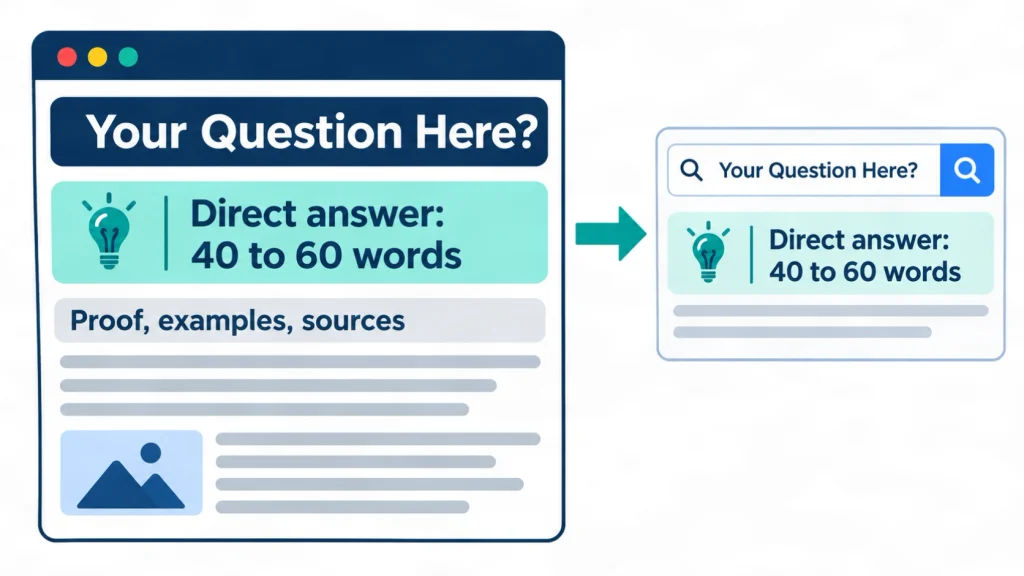
A working target is 40 to 60 words placed directly under the matching heading, but Google publishes no exact minimum or maximum. Google states that the minimum length varies with the information, the language, and the device, so treat 40 to 60 words as a habit that keeps answers tight, not as a rule.
Here is an original example of a snippet-ready answer, written for this guide:
To optimize content for featured snippets, answer the target question in about 40 to 60 words directly under a matching heading, use a real list or table when the query asks for steps or comparisons, and keep the page indexable and genuinely helpful.
Notice what it does. It names the subject, gives the method, and stops. The explanation, proof, and examples follow in the paragraphs below it.
Step 6: How Do Lists and Tables Help?
Real HTML lists and tables give Google a clean structure to read, so use them when the question asks for steps, items, or comparisons. Use an ordered list for steps, an unordered list for items, and a table for side-by-side comparisons.
Keep list items short and parallel. In a table, give each column a clear header and keep cell text brief. Do not turn the whole article into bullets, because prose is still the best way to explain why a step works.
Step 7: How Do You Add Depth Below the Snippet Answer?
Add original experience, evidence, and examples under the short answer, because Google’s guidance favors unique, non-commodity content. Google’s generative AI guide says a first-hand view stands out, while a restated version of what others wrote adds little.
This is where expertise shows. Explain when the method fails, add a documented process, and name your sources. If you have real results from a test, publish the method and the limits. If you do not, say less, and invent nothing. My own work covers Local SEO, Google Business Profile optimization, topical maps, and content optimization for clients across Europe, and I only describe methods here that I can explain clearly. Where I have no measured result to show, I say so.
Step 8: When Should You Use Structured Data?
Use structured data only when it accurately reflects the visible page, and do not expect it to win a snippet by itself. Google’s guide says structured data is not required for generative AI search, though it can help with eligibility for rich results.
Ahrefs also cited a GetStat study of featured snippets in which Schema.org markup appeared on 15.7% of featured snippet URLs and 19.6% of regular result URLs. That is old data from one sample, but it supports the same point: markup is not the shortcut many people assume.
Step 9: How Do You Make Sure the Page Is Eligible?
Make sure the page is indexable, loads well on mobile, and does not block snippets with a nosnippet rule or a very low max-snippet value. Google states that nosnippet blocks all snippets, and a low max-snippet setting makes featured snippets less likely.
Run a quick technical SEO audit before you rewrite anything. A perfect answer on a page that Google cannot index will not appear anywhere.
How Do You Optimize Content for Mobile Readers?
Optimize content for mobile by keeping answers short, headings clear, and tables readable on a narrow screen. Google notes that the amount of text needed for a useful snippet varies by device, so a short answer that reads well on a phone is the safest starting point.
Practical steps include short paragraphs, headings that fit on two lines, and tables that scroll inside their own container instead of stretching the page. Test the page on a real phone, not only in a desktop preview. Also check that buttons and links are easy to tap, since a clear answer loses value if the page is hard to use.
How Can You Optimize Content for AI and ChatGPT?
Optimize content for AI the same way you optimize for search: publish helpful, original content, keep pages crawlable, and avoid shortcuts. Google says its generative AI features rely on its core ranking and quality systems, so standard SEO best practices still apply. From Google’s view, optimizing for these features is still SEO (Google Search Central, updated July 10, 2026).
The same guide lists tactics you can skip for Google: special llms.txt files, splitting content into tiny chunks, rewriting pages only for AI systems, and seeking inauthentic mentions. It also warns that creating many pages for every query variation can violate Google’s scaled content abuse policy.
ChatGPT works differently. OpenAI says OAI-SearchBot is the crawler that surfaces websites in ChatGPT search results, and sites that opt out will not appear in ChatGPT search answers, though they can still show as navigational links (OpenAI crawler documentation). OpenAI recommends allowing it in your robots.txt file, and says a change can take about 24 hours to take effect.
User-agent: OAI-SearchBot
Allow: /
GPTBot is a separate crawler tied to model training, so allowing one does not force you to allow the other. None of this guarantees a citation. It only removes a technical barrier.
How Do You Plan a Content Optimization Strategy Around Snippets?
Start with pages that already rank on page one, group their queries by intent, and fix the pages with the highest business value first. A content optimization strategy works best when it is small and measurable, not a rewrite of the whole site.
| Priority | Page type | Why it comes first | First action |
|---|---|---|---|
| High | Service pages ranking in positions 3 to 8 | Closest to a business result | Add a short answer block and a clear FAQ |
| High | Blog posts with question headings | Easy to match snippet formats | Tighten the first sentence under each heading |
| Medium | Older guides with outdated facts | Accuracy risk and freshness | Update facts, dates, and sources |
| Low | Thin pages with no ranking | Little chance of a snippet | Merge, improve, or leave alone |
This is where a topical map helps, because it shows which questions belong on which page and stops you from writing near-duplicate pages. It also connects to semantic SEO, where you name entities clearly and explain how they relate. For local service pages, the same answer-first structure applies, and my local SEO articles show how.
What Is a Snippet-Ready Checklist for Creating Content?
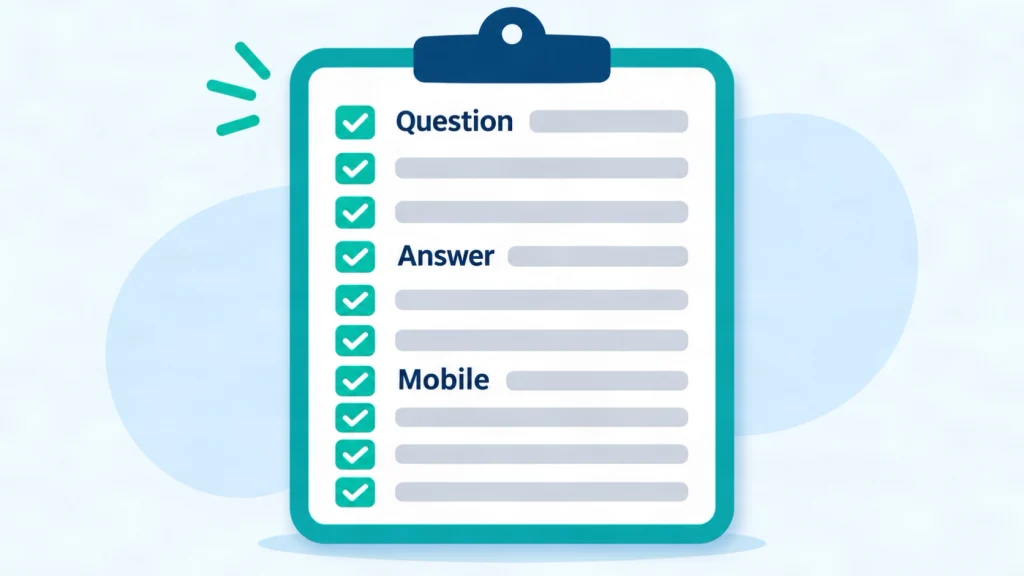
A snippet-ready checklist is a short list of checks you run on every page before publishing. Use it as a checklist for creating content, whether you are a beginner or a professional editor.
- Name the one question the page or section answers.
- Search that question and note the current snippet format.
- Confirm the page can reach page one for the query.
- Write a heading that mirrors the question in natural words.
- Answer in the first sentence, then keep the full answer near 40 to 60 words.
- Use a real list or table when the question calls for one.
- Add original experience, examples, and sources below the answer.
- Link to the original source for every figure, and show the year.
- Check that the page is indexable, fast, and readable on mobile.
- Record the date, then review the page again in six months.
Which Mistakes Can Cost You a Featured Snippet?
The most common mistakes are burying the answer, using the wrong format, blocking snippets by accident, and making claims you cannot support. Each one weakens the page for readers first and for Google second.
Google removes snippets that break its policies, and a site with many policy-breaking snippets can lose eligibility for featured snippets altogether (Google Search Help). Other mistakes that cost featured snippets include padding the answer with filler, copying a competitor’s wording, stuffing the keyword into every heading, and publishing a page for every minor query variation. Each of these helps nobody and risks the page’s reputation.
How Do You Know If Your Snippet Work Is Paying Off?
Compare impressions, average position, and click-through rate in Search Console for the target query before and after your change, and check the live result for featured snippets yourself. Google results vary by device and location, so one manual check is a clue, not proof.
Give the change time to be recrawled, then review a few weeks of data. If you need to track AI features, Google points to the Generative AI performance report in Search Console. Third-party tools can help your workflow, but they cannot see Google’s internal data, so avoid treating their scores as facts.
Limits, Risks, and When to Ask a Qualified Professional
This guide cannot promise a featured snippet, a ranking, more traffic, or an AI citation, because Google and other platforms make those decisions. Google says site owners cannot mark a page as a featured snippet, and Ahrefs’ own CMO wrote that there is no guaranteed way to get one.
Several limits apply. The Ahrefs figures date from 2017 and the Pew figures come from US users in March 2025, so they may not match your market. Search results change often. Treat the steps above as practical guidance based on official documentation and published studies, not as proof of results for your site.
This topic is marketing advice, not medical, legal, or financial advice. If you optimize pages about health, money, law, or safety, a short snippet can mislead, so use current primary sources, add clear limits to the answer, and ask a qualified professional to review the content before you publish. For site-wide decisions with real business risk, work with a qualified SEO professional who can review your situation.
Sources and Review Notes
Every figure and quotation in this guide comes from the sources below, checked on November 3, 2026. I did not use unverified statistics, and I have not invented any test results.
- Google Search Central, “Featured snippets and your website,” https://developers.google.com/search/docs/appearance/featured-snippets (last updated December 10, 2025).
- Google Search Central, “Optimizing your website for generative AI features on Google Search,” https://developers.google.com/search/docs/fundamentals/ai-optimization-guide (last updated July 10, 2026).
- Ahrefs, Tim Soulo, “Ahrefs’ Study Of 2 Million Featured Snippets: 10 Important Takeaways,” https://ahrefs.com/blog/featured-snippets-study/ (published May 29, 2017).
- Pew Research Center, Athena Chapekis, “Google users are less likely to click on links when an AI summary appears in the results,” July 22, 2025, https://www.pewresearch.org/short-reads/2025/07/22/google-users-are-less-likely-to-click-on-links-when-an-ai-summary-appears-in-the-results/
- OpenAI, “Overview of OpenAI Crawlers,” https://developers.openai.com/docs/bots.
Two short quotations appear in this guide. Google Search Central states that “Google systems determine whether a page would make a good featured snippet” for a search request (documentation updated December 10, 2025). Tim Soulo of Ahrefs wrote that “there’s no guaranteed way to do it” when asking how to rank in a featured snippet (May 29, 2017). Review horizon: I will recheck the Google and OpenAI pages in six months, since both change.
Conclusion
To win featured snippets, find a question that already shows a snippet, match its format, answer it in a short block under a matching heading, and back it with real depth. Three points matter most. Google decides selection, so you cannot force a result. Clear structure and honest evidence help both readers and search systems. And AI Overviews mean a snippet should earn trust, not just a click.
If you want help turning this process into pages that rank, I can help with SEO content writing and content briefs built around the questions your customers ask. You can also learn more about Forkan Mahmud or contact me to discuss your site.
Frequently Asked Questions
What is a featured snippet in Google?
A featured snippet is a highlighted answer box at the top of Google results that shows a short excerpt from a page, followed by that page’s title and link. Google chooses the excerpt automatically from pages that already rank well, and the format can be a paragraph, list, table, or video. You cannot apply for it.
Can I mark my page as a featured snippet?
No, you cannot mark a page or send a request, because Google’s systems decide which page makes the best answer for a search. What you can do is write a clear answer, match the current format, and keep the page indexable. Those steps raise the odds without any guarantee of selection.
Do I need to rank first to get a featured snippet?
You do not need position one, but you usually need page one. In Ahrefs’ 2017 study, 99.58% of featured pages already ranked in the top 10 for the query, and only 30.9% of snippets sat at the very top. A page in positions three to eight is often a good target.
How long should a featured snippet answer be?
Aim for about 40 to 60 words as a working habit, since Google publishes no exact length. Google says the minimum varies by language, information, and device. If your answer needs more room, give the short answer first, then add the detail in the paragraphs, list, or table that follow.
Does structured data help win featured snippets?
Not by itself. Google says structured data is not required for its generative AI features and has no special markup for them, although it can help with rich result eligibility. Add markup only when it matches the visible page. A clear heading, a direct answer, and a ranking page matter more.
How do I optimize content for ChatGPT?
Allow OAI-SearchBot in your robots.txt file, since OpenAI says blocked sites will not appear in ChatGPT search answers. Then publish original, helpful, well-sourced pages that answer questions clearly. OpenAI does not promise citations, so treat this as removing a technical barrier, not as a guaranteed way to appear.
Can I use the same steps for YouTube or LinkedIn?
Partly. YouTube video descriptions have appeared in Google snippets, according to the Ahrefs study, so clear titles and descriptions can help. LinkedIn is a separate platform with its own feed rules, so Google snippet steps do not transfer directly. Use the same habit of a clear question and short answer, then check each platform’s guidance.
How do I stop a page from appearing as a featured snippet?
Add the nosnippet rule to the page, which blocks all snippets, including regular ones. If you want to keep normal snippets, try lowering the max-snippet value, though Google says this does not guarantee featured snippets will stop. Only nosnippet is a guaranteed solution, so choose based on whether you still want regular snippets.
How long does it take to win a featured snippet?
No verified timeline exists, and anyone who gives you a fixed number is guessing. Results depend on your current ranking, the competing page, and how quickly Google recrawls your update. Review Search Console data over several weeks after each change, and treat a snippet as a possible result, not a promise.
What is the difference between optimized content and keyword stuffing?
Optimized content answers a specific question clearly, matches search intent, and is easy to read, while keyword stuffing repeats a phrase to manipulate rankings. Stuffing makes the page worse for readers and can break Google’s spam policies. Use the keyword naturally where it fits, and never add repetitions just to reach a percentage.