How to Find and Use Semantic Keywords in SEO: 9 Easy Hacks
Learn how to find and use semantic keywords in SEO with practical research methods, keyword clustering, entity mapping, and content optimization strategies.

Search engines no longer rely only on exact keyword matches to understand a page. They also analyze meaning, context, entities, relationships, and search intent. This is why learning how to find and use semantic keywords in SEO is important for creating content that answers real search questions.
Semantic keywords help search engines understand what a page is about and how its information connects to a wider topic. They also help content creators cover a subject more naturally instead of repeating the same keyword throughout an article.
However, using semantic keywords does not mean adding every related phrase you can find. The goal is to understand the topic, identify what searchers need, and provide useful information in a clear structure.
In this guide, you will learn how semantic keywords work, how to research them, how to organize them, and how to use them in website content. You will also see practical examples, useful tools, and common mistakes to avoid.
1. What Are Semantic Keywords in SEO?
Semantic keywords are words and phrases that are conceptually related to a main topic. They help explain the meaning, context, and relationships behind a search query.
For example, consider the main keyword local SEO.
Related semantic terms may include:
- Google Business Profile
- Local search rankings
- Business citations
- NAP consistency
- Local search intent
- Customer reviews
- Location pages
- Service areas
- Local business schema
These phrases are not all synonyms of local SEO. Instead, they represent different concepts that help explain the subject.
A useful article about local SEO may need to discuss Google Business Profile, reviews, citations, and location relevance. These concepts make the content more complete and useful.
Are semantic keywords the same as synonyms?
No. Synonyms have similar meanings, while semantic keywords can describe related entities, attributes, actions, processes, or concepts.
For example:
| Main topic | Related semantic concepts |
|---|---|
| Website design | User experience, navigation, responsive design, accessibility |
| Roofing services | Roof repair, roof replacement, shingles, inspections |
| Keyword research | Search volume, keyword difficulty, search intent, keyword clusters |
| Content marketing | Content strategy, audience research, editorial calendar, conversions |
A synonym may replace a word without changing its meaning. A semantic term may add a new piece of information that helps explain the topic.
This distinction matters because good SEO content should cover relevant concepts, not simply repeat variations of the same phrase.
2. How Does Semantic Search Understand Keywords and Context?
Semantic search focuses on understanding the meaning behind a search rather than matching only individual words.
When someone searches for “best way to fix a leaking roof,” they may need information about:
- Common causes of roof leaks
- How to identify the damaged area
- Temporary repair methods
- Roofing materials
- When professional repair is necessary
A useful search system must understand the relationship between the query and these possible needs.
What role does search intent play?
Search intent describes the main reason behind a search.
Most SEO queries can be grouped into four common intent types:
| Search intent | What the user wants | Example |
|---|---|---|
| Informational | Learn something | What is semantic SEO? |
| Navigational | Find a specific website or page | Google Search Console login |
| Commercial | Compare products or services | Best keyword research tools |
| Transactional | Take an action or make a purchase | Hire a local SEO expert |
Semantic keywords should support the intent of the page.
For example, an informational article about semantic keywords should explain definitions, research methods, examples, and practical use. Adding unrelated service and purchase phrases would not improve its usefulness.
Why does context matter more than keyword repetition?
A page can repeat a keyword many times without explaining the topic properly.
Imagine two articles about keyword research.
The first repeats “keyword research” in almost every paragraph but provides little practical information.
The second explains search intent, keyword difficulty, topic relevance, SERP analysis, keyword clustering, and content planning.
The second article gives readers a clearer understanding of the subject. Its related concepts also help search systems interpret the page.
The lesson is simple: explain the topic properly instead of relying on repetition.
3. Why Are Semantic Keywords Important for SEO?
Semantic keywords support better content planning and help create pages that answer a wider range of relevant questions.
They are useful for several reasons.
3.1 They improve topical coverage
A topic often contains several connected subtopics.
An article about technical SEO, for example, may need to cover crawling, indexing, XML sitemaps, canonical URLs, redirects, and structured data.
These concepts help readers understand the wider subject.
Without relevant supporting information, a page may answer only a small part of the user’s question.
3.2 They help match search intent
People use different words to search for the same problem.
One person may search for “how to improve Google Business Profile rankings.” Another may search for “local business visibility on Google.”
These queries are related, but the exact wording is different.
Understanding their shared intent helps you create content that answers the actual need rather than targeting isolated phrases.
3.3 They support natural writing
Repeating the same exact keyword can make content difficult to read.
Semantic terms provide natural ways to explain different aspects of a subject.
For example, an article about content optimization can discuss headings, readability, internal links, search intent, entities, and page structure without forcing the same phrase into every paragraph.
3.4 They help organize website content
Semantic keyword research can reveal relationships between topics.
These relationships are useful when planning:
- Main pillar pages
- Supporting articles
- Service pages
- Category pages
- Internal links
- Topic clusters
A well-organized website makes it easier for users to discover related information.
You can explore more about building topical authority and how related content can support a wider website structure.
4. What Is the Difference Between Primary, Secondary, Semantic, and LSI Keywords?
These terms are often used together, but they do not mean exactly the same thing.
| Keyword type | Meaning | Example for a page about keyword research |
|---|---|---|
| Primary keyword | Main target query | Keyword research |
| Secondary keyword | Another relevant query to target or support | Keyword research process |
| Semantic keyword | A conceptually related term | Search intent |
| Long-tail keyword | A more specific search phrase | How to do keyword research for a small business |
| LSI keyword | A commonly used SEO term referring to latent semantic indexing | Often incorrectly used as a synonym for related keywords |
Are LSI keywords the same as semantic keywords?
No. Latent Semantic Indexing (LSI) is a mathematical information-retrieval method. It is not a modern Google SEO technique for finding a list of related keywords.
The phrase “LSI keywords” is still common in SEO discussions, but it should not be treated as a technical requirement for ranking.
Instead of chasing LSI keyword lists, focus on relevant concepts, entities, search intent, and the information your audience needs.
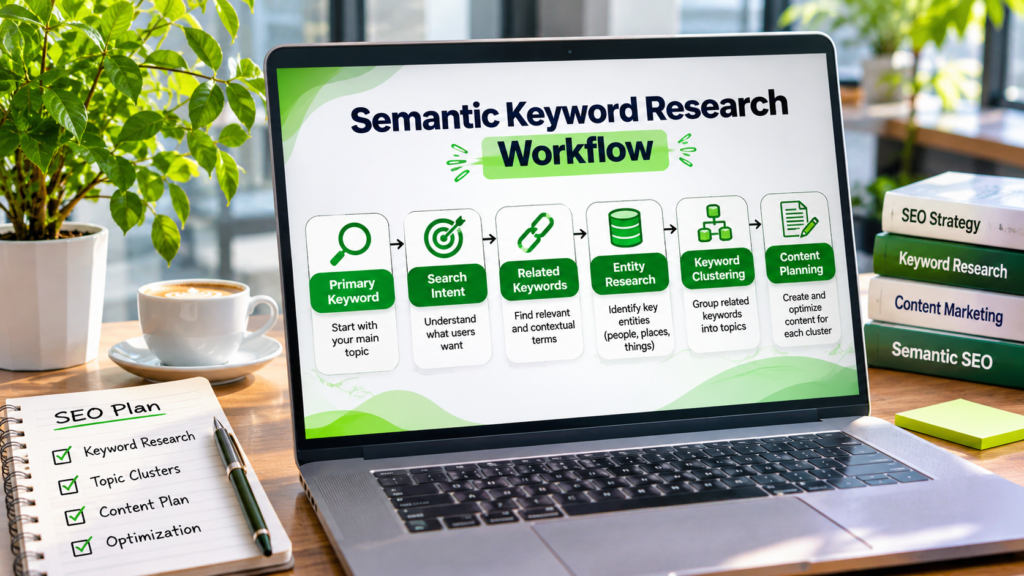
5. How to Find and Use Semantic Keywords in SEO: 9 Practical Steps
Finding useful semantic keywords requires more than copying suggestions from a keyword tool. You need to understand the topic, examine search results, identify connected concepts, and organize the findings.
Here are nine practical steps.
Step 1: Start With One Clear Primary Keyword
Begin with the main subject of your page.
Choose a keyword that accurately represents the information you intend to provide.
For example:
Primary keyword: Semantic keywords
Before researching related terms, understand what the searcher expects to find.
Ask yourself:
- Is the user looking for a definition?
- Do they want a practical tutorial?
- Are they comparing different SEO concepts?
- Do they need examples?
- Are they looking for a tool or service?
These questions help define the direction of your research.
Do not choose a primary keyword only because it has a high search volume. Relevance and intent are equally important.
Step 2: Analyze Google’s Search Results
Search your primary keyword and examine the pages that appear.
Look beyond the titles. Study the actual information presented by competing pages.
Pay attention to:
- H1, H2, and H3 headings
- Questions answered in the content
- Related entities and concepts
- Common examples
- Content formats
- Search intent
- Missing information
- Areas where explanations are unclear
The purpose is not to copy competitors. It is to understand what users expect and discover opportunities to provide better information.
For a semantic keyword article, you may find that competing pages discuss entities, search intent, keyword clustering, contextual relevance, and content optimization.
These topics can help shape your own content plan.
Step 3: Use Google’s Autocomplete and Related Questions
Google can provide useful clues about how people search for a topic.
Start typing your main keyword and review the autocomplete suggestions.
For example, searches related to semantic keywords may lead to questions such as:
- What are semantic keywords?
- How do semantic keywords work?
- How do I find related keywords?
- What is semantic SEO?
- How are semantic keywords different from LSI keywords?
Also review the “People also ask” section when it appears.
These questions can help you identify user concerns and create useful subheadings.
Remember that suggestions are research clues, not proof of search volume or ranking difficulty.
Step 4: Research Related Keywords With SEO Tools
Keyword research tools can help discover related queries and compare their potential.
Useful options include:
- Google Keyword Planner
- Google Search Console
- Semrush
- Ahrefs
- Google Trends
For each related query, review its relevance, intent, search demand, and competition where reliable data is available.
A keyword with a high search volume is not automatically a good choice.
For example, a broad phrase may attract visitors who are not interested in your page. A more specific phrase with lower search volume may bring a more relevant audience.
Use tools to support your judgment, not replace it.
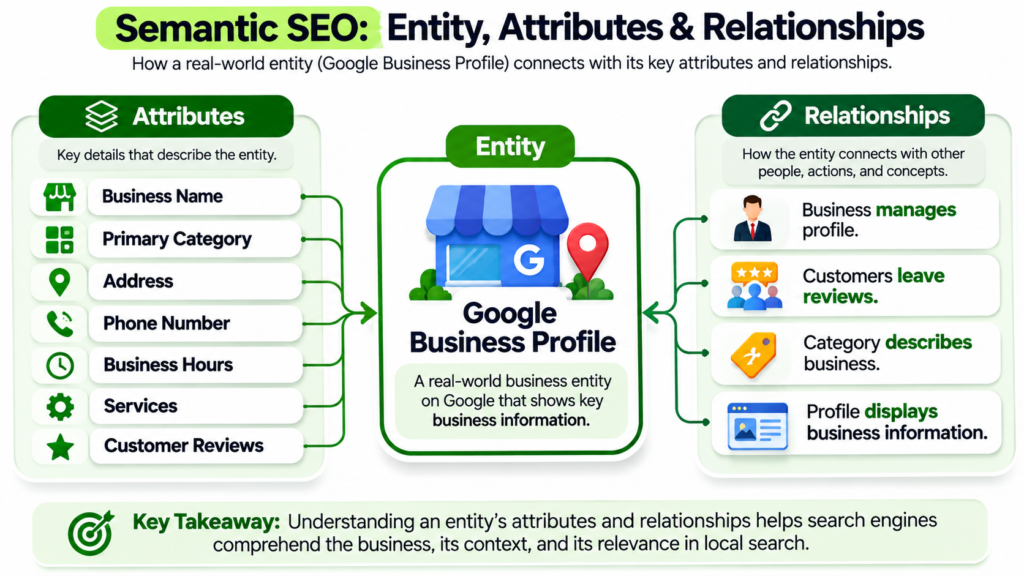
Step 5: Identify Entities, Attributes, and Relationships
This is one of the most useful parts of semantic research.
An entity is a recognizable person, place, organization, product, concept, or thing.
An attribute describes a characteristic of that entity.
A relationship explains how two or more entities or concepts connect.
Consider this example:
Entity: Google Business Profile
Attributes:
- Business name
- Primary category
- Address
- Phone number
- Business hours
- Services
- Reviews
Relationships:
- A business manages its Google Business Profile.
- Customers leave reviews on a business profile.
- A primary category describes the business.
- Business information can help users identify a local company.
This type of mapping helps you identify which concepts belong in a page.
For a semantic SEO article, relevant entities may include Google Search, Google Search Console, search intent, keyword research, entities, attributes, and topical authority.
Do not add an entity simply because it is popular. Include it when it helps explain the subject.
Step 6: Group Related Keywords Into Clusters
Keyword clustering means organizing related search queries into groups based on shared meaning and intent.
For example:
Main topic: Semantic keywords
Cluster 1: Definitions
- What are semantic keywords?
- Semantic keywords meaning
- Semantic SEO definition
Cluster 2: Research
- How to find semantic keywords
- Semantic keyword research
- Related keyword research
Cluster 3: Implementation
- How to use semantic keywords
- Semantic keyword optimization
- Semantic keywords in content
Cluster 4: Related concepts
- Entity-based SEO
- Search intent
- Topical relevance
- Keyword relationships
Clustering helps you decide which queries belong on one page and which deserve separate articles.
Do not create a separate page for every minor keyword variation. If several queries have the same intent and require the same answer, one comprehensive page may be more useful.
For a larger website, a professional topical map can help organize related topics and supporting pages.
Step 7: Build a Content Brief Before Writing
Once your keyword research is complete, turn it into a clear content brief.
A useful brief may include:
| Content element | What to define |
|---|---|
| Primary keyword | Main search target |
| Secondary keywords | Closely related queries |
| Search intent | What the reader wants |
| Main entities | Important concepts and things |
| Attributes | Relevant characteristics |
| Questions | Problems the article must answer |
| H2 topics | Main sections |
| H3 topics | Supporting explanations |
| Internal links | Relevant pages on your website |
| Evidence | Examples, experience, and reliable sources |
A content brief prevents random keyword insertion and keeps the article focused.
It also makes the writing process more efficient.
Step 8: Add Semantic Keywords Naturally
Now use your research while writing.
Place important concepts where they make sense:
- In relevant headings
- In introductory explanations
- In examples
- In comparisons
- In FAQs
- In image descriptions when appropriate
For example, an article about semantic keywords can naturally explain search intent, entity relationships, keyword clustering, and topical coverage.
You do not need to include every related phrase in every section.
A good paragraph should communicate one clear idea. If a keyword does not improve the explanation, leave it out.
Step 9: Review, Improve, and Measure the Content
After publishing, monitor how the page performs.
Use Google Search Console to review:
- Search queries
- Impressions
- Clicks
- Click-through rate
- Average position
- Pages receiving search traffic
Look for relevant queries that bring impressions but are not addressed clearly in the article.
If the missing information is useful to readers, consider improving the relevant section.
Do not add content simply to increase keyword count. Improve the page when there is a genuine information gap.
6. How Do Entities, Attributes, and Semantic Relationships Improve Content?
Semantic SEO is not only about finding related words. It also involves understanding how concepts connect.
A useful way to plan content is to create an entity-attribute-relationship model.
Consider a roofing contractor website.
| Entity | Attribute | Related information |
|---|---|---|
| Roofing contractor | Service | Roof repair |
| Roofing contractor | Service area | Towns and cities served |
| Roof | Material | Asphalt shingles |
| Roof | Condition | Damaged or leaking |
| Customer | Need | Inspection or replacement |
| Roofing service | Process | Estimate, inspection, installation |
This model can help you decide what information a service page should include.
For example, a page about roof repair may need to explain common damage, repair methods, materials, service locations, and when an inspection is necessary.
The purpose is not to include a fixed list of entities. It is to make sure the content explains the topic in a way that is useful and understandable.
Should every article include an entity list?
No.
Entity research is a planning method, not a requirement to publish a visible entity list.
Some topics need detailed entity relationships. Others can be explained clearly with a few supporting concepts.
Use the level of detail that the topic and audience require.
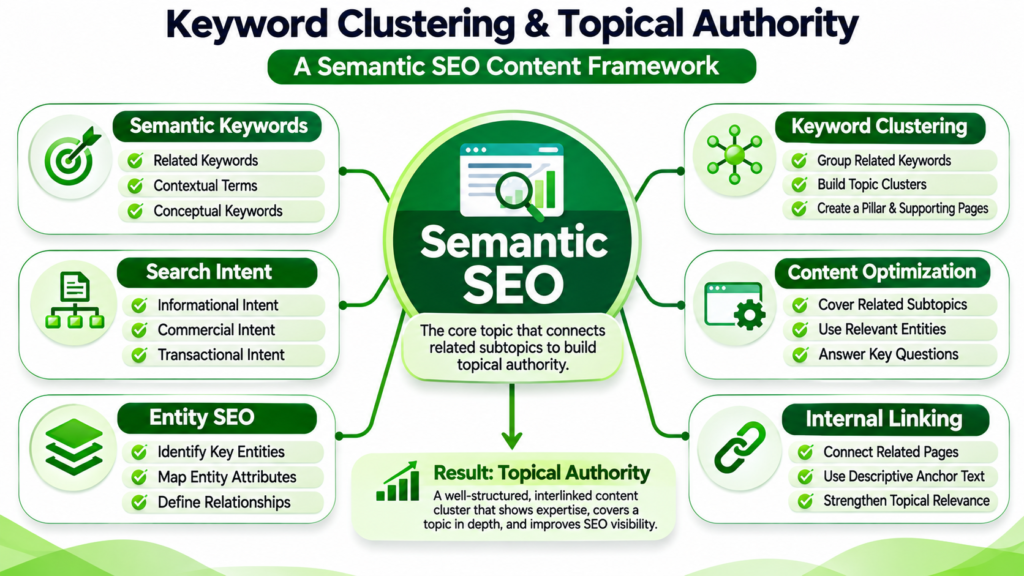
7. How Does Keyword Clustering Support Topical Authority?
Topical authority is a way of describing a website’s depth and relevance across a subject area. It is not a simple score that guarantees rankings.
A website can organize related content around a central topic.
For example, a website focused on SEO may have a main semantic SEO topic supported by articles about:
- Semantic keywords
- Search intent
- Entity SEO
- Topical maps
- Keyword clustering
- Content briefs
- Internal linking
- Content optimization
Each page should have a clear purpose.
A central guide may introduce the wider topic, while supporting articles explain individual concepts in greater detail.
Relevant internal links help visitors move between connected pages.
You can explore more about semantic SEO concepts and SEO content strategy and briefs to understand how these elements fit into a wider content process.
How should you connect related pages?
Use descriptive anchor text that explains what the destination page is about.
For example:
- Link “keyword clustering” to a detailed clustering guide.
- Link “topical map development” to a relevant service page.
- Link “content optimization” to a practical optimization resource.
Avoid using the same generic anchor text for unrelated destinations.
Internal links should help users discover useful information, not exist only to place keywords on a page.
8. How Should You Use Semantic Keywords in Different Content Types?
Semantic keyword implementation depends on the purpose of the page.
Blog articles
A blog article should answer the main question and cover relevant supporting questions.
Use semantic concepts in explanations, examples, headings, and FAQs.
Service pages
A service page should explain what the service does, who needs it, what problems it solves, and what the customer can expect.
For example, a local SEO service page may discuss Google Business Profile optimization, local keyword research, business citations, location relevance, and local landing pages.
Do not turn a service page into a glossary of unrelated SEO terms.
Product pages
Product pages should explain product features, specifications, benefits, use cases, compatibility, and important details.
Use related terms only when they accurately describe the product.
Location pages
Location pages should provide genuine information about the location and the service available there.
Relevant information may include service areas, local customer needs, nearby communities, and location-specific details.
Avoid publishing many nearly identical location pages with only city names changed.
Category pages
Category pages should help users understand what products, services, or resources belong in that category.
Relevant subtopics and descriptive links can improve navigation and content clarity.
9. Practical Example: Semantic Keyword Research for a Local SEO Topic
Let’s use an illustrative example.
Suppose a business wants to improve its visibility in local search.
Primary topic: Local SEO services
Possible related concepts include:
- Google Business Profile optimization
- Local keyword research
- Business citations
- Customer reviews
- NAP consistency
- Local landing pages
- Service-area relevance
- Local search intent
A content planner can organize these concepts by user need.
| User need | Related concepts | Possible content section |
|---|---|---|
| Understand local SEO | Local search, location relevance | What Is Local SEO? |
| Improve profile visibility | Google Business Profile, categories, services | How to Optimize a Business Profile |
| Improve local relevance | Local keywords, service areas | How Local Keyword Research Works |
| Build trust | Reviews, business information | Why Reviews and Accurate Details Matter |
| Improve website structure | Location pages, internal links | How to Organize Local Landing Pages |
This example demonstrates how related concepts can support a clear content structure.
It is an illustrative planning example, not a report of measured client results.
For practical examples of SEO work, you can also review local SEO case studies.
10. Which Tools Can Help You Find Semantic Keywords?
No single tool can identify every useful semantic concept. Different tools provide different types of information.
Google Search
Use Google to review autocomplete suggestions, related questions, and the pages appearing for your target queries.
It helps you understand the language people use and the topics that search results commonly cover.
Google Search Console
Search Console provides performance data from your own website.
You can review queries that generate impressions and clicks, identify pages receiving relevant traffic, and discover opportunities to improve existing content.
Google Keyword Planner
Keyword Planner can help discover keyword ideas and review search-demand estimates.
It is useful for expanding your initial keyword list, particularly when planning content around a service or product.
Semrush
Semrush provides keyword research, competitive analysis, and topic discovery features.
It can help you explore related queries and compare opportunities.
Ahrefs
Ahrefs offers keyword research and competitor analysis features that can support topic discovery and content planning.
Google Trends
Google Trends helps compare interest in search terms over time and across locations.
It can be useful when a topic has seasonal or changing demand.
AI writing and research tools
AI tools can help brainstorm related concepts, organize keyword lists, and create initial content briefs.
However, AI-generated suggestions should be checked.
An AI tool may produce irrelevant entities, inaccurate relationships, or search queries that have little practical value.
Always validate important information using reliable sources and actual search data.
You can find additional SEO tools and resources for your research and content workflow.
11. How Do Semantic Keywords Help With AI Search and LLM Visibility?
Search experiences are changing. Users may receive answers from traditional search results, AI-generated summaries, conversational search tools, and large language models (LLMs).
This makes clear and useful content increasingly important.
Semantic keyword research can support this goal because it helps writers understand the questions, concepts, and relationships that belong to a topic.
However, using semantic keywords does not guarantee that an AI system will cite, mention, or recommend a website.
What makes content easier to understand?
Consider these practices:
Answer questions directly. Start important sections with a clear response before adding details.
Use descriptive headings. Make it easy to understand what each section explains.
Explain entities clearly. Introduce important people, organizations, products, and concepts with enough context.
Support claims with reliable sources. Link to original documentation or trustworthy evidence when appropriate.
Use examples. Practical examples help explain abstract concepts.
Keep information consistent. Avoid conflicting statements across related pages.
Make pages accessible. Ensure that important content can be discovered and accessed by search systems.
Google’s guidance on AI features and your website explains that the normal foundations of SEO remain relevant to Google’s AI search experiences. There is no separate special schema or guaranteed optimization method for appearing in AI Overviews or AI Mode.
Does GEO require a different keyword strategy?
Generative Engine Optimization (GEO) is a term used for improving content visibility in generative AI experiences.
The practical approach should still begin with understanding users and providing accurate, relevant information.
Clear definitions, useful explanations, trustworthy evidence, and a well-organized website can make content easier for people and systems to interpret.
Do not create artificial keyword lists or publish unnecessary pages simply to target AI search.
12. How Does E-E-A-T Support Semantic SEO?
E-E-A-T stands for:
- Experience
- Expertise
- Authoritativeness
- Trustworthiness
Google uses these concepts in its Search Quality Rater Guidelines to help describe aspects of content quality. E-E-A-T itself is not a single ranking factor.
Semantic keyword optimization can improve topic coverage, but it cannot replace genuine experience, reliable information, or trust.
How can you demonstrate experience?
Include relevant first-hand examples when you have them.
For example:
- Explain how you approach keyword research.
- Show a real content-planning process.
- Share a documented project example.
- Explain a problem you encountered and how you addressed it.
- Use screenshots or supporting evidence where appropriate.
Do not invent client outcomes or claim that an example produced a specific ranking improvement unless you can verify it.
How can you demonstrate expertise?
Explain technical concepts accurately and in a way that your audience can understand.
Use reliable references, define unfamiliar terms, and distinguish established search guidance from personal opinions or industry theories.
Why is trust important?
Readers need to know whether the information is reliable.
Provide accurate author information, maintain your content, correct outdated claims, and make important business information easy to find.
You can learn more about the author’s SEO experience and expertise.
13. How Can You Measure the Performance of Semantic Keyword Optimization?
After publishing, measure whether the page is attracting relevant visitors and helping them find useful information.
Do not judge success only by the number of keywords included.
Monitor Google Search Console
Review:
- Total clicks
- Total impressions
- Average click-through rate
- Average position
- Queries bringing traffic
- Pages receiving impressions
Look for relevant search queries that your page already appears for.
If a query is closely related to the page but the content does not answer it, consider adding a useful explanation.
Review engagement and conversions
Depending on the purpose of your page, you may also measure:
- Relevant enquiries
- Form submissions
- Service-page visits
- Product interactions
- Newsletter sign-ups
- Other meaningful conversions
A page can attract visitors without achieving its business goal. The right measurement depends on why the page exists.
Improve content based on evidence
Use performance data to identify genuine opportunities.
For example, if Search Console shows impressions for a related question, check whether the article provides a useful answer.
If the answer is missing, add it in the most relevant section.
Avoid changing headings or adding keywords just because a tool recommends a higher density score.
You should also review technical SEO and content accessibility when technical issues may prevent search systems from accessing important content.
14. What Are the Most Common Semantic Keyword Mistakes?
Semantic keyword research is useful, but poor implementation can reduce content quality.
Avoid these mistakes.
Mistake 1: Adding Every Related Keyword
Not every suggested keyword belongs in your article.
Choose terms based on relevance and user needs.
Mistake 2: Confusing Semantic Keywords With Synonyms
Related concepts can have different meanings.
Understand the relationship before including a term.
Mistake 3: Ignoring Search Intent
A keyword may be related to your topic but still have a different intent.
Make sure your page answers the question behind the search.
Mistake 4: Overusing Exact-Match Keywords
Repeating the same phrase unnaturally does not make an article more useful.
Use your primary keyword where it fits and explain the topic naturally.
Mistake 5: Creating Too Many Similar Pages
Publishing separate pages for every small keyword variation can create unnecessary overlap.
Group queries with shared intent when one page can answer them properly.
Mistake 6: Copying Competitor Headings
Competitor analysis should help identify user needs and content gaps.
It should not become a copy-and-paste exercise.
Mistake 7: Trusting AI Suggestions Without Checking Them
AI can help with brainstorming, but it can also suggest unrelated terms or incorrect information.
Validate important concepts before using them.
Mistake 8: Forgetting Internal Links
Related pages should connect where the links genuinely help readers.
Use descriptive anchor text and link to relevant destinations.
Mistake 9: Measuring Only Keyword Density
Density is a writing check, not a ranking guarantee.
Focus on content quality, relevance, accuracy, and usefulness.
15. Frequently Asked Questions About Semantic Keywords
1. What are semantic keywords in SEO?
Semantic keywords are words and phrases related to the meaning and context of a main topic. They help explain connected concepts, entities, attributes, and user needs.
2. How do I find semantic keywords?
Start with a primary keyword, analyze search results, review Google’s autocomplete and related questions, use keyword research tools, and identify relevant entities and concepts.
3. Are semantic keywords and LSI keywords the same?
No. LSI refers to Latent Semantic Indexing, a mathematical information-retrieval method. The term “LSI keywords” is commonly used in SEO, but it is not an official Google keyword research requirement.
4. How many semantic keywords should I use in an article?
There is no fixed number. Include the concepts necessary to explain the subject properly. Relevance and usefulness matter more than reaching a specific keyword count.
5. Do semantic keywords improve Google rankings?
They can support relevant, complete content, but using them does not guarantee rankings. Google considers many signals when evaluating and ranking pages.
6. Can I use semantic keywords in headings?
Yes. Use them in headings when they accurately describe the section. Avoid adding phrases to headings only to increase keyword frequency.
7. What is the difference between semantic keywords and secondary keywords?
Secondary keywords are additional search queries you want a page to address. Semantic keywords are related concepts that help explain the main subject. The two groups can overlap.
8. Can AI tools find semantic keywords?
AI tools can suggest related concepts, entities, and questions. However, their suggestions should be checked against search results, reliable sources, and the actual needs of your audience.
9. Are semantic keywords important for AI search?
They can help writers organize related information and explain topics clearly. However, semantic keyword usage alone does not guarantee visibility in AI-generated answers.
10. Should every page target semantic keywords?
Every page should use relevant language and explain its subject clearly. The amount of semantic research required depends on the page’s purpose, topic complexity, and audience.
Conclusion: Build Better Content With Semantic Keyword Research
Effective SEO content is about more than placing a keyword in a title or repeating it throughout a page.
You need to understand the main topic, identify related concepts, examine search intent, and organize information in a way that helps readers.
Learning how to find and use semantic keywords in SEO gives you a practical method for planning more relevant content. Start with one clear topic, research its connected entities and questions, organize related queries, and use the findings naturally.
Most importantly, focus on answering real questions with accurate and useful information. Strong content structure, relevant internal links, genuine experience, and clear explanations create a better foundation for long-term search visibility.
If you want to build a more organized content strategy, explore professional topical map development and SEO content writing services.