What Is Local SEO and How Does It Work? A Complete Guide
Local SEO connects nearby consumers with regional businesses by optimizing geographic and entity signals. Learn how the Google local algorithm calculates proximity, relevance, and prominence to position your business in the Local 3-Pack.

What Is Local SEO and How Does It Work? A Complete Guide
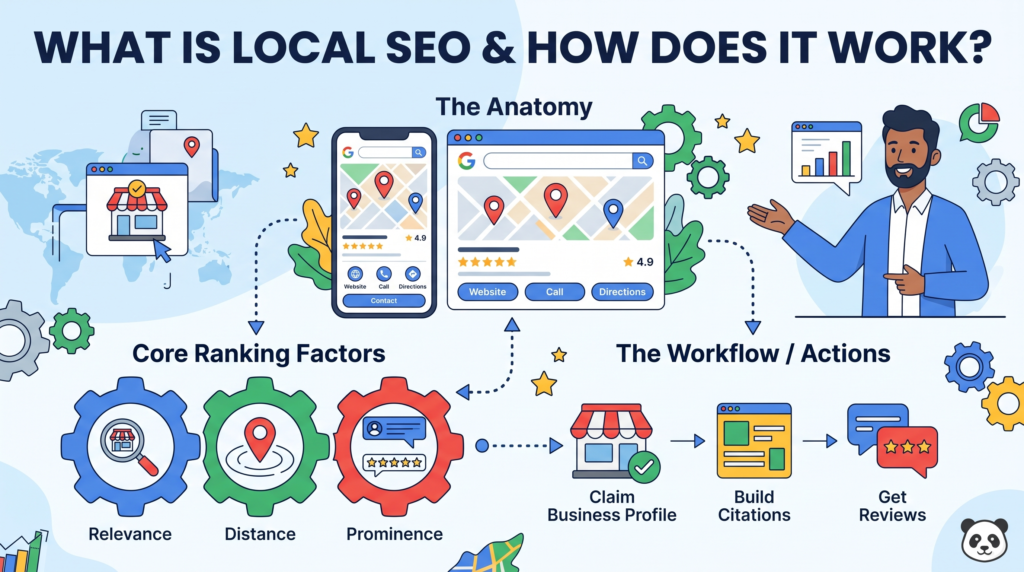
Local SEO is the practice of optimizing your online presence to increase organic traffic, visibility, and leads from location-based search queries. When people search for products or services near them, search engines tailor results based on proximity, relevance, and prominence. Understanding how local search functions allows your business to capture high-intent customers right when they are ready to make a purchase.
Local SEO (Definition): A specialized branch of search engine optimization focused on improving a business’s visibility in local search engine results pages (SERPs), specifically within map packs and localized organic listings, by optimizing geographic and entity signals.
What Is Local SEO?
Local SEO connects regional consumers with nearby brick-and-mortar storefronts and service providers. Unlike traditional SEO, which focuses on global or national reach, local optimization depends on geographic proximity and regional intent signals.
When a user searches for a query like “emergency plumber” or “coffee shop near me,” search engines recognize that the query has explicit local intent. The engine alters the results layout to display maps, phone numbers, customer ratings, and physical addresses.
- Physical Storefronts: Grocery stores, dental clinics, and restaurants that rely on in-person foot traffic.
- Service Area Businesses (SABs): Electricians, roofers, and pest control technicians who travel directly to customer locations.
- Multi-Location Brands: Regional franchises and enterprise chains requiring distinct local visibility for individual branch locations.
How Does Google’s Local Search Algorithm Work?
Google’s local algorithm calculates rankings using three primary pillars: relevance, distance, and prominence. These pillars ensure that searchers receive immediate, geographically accurate, and trustworthy answers for local needs.
According to official documentation from Google Business Profile Help on local rankings:
“Local results are based primarily on relevance, distance, and prominence. A combination of these factors helps find the best match for your search.” (Google Business Profile Help, 2025)
Google combines these three signals to determine which businesses appear in the top positions of map listings and localized web results.
1. The Role of Relevance in Local Rankings
Relevance measures how well a local business profile matches what the searcher needs. Google determines relevance by reading your primary business category, service listings, website copy, and structured data attributes. If your business profile is incomplete or lacks detailed service descriptions, the search engine cannot accurately connect your profile to specific customer queries.
2. How Distance Influences Map Visibility
Distance calculates how far each potential business location is from the search term’s location tag or the user’s physical GPS coordinates. If a searcher does not specify a city or neighborhood, Google calculates distance based on device IP addresses, mobile cell tower signals, and Wi-Fi locations. While you cannot manipulate a searcher’s physical location, establishing clear geographic service boundaries helps Google serve your business to relevant nearby users.
3. What Builds Prominence in Local Search?
Prominence refers to how well-known, authoritative, and trusted a business is in both the physical and digital world. Search engines measure prominence by analyzing directory citations, news mentions, backlinks from local organizations, total review volume, and ongoing customer sentiment. Businesses with an established offline presence often translate that trust into online search prominence.
The Anatomy of the Google Local Pack
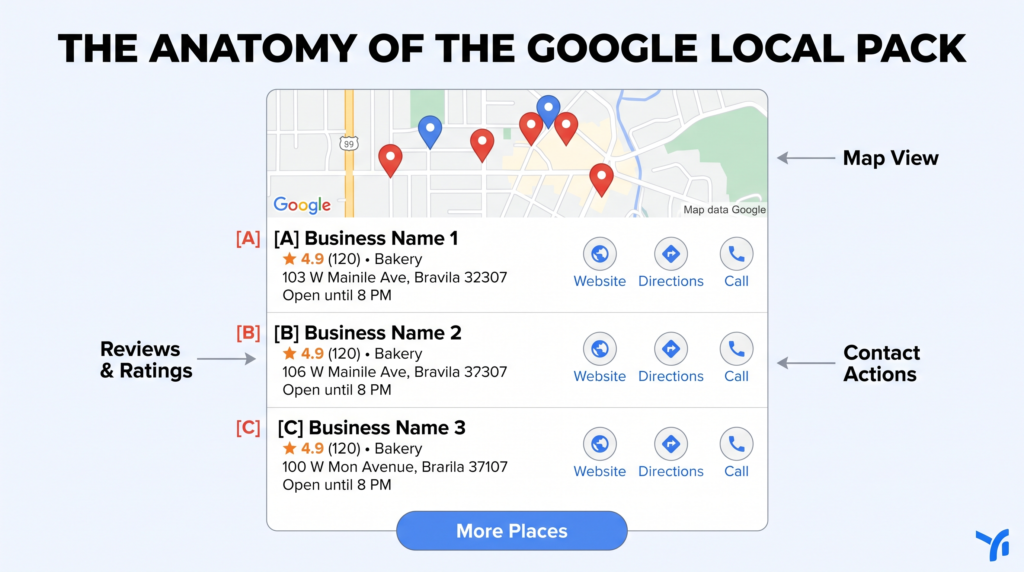
The Google Local Pack is the boxed section appearing at the top of search results displaying a map alongside three featured local businesses. Securing a spot within this top tier is the primary objective of local optimization because it attracts the vast majority of local mobile clicks.
As industry researcher Darren Shaw highlighted in the Whitespark Local Search Ranking Factors study:
“Google Business Profile signals continue to be the single most impactful factor for Local Pack rankings, while organic website signals drive localized organic positions.” (Whitespark, 2025)
Whitespark’s benchmark data reveals that Google Business Profile signals account for approximately 32% of Local Pack ranking weight, followed by review signals at 20% and on-page signals at 15%.
The Google Local Pack displays three prominent local listings alongside a map view, customer ratings, and contact buttons.
Step-by-Step Local SEO Strategy for Higher Rankings
Executing an effective local SEO strategy requires aligning your profile data, website structure, and brand reputation across the web.
1. Optimizing Your Google Business Profile
Claiming and verifying your Google Business Profile (GBP) is the cornerstone of any local marketing plan. Complete every profile field accurately, including your real-world business name, street address, local telephone number, and business hours. Select the most accurate primary category available, as this acts as your strongest relevance signal. Regularly upload authentic photos of your storefront, team, and work to maintain profile activity.
2. Building and Managing Local Citations
A citation is any online mention of your core NAP data: Name, Address, and Phone Number. Citations appear on directory platforms like Yelp, YellowPages, Better Business Bureau, and industry-specific portals. Search engines cross-reference these directory listings to verify your physical location. Ensure your contact details match identically across every public directory to prevent algorithmic confusion.
3. Generating and Managing Customer Reviews
Customer reviews build prominence and directly influence buyer decisions. According to the BrightLocal Local Consumer Review Survey, 75% of consumers regularly read online reviews when evaluating local businesses, and 41% are more likely to use a business that responds to all of its reviews compared to one that ignores them. Create a standardized process to request reviews from satisfied clients via email or SMS, and reply to all feedback professionally
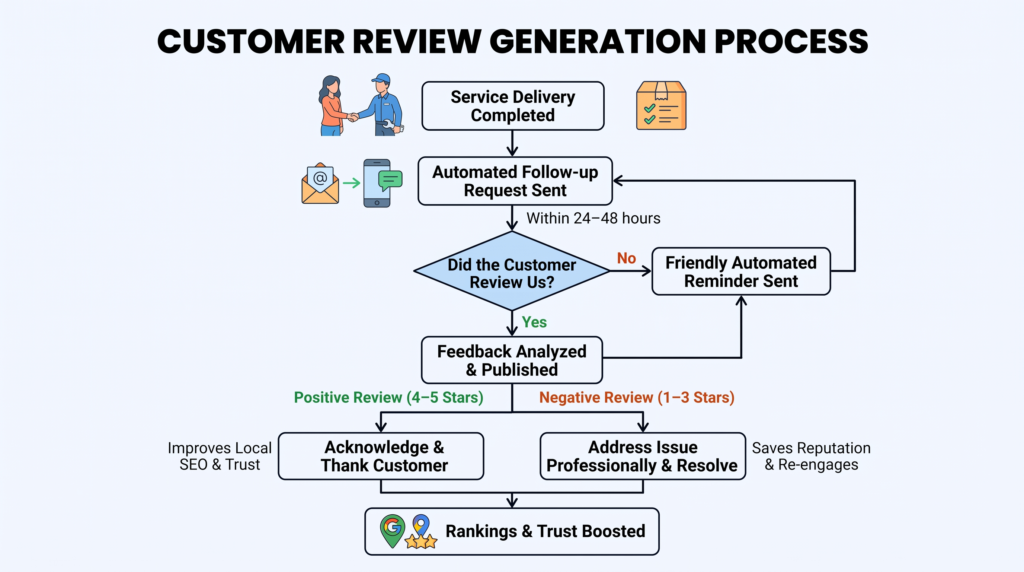
A structured customer review cycle drives review velocity and signals ongoing business activity to search engines.
Advanced Technical Local SEO: Schema Markup and Entity Mapping
Modern search engines rely on semantic understanding and structured entities rather than simple keyword matches alone. LocalBusiness schema markup is structured code placed on your website that helps search crawlers identify your exact organizational details without ambiguity.
Adding JSON-LD structured data to your website header clarifies your business name, geolocation coordinates, operating hours, accepted payment methods, and service areas.
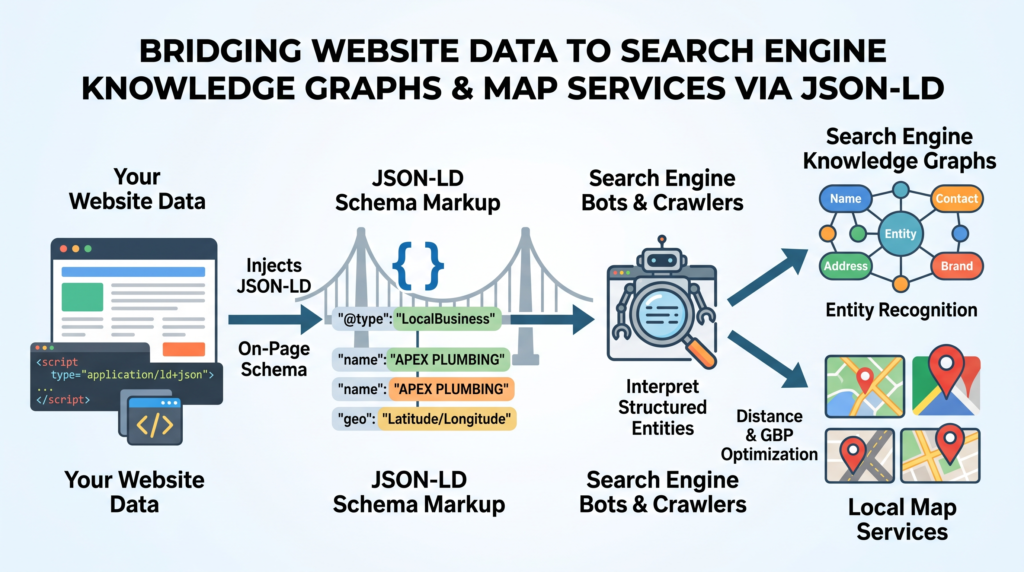
This markup establishes clear entity relationships that generative AI tools and search engine algorithms use when generating answers for localized queries.
Structured JSON-LD schema connects on-page content with search engine knowledge graphs to verify local business entities.
Local SEO vs. Traditional SEO: Key Differences
Local SEO and traditional organic SEO share foundational best practices, such as site speed and quality content, but their goals, search intent, and primary ranking mechanisms differ significantly, as highlighted in comprehensive analysis by Semrush.
| Feature | Local SEO | Traditional SEO |
|---|---|---|
| Primary Target | Local and regional searchers within a specific geographic radius | National or international audiences regardless of location |
| Main Search Assets | Google Business Profile, Local 3-Pack, local directories | Organic website URLs, blog content, category pages |
| Core Ranking Signals | Proximity, NAP consistency, local reviews, citations | Domain authority, comprehensive topical content, backlink profiles |
| Conversion Focus | Phone calls, store visits, direction requests, regional form leads | Digital subscriptions, global e-commerce purchases, software sign-ups |
| Primary Toolsets | Google Business Profile Manager, Apple Business Connect, BrightLocal | Ahrefs, Semrush, Google Search Console |
Limitations of Local SEO
Local SEO cannot compensate for physical geographic boundaries or poor real-world service. If your business is located 25 miles away from a city center, algorithm proximity constraints will generally prevent you from ranking in the Local Pack for queries originating in that downtown core, regardless of review count. Additionally, local optimization requires ongoing profile maintenance, as directory inaccuracies or unaddressed negative customer experiences directly harm visibility.
Conclusion
Local SEO is an indispensable marketing engine for businesses seeking to turn regional search intent into real-world customers. By optimizing your Google Business Profile, maintaining consistent citation data across authoritative directories, acquiring regular customer reviews, and adding structured schema markup to your website, you build the relevance and prominence required to dominate local map results. Consistent execution across these foundational pillars ensures sustained visibility and ongoing customer acquisition. If you need specialized guidance on implementing entity-first local architecture, feel free to reach out via our SEO consultation portal.
Frequently Asked Questions
1. What is the difference between organic SEO and local SEO?
Organic SEO focuses on ranking website URLs for non-geographic queries on a national or global scale. Local SEO targets geographically constrained searches, focusing on ranking within Google Maps and the Local Pack to drive physical store visits, phone calls, and localized leads.
2. How long does it take to see results from local SEO?
Most businesses observe initial ranking improvements within four to eight weeks after claiming and optimizing their Google Business Profile and correcting citation discrepancies. Highly competitive markets or neglected profiles with sparse reviews may require three to six months of consistent optimization.
3. Do I need a physical storefront to do local SEO?
No, you do not need a physical storefront to execute local SEO. Service Area Businesses that travel directly to clients, such as mobile mechanics or plumbers, can configure their Google Business Profile to hide their physical home address while specifying their designated service boundaries.
4. How many Google Business Profile categories should I select?
You should choose one primary category that matches your core business offering most specifically, followed by two to five secondary categories that represent legitimate supporting services. Adding irrelevant categories dilutes profile relevance and can harm your local search visibility.
5. Why is my competitor outranking me in the Local Pack?
Competitors typically outrank you due to greater physical proximity to the searcher, higher total review counts with positive sentiment, or more consistent citation profiles. They may also possess stronger on-page optimization and localized backlinks pointing to their linked landing page.
6. How do customer reviews affect local map rankings?
Customer reviews feed directly into Google’s prominence ranking factor. Review velocity, overall star ratings, review recency, and customer keywords inside review text signal trust and active engagement, which helps elevate your profile within map search results.
7. What is NAP consistency and why is it important?
NAP consistency refers to keeping your business Name, Address, and Phone number identical across all online directories, social profiles, and websites. Inconsistent abbreviations or mismatched phone numbers confuse search crawlers, eroding trust in your business location data.
8. Do I need a website if I have a Google Business Profile?
Yes, having a dedicated website is critical for local search success. Google pulls relevance signals, topical context, and link authority from your linked landing page to rank your Google Business Profile in competitive Local Pack queries.
9. What types of schema markup are essential for local SEO?
The most essential structured data type is LocalBusiness schema (or specific sub-types like MedicalBusiness, Restaurant, or Plumber) implemented via JSON-LD. It explicitly defines your organization’s address, geo-coordinates, telephone number, business hours, and operational departments for search crawlers.
10. How can I track the performance of my local SEO campaign?
Track local performance using Google Business Profile Performance Insights to monitor phone calls, direction requests, website clicks, and profile impressions. Complement this data with Google Search Console and local rank trackers to measure geographic map pack rankings over time.