Entity SEO: What It Is, Why It Matters, and How to Master It
Entity SEO is the practice of optimizing around the things your content is about, not just the words people type. This guide explains what entity SEO is, how Google uses entities, how it differs from keyword SEO, and how to measure it, including the honest limits.

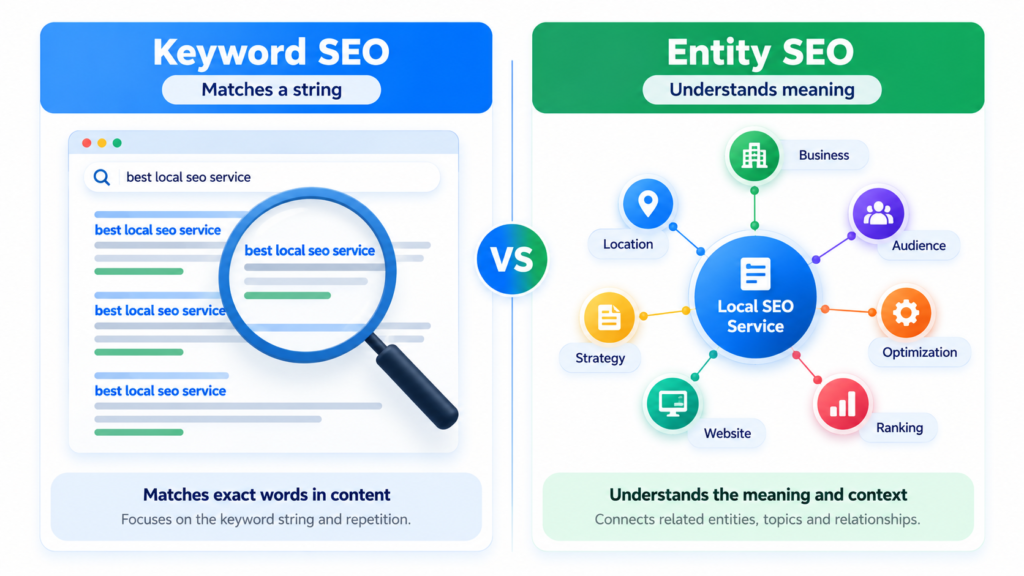
Entity SEO is the practice of optimizing your content around the things it is about, not only the words people type. Instead of repeating a keyword, you make the meaning of a page clear: what or who it covers, what that subject connects to, and how it relates to other things Google already knows. The goal is to remove ambiguity so search engines and AI systems can identify your content correctly and match it to the right question.
This guide explains what entity SEO is, how it differs from keyword SEO, how Google uses entities, and why the topic matters now. It also gives a practical framework, worked examples, ways to measure results, and the honest limits of what entity SEO can do. The focus stays on what Google documents, not on the folklore that spreads around the subject.
In our own topical map work at SERP Panda, one pattern repeats on almost every project: the pages that gain clarity fastest are rarely the ones carrying the most keywords. They are the ones where a single page owns a single entity, states it plainly, and links outward with honest anchor text. That observation shapes everything below.
About the author. Forkan Mahmud is a Semantic SEO Specialist and Topical Map Strategist at SERP Panda. He works on topical map strategy, search intent, entity relationships, and content structure, and he publishes semantic SEO guides at forkanmahmud.com.
Credentials: Semantic SEO Specialist, Topical Map Strategist, SERP Panda. Read the full profile or
get in touch.
What Is Entity SEO?
Entity SEO is the work of making your content, brand, products, and authors easy to identify as distinct things, so search engines can connect them to knowledge they already hold. It sits inside the wider discipline of semantic SEO, and it depends on clear writing as much as on technical markup.
The idea is simple to state and harder to do. A machine does not see your page the way a person does. It breaks the page into signals, tries to work out what each part is about, and then compares those signals with what it already knows. If your page is vague, the machine has to guess. If your page is clear, the machine can place your content against the right subject and the right relationships.
What an Entity Actually Is
An entity is a person, place, organization, product, event, or idea that is distinct enough to be named and described. Google has described an entity in a patent as a thing or concept that is singular, unique, well defined, and distinguishable. In everyday terms, that means the entity is not the word itself. The word is a label. The entity is the thing the label points to.
Take the word “Apple.” As a string of letters it could refer to a fruit, a technology company, or a record label. As an entity, each of those is a separate thing with its own identity, attributes, and relationships. A company has founders, products, and a headquarters. A fruit has varieties, seasons, and nutritional facts. Entity SEO is what helps a machine tell them apart.
What Entity SEO Is Not
It helps to clear up a few common misunderstandings before going further.
- It is not a plugin or a single setting you switch on.
- It is not keyword stuffing with a new name, where you repeat entity names instead of keywords.
- It is not only schema markup. Structured data is one way to express entities, not the whole practice.
- It is not a confirmed Google ranking factor under the name “entity SEO.” Google does not publish a ranking factor with that label.
Each point matters. Readers often meet the topic through a tool that claims to “fix” entity SEO in one click. The reality is closer to careful editing, clear structure, and consistent identity.
Why Entity SEO Matters: How Google Turns Words Into Meaning
Entity SEO matters because Google does not read your page as a pile of separate words. It reads your page as a set of things and the relationships between them, then uses those relationships to decide what the page means. When meaning is clear, your page has a better chance of matching the right question and of being understood correctly in search features.
From Strings to Things
In 2012, Google introduced the Knowledge Graph and explained the shift in plain language: moving from strings to things. The company described a model that understands real world entities and the relationships between them, and at launch it reported that the graph already held more than 500 million objects and more than 3.5 billion facts and relationships between them. It also noted that the information shown for one public figure answered 37 percent of the follow-up questions people asked about him. Those numbers are from Google’s own announcement, not from a third party estimate.
Before that shift, a query was mainly a string of characters to match. After it, a query became a set of things to understand. A search for a famous monument, a musician, and a restaurant with the same name could point to three different entities, and the system could work out which one a person meant from context.
How Entities Create Relevance
Once a machine can identify the things on your page, relevance stops being about word matches and starts being about meaning. Two processes do most of the work. The first is understanding the query, where the system works out which entities a search is about. The second is understanding the page, where the system works out which entities your page covers and how strongly.
The result is that a page can rank or be surfaced even when it does not repeat the exact query wording, because the meaning lines up. Google has stated that its systems have improved at understanding the relevance of pages even when there is no exact match between the query and the page’s primary content. That is the practical benefit of clear entities. You are no longer limited to the exact words a person typed.
A Short History of Entities in Google Search
The move toward entities did not happen in one step. It built up over more than a decade, and knowing the timeline helps you separate long term direction from short term tactics.
- 2012, Knowledge Graph. Google introduces a model of things and their relationships, and describes the shift from strings to things.
- 2013, Hummingbird. Google rolls out a rewritten core algorithm that leans more on meaning and context than on keyword matching.
- 2015, RankBrain. Google adds a machine learning component that helps handle queries it has not seen before.
- 2019, BERT. Google applies natural language processing to better understand the context of words in a query and on a page.
- 2021, MUM. Google describes a more capable language model that can work across languages and formats.
- 2024 and beyond, AI Overviews and AI Mode. Google brings generative answers into Search, drawing on its existing ranking systems to retrieve and summarise content.
None of these steps means that keywords stopped mattering. They mean that keywords became one signal among many, and that understanding meaning became the centre of the system.
Entity SEO vs Keyword SEO: What Actually Changed
The core change is this: keyword SEO tries to match the words a person types, while entity SEO tries to make the meaning behind those words unambiguous. Keywords are still useful for finding demand. Entities are how you show a machine that you cover the subject properly.
| Point of comparison | Keyword SEO | Entity SEO |
|---|---|---|
| Main goal | Match the query wording | Make meaning and identity clear |
| Unit of work | Words and phrases | Things, attributes, and relationships |
| Strength | Captures demand and search volume | Builds depth, context, and clarity |
| Failure mode | Thin pages that repeat a term | Vague pages and unclear identity |
| How it is measured | Rankings for target terms | Coverage, clarity, branded demand, feature presence |
Good entity work also reduces the risk that comes with thin pages. A page that repeats a phrase but adds nothing new is easy for a machine to skip. A page that covers a subject through its related things and their relationships gives a machine more to work with.
Entity SEO vs Semantic SEO, Topical Authority and Schema Markup
These four terms are often used as if they mean the same thing. They do not. They describe different layers of the same effort, and knowing how they fit together prevents wasted work.
- Semantic SEO is the broad discipline of optimizing for meaning, entities, and context. Entity SEO is one part of it. If you want a starting point, this guide to
what semantic SEO is breaks the concept down.
- Entity SEO is the part that focuses on identifying and clarifying the things your content is about.
- Topical authority is what you build when you cover a subject fully, across many connected pages, rather than in one article. You can read more in the
- Schema markup is one technical way to express entities and their relationships in machine readable form.
| Approach | Focus | Typical output |
|---|---|---|
| Semantic SEO | Meaning and context across the site | A coherent content system |
| Entity SEO | Identifying and clarifying things | Clear entities and relationships |
| Topical authority | Full coverage of a subject | Clusters and pillar pages |
| Schema markup | Machine readable labels | Structured data in the page code |
The practical lesson is that these are not competing choices. Schema markup without clear writing does little. Clear writing without coverage builds little authority. The layers reinforce each other.
What Google Actually Says About Entity SEO
Most articles on this subject lean on opinion. It is more useful to separate what Google documents from what people infer. The line between the two is where trust is won or lost.
What Google Confirms
Google confirms several things that entity SEO depends on.
- Its systems use meaning and context, not only keyword matching.
- It maintains a Knowledge Graph of things and their relationships.
- Structured data helps Google understand pages and can make them eligible for rich results.
- Clear authorship, clear sourcing, and demonstrable expertise support how content is evaluated.
What Google Does Not Claim
Google does not describe “entity SEO” as a named ranking factor. It does not promise that adding entities, or structured data, or author markup will move a page up the results. In its guidance on generative AI features, Google also notes that structured data is not required for those features.
Three Myths to Ignore
Google’s guidance on optimizing for generative AI features names several tactics that spread widely but do not help in Google Search.
- Special AI files and markup. Google states that it does not use files such as llms.txt for its generative AI features, and that creating them will neither help nor harm a site in Google Search.
- Chunking content into tiny pieces. Google states that there is no requirement to break content into small parts, and that its systems can understand several topics on one page.
- Inauthentic mentions. Google states that seeking fake mentions across the web is not as useful as it sounds, because its systems focus on high quality content and block spam.
Each of these points is worth knowing because it saves effort and protects you from tactics that could breach Google’s spam policies.
How to Do Entity SEO: A Seven-Step Framework
Entity SEO works best as a sequence. Start with the thing your page is about, then build outward to the related things, the content, the markup, and the consistency signals. The steps below work for a single page and for a whole site.

Step 1: Define Your Central Entity
Every page should have one main subject. Name it clearly. If you are writing about a service, say which service. If you are writing about a product, say which product. A page that tries to be about five things at once gives a machine nothing firm to hold on to.
Step 2: Map Related Entities and Attributes
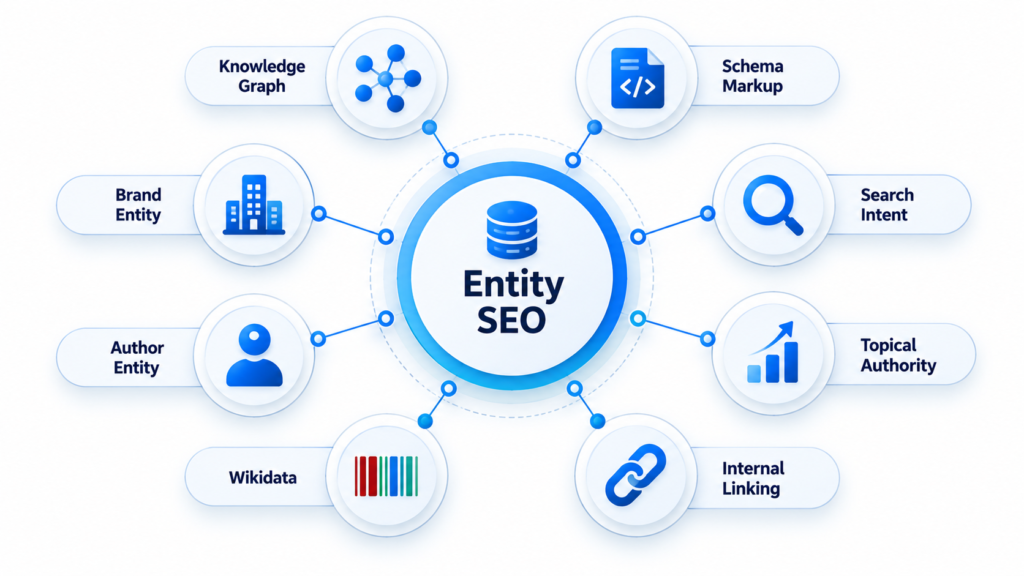
List the things connected to your central entity. Include its attributes, such as purpose, features, and limits, and its neighbours, such as the tools, people, places, or concepts that sit around it. For this article, the central entity is entity SEO, and its neighbours include the Knowledge Graph, schema markup, search intent, and topical authority.
Step 3: Build Content Around Entity Relationships
Cover the relationships, not only the definitions. If topic clusters are new to you, this is where a planned structure pays off. A topical map service exists for exactly this reason: it plans which pages cover which entities, so coverage grows in a deliberate order instead of by accident.
Step 4: Express Entities With Schema Markup
Use the shared vocabulary at schema.org to label what is on the page. Common types include Organization, Person, Product, and Article. Assign a stable identifier, using the @id property in JSON-LD, so the same thing is referred to the same way everywhere. Then describe relationships, such as author, founder, or location, so the links between entities are explicit. For a closer look at the wider set of semantic SEO guides, that library covers the supporting topics in more depth.
Step 5: Link Entities Internally
Internal links show how your pages relate. Link a mention of a subject to the page that covers it, using natural anchor text that describes the destination. Avoid forcing the same exact phrase into every link, and avoid vague anchors that tell the reader nothing. One page should own each entity, so links point there rather than scattering across near duplicates.
Step 6: Keep Identity Consistent Across the Web
Your entity is not only your website. Use one business name, one description, and consistent contact details across your site, your business profile, and your social profiles. When your name is written three different ways in three places, you ask a machine to decide which version is real.
Step 7: Earn Genuine Mentions and Citations
Real mentions from other sites help confirm that a thing exists and matters. Earn them by being useful, not by manufacturing them. Google’s guidance is explicit that inauthentic mentions are not a shortcut. The same applies to reviews and testimonials. Real ones carry weight, invented ones put the page at risk.
Entity SEO in Practice: Three Worked Examples
Abstract advice is easy to nod along to and hard to apply. Three short examples show how the same framework adapts to different businesses. These are illustrative scenarios, not client results.
A Local Service Business
Imagine an air conditioning repair company in one city. The central entity is the business. Its attributes include the services offered, the areas served, and the hours of operation. Its neighbours include the equipment brands it repairs and the neighbourhoods it covers. A clear About page, one page per core service, and consistent name, address, and phone details across the web give a machine a firm identity to work with.
An E-commerce Store
For a store selling coffee equipment, the central entities are the products. Each product has attributes such as material, capacity, and compatibility, and neighbours such as related accessories and brewing methods. Clear product pages, consistent product identifiers, and structured data for each item help a machine connect a search for a specific item to the right listing.
A B2B or SaaS Company
For a software company, the central entity is the organization and its product. Attributes include what the product does, who it is for, and what it integrates with. Neighbours include the categories it belongs to and the problems it solves. Named authors, a clear About page, and consistent descriptions across the site and external profiles help a machine understand both the company and the people behind it.
Common Entity SEO Mistakes to Avoid
The failures tend to repeat. Knowing them in advance saves time.
- Over-optimizing by repeating entity names until the writing feels forced.
- Treating schema markup as the whole job and ignoring clear writing.
- Creating several near identical pages for one entity, which splits signals.
- Writing paragraphs that start with “this” or “it” and never name the subject.
- Adding headings for the sake of length rather than to answer a real question.
- Chasing fake mentions and artificial citations.
- Leaving identity details inconsistent across the site and external profiles.
- Promising guaranteed rankings or guaranteed AI citations to clients or readers.
How to Measure Entity SEO
Entity SEO has no single dashboard that says “entities: improved.” You measure it through several signals that together show whether your meaning is landing. Expect this to be a gradual project rather than an overnight jump.
Branded Search and Demand
When people start searching for your brand name, that suggests your identity is becoming known. Watch branded queries over time. A slow rise is often the first visible sign.
Service and Money Page Performance
Track the pages that matter commercially, not only blog posts. If clarity is improving, service and contact pages tend to strengthen because they are the pages with the clearest identity and intent.
SERP Features and the Knowledge Panel
Watch whether your brand or key people appear in knowledge panels and other features. These are not guaranteed, but they are useful observations when they change.
The Search Console Generative AI Report
Google provides a generative AI performance report in Search Console, which shows how content is performing in its generative AI features. Use it to see whether some of your pages are being discovered through those experiences, and treat it as one signal among several rather than a full picture.
Entity SEO and AI Search: What to Expect
Entity SEO is often discussed together with AI search, so it helps to be precise about the connection. The same clarity that helps traditional search also helps AI systems, but the mechanisms are specific.
AI Overviews and How Retrieval Works
Google’s generative features rely on its core ranking systems to retrieve relevant pages, then use the information from those pages to build an answer. Google describes this as retrieval augmented generation, and describes how a single question can expand into several related queries. Clear entities help at both stages, because they make it easier for a system to identify what a page is about and to confirm that it matches part of the question.
What Actually Helps, and What Does Not
What helps is useful, original content with a clear point of view, organised with headings, and supported by relevant images or video. What does not help is the short list of tactics Google has already addressed: special AI files, forced chunking, and artificial mentions. Treat the fundamentals as the strategy and ignore the shortcuts.
Does Entity SEO Guarantee Rankings or AI Citations?
No. Entity SEO does not guarantee rankings, traffic, rich results, or AI citations, and no one can promise those outcomes. What it does is reduce ambiguity, so that a machine has fewer reasons to misread your content. That is a real advantage, and it is a different claim from a guarantee.
Anyone who promises first place rankings or guaranteed placement in AI answers is promising something they cannot control. Google states plainly that its systems do not accept payment to rank pages higher, and that crawl, index, and serving decisions are not guaranteed even for pages that follow the guidance.
Conclusion
Entity SEO is not a trick and not a plugin. It is the practice of making your meaning clear, so that search engines and AI systems can identify what your content is about and connect it to what they already know. The work starts with a clear central subject, expands to the related things and their relationships, continues through structured data and internal links, and holds together through consistent identity across the web.
The benefits are real but gradual. You gain clarity, depth, and a content system that holds up as search changes. You do not gain a guarantee. What you gain is a fair chance of being understood correctly, which is the part you actually control.
If you want help turning this into a plan for your site, you can review the SEO services or a focused
SEO content writing service that builds pages around real entities and search intent.
Frequently Asked Questions
How do I measure entity SEO?
What is an entity in SEO?
What is entity SEO in simple terms?
How is entity SEO different from keyword SEO?
Is entity SEO the same as semantic SEO?
Do I need schema markup for entity SEO?
How do I find entities for my topic?
How does entity SEO help with AI Overviews and ChatGPT?
Does entity SEO guarantee higher rankings?
What is an entity home?
By Forkan Mahmud, Semantic SEO Specialist and Topical Map Strategist at SERP Panda
About Forkan Mahmud and his work
Published: 17 October 2026 | Last updated: 17 October 2026